
By Lewis Jackson and Sam Li
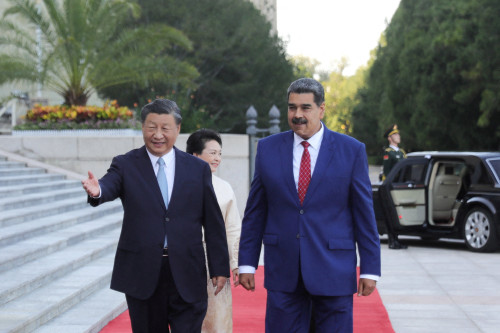
Jan 5 (Reuters) – China is a major customer of and investor in Venezuela’s oil sector, which President Donald Trump aims to revive following the U.S. military’s ouster of President Nicolas Maduro on Saturday.
Years of mismanagement, underinvestment and, more recently, U.S. sanctions have slashed Venezuelan crude production to about 1.1 million barrels per day (bpd) last year from a peak of some 3.5 million bpd in the late 1990s, according to official figures.
Here are details on Beijing’s role in the country’s oil sector.
A MAJOR BUYER
Much of Venezuela’s exported oil is sold to China, although Beijing declares very little and imports are often rebranded. Imports hit about 470,000 bpd during 2025, according to energy analytics firm Vortexa, or roughly 4.5% of China’s seaborne crude imports.
Small independent refiners known as “teapots” are the main Chinese buyers of discounted Venezuelan crude. A portion also goes to repaying Caracas’ debt to Beijing, which analysts estimate exceeds $10 billion.
AN INVESTOR AND PRODUCER
Chinese investors poured $2.1 billion into the country’s oil sector after 2016, according to a 2023 estimate from the American Enterprise Institute, and are among a handful of foreign firms still operating in the country.
* China National Petroleum Corp. The major state-owned oilcompany was a big investor before the U.S. imposed sanctions in2019 and still produces crude at the Sinovensa joint venturewith state-owned oil company PDVSA. CNPC stopped liftingVenezuelan oil in 2019, but crude has since made its way toChina via traders and other state-owned firms.CNPC is a partnerin a joint venture that controls 1.6 billion barrels of oilreserves in the country, according to Morgan Stanley. * Sinopec Group. The state-owned giant is a partner in ajoint venture that controls 2.8 billion barrels of reserves inVenezuela, according to Morgan Stanley.CNPC and Sinopec did notimmediately respond to queries on their Venezuela involvement. * China Concord Resources Corp. The private company plannedlast year to invest more than $1 billion in two oilfields toproduce 60,000 bpd by the end of 2026, Reuters reported. Thecompany could not be reached for comment. * Kerui Petroleum. The private oil services company wasgranted an oil production contract in 2024 by PDVSA, accordingto a July 2024 S&P report, citing an anonymous PDVSA official.It was unclear if the contract is active, as many are not. Thecompany did not respond to a request for comment. * Anhui Erhuan Petroleum Group. The private refined oilwholesaler and retailer was also granted an oil productioncontract in 2024 by PDVSA, according to the same S&P report,again citing an anonymous PDVSA official. It was also unclear ifthe contract is active. The Chinese company denied anyinvolvement in a PDVSA joint venture in a phone call to Reuterson Monday.
(Reporting by Lewis Jackson and Sam Li in Beijing;Editing by Tony Munroe and Louise Heavens)
About the Author