
A brutally vicious sell off of Gold and Silver snuck up on Friday’s market last week. Gold tumbled 11%, falling to $4,713.90 a troy ounce. Silver plummeted to $78.53, a troy ounce off $35.90 for the day. Not since the Hunt Brothers terrorized the silver market in March of the 80s has silver been so volatile. Both metals lost their footing after President Trump announced his Federal Reserve choice to be Kevin Warsh, known to be a ‘hawk on inflation and dollar stability.’ Investors and traders rushed to salvage profits, driving both metal valuations lower. Adrian Ash, director of research at precious materials market place BullionVault commented: “I’ve been in the market for 20 years. I’ve never seen anything quite like this market. The short answer is I have no idea.” Many analysts see the sell off as “a much needed reset” for gold and silver, as both metals have surged for several months. Increased industrial usage of solar panels, electronics, electric batteries, has pressured silver demand, driving prices higher as never before seen. Consumer buying has been heavy as investors have pivoted from riskier investments to ‘safer areas.’
Markets were positive on Monday’s open, with the Dow Jones Industrial Average surging up 515 points, or 1.5%, nearing a milestone of 50000. Both the S&P 500 and Nasdaq edged higher also, up 0.5% and 0.6% respectively. A boost from a survey by the Institute for Supply Management suggested U.S. factories are actively growing at its fastest pace since 2022. Gold and silver have settled down after the volatile finish last week, as gold is presently $4,866 a troy ounce and silver is off 12% at $74.20 a troy ounce. Bitcoin has weakened substantially, falling Wednesday to $67,857, leading the trend downward for all cryptocurrencies. “We’re certainly expecting more volatility in prices,” said Gerry O’Shea, head of global market insights at Crypto-focused investment firm Hashdex. Oil prices steadied after a drawback in reaction to President Trump saying, “Iran is negotiating seriously.” Oil is hovering at near $66.00 a barrel after a 4.4% down turn.
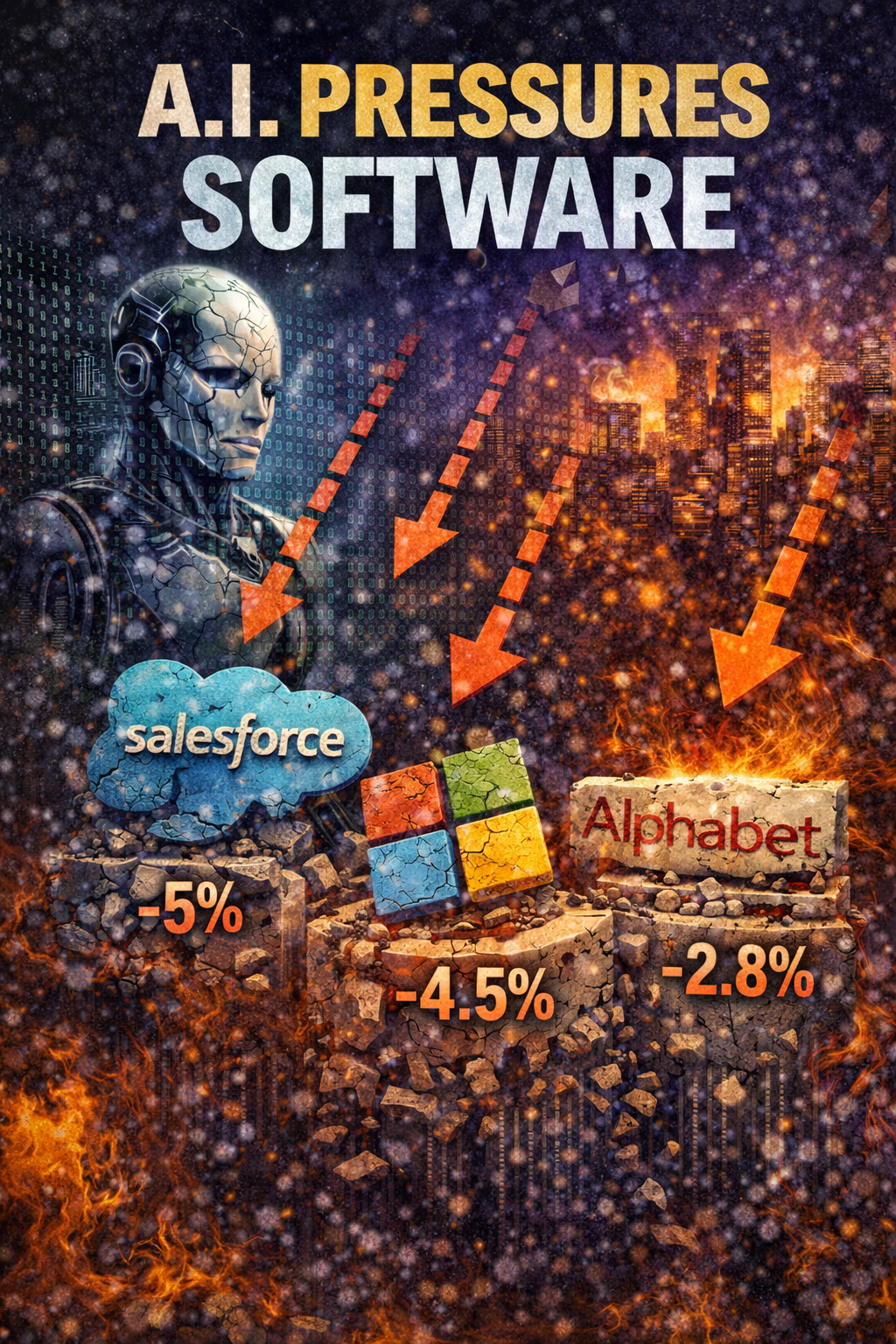
With a government shutdown looming, a partial shutdown is in effect as of last Saturday. “Many important Federal Agencies and programs and essential functions will continue to operate under the partial shutdown.” Federal employees however could ‘go without pay.’ All three indexes shed value Tuesday, as the heavy tech Nasdaq Composite was off 1.4%, with the S&P 500 dropping 0.8%. The bread and butter Dow Jones lost 167 points in a lethargic market day. Investors and traders recently have become more focused on the impact of the Artificial Intelligence sector on the software sector. Many investors are rotating out of
software stocks, (and into value blue-chip stocks,) fearing the demise of needed software as AI becomes more all-inclusive. The recent wave of software stock selling, according to the Wall Street Journal, “wiped out $300 billion from market value of software and data-provider stocks.” Many investors on Wednesday channeled heavy dollars into companies directly connected to the robust economy. Basic blue-chip stocks, as noted before, are again the market leaders. Art Hogan, chief market strategist at B. Riley Wealth Management said: “If things are advancing as rapidly as we hear from OpenAI and Anthropic, it’s going to be a problem. Investors are starting to go after any of the companies that could be disrupted, which is all kinds of software application names.” The Nasdaq Composite fell 1% Wednesday, as stepped-up ‘rotation trading’ affected the techs and software stocks… a rough two sessions. The Dow Jones added 260 points, as stock buying was strong on the exchange.
RUMBLINGS ON THE STREET
Toby Ogg, JPMorgan Chase WSJ – “We are now in an environment, where the sector [softwear] isn’t just guilty until proven innocent but is now being sentenced before trial.”
Jon Gray, Blackstone’s president and chief operating officer [said at WSJ Invest Live on Tuesday], WSJ – “I don’t view this as a private credit or liquidity issue. It’s the change happening in the economy. You could be an incumbent software company that’s the system of record and maybe you face risk from AI disrupters.”
Jack Ablin, chief investment strategist at Cresset Capital, WSJ – “With valuations where they are, market reactions are going to be pretty harsh. Expectations right now are very very high.”
About the Author