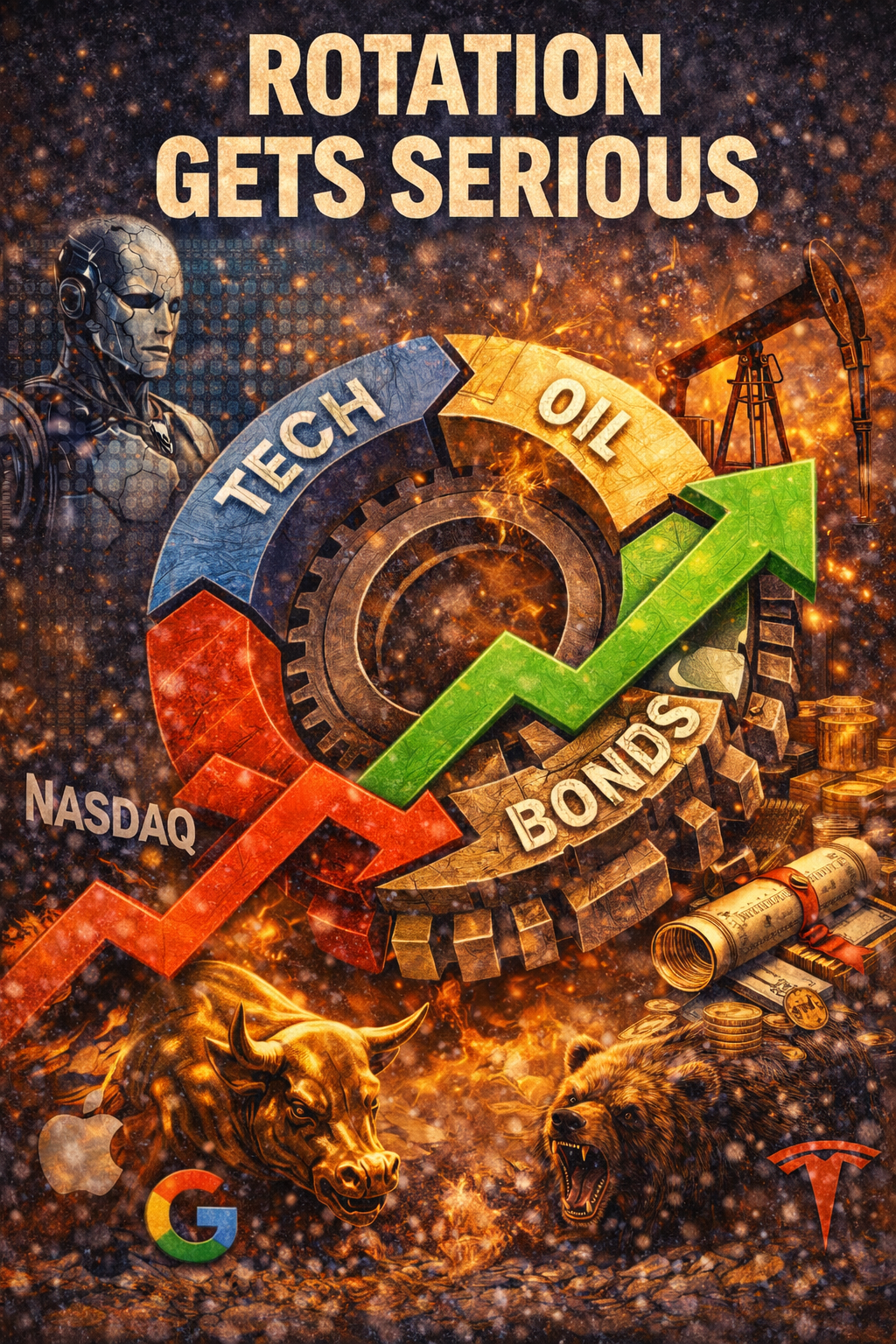
Technology and artificial intelligence stocks are losing favor…while investors and traders rotate, and pivot into value-proven companies. After coming off a 3 year run of soaring high techs and more recently the AI run-up, cautious investors are opening 2026 carefully choosing stocks in the various value sectors. The ‘new term,’ according to The Wall Street Journal, “sector rotation,” referring to rotation trade, as investors begin to reassess and shift investments and infuse capital moving from one sector to another. The serious rotation began in the latter part of December as a definitive trend, picking up steam in the early days of January as investors are serious, exhibiting “rotation trends.” With all the negatives aside, Wall Street remains “Bullish” on the economy. With the Jobs numbers showing negative trends the past 4 months, and inflation that is still stubborn, the market has shrugged off seemingly most negatives, as investors continue to seek out new areas of growth and consumer dependence. “US growth continues to be in a very good place,” said Oumide Owolabi, head of the U.S. rates team at Neuberger Berman. He adds, “it’s going to be difficult for [longer term yields] to trade so low when the economy is growing at the place at which it’s growing.”
The short week opened [January 19, Martin Luther King observance holiday] Tuesday with stocks getting hammered as President Trump reiterated again of his intention to take over Greenland. He issued new threats of tariffs and trade restrictions aimed at European Countries opposing him. “This brings back the fluidity of tariffs, and it’s not just for economic reasons,” said Brad Long, chief investment officer at Wealthspire. “That throws all the cards back on the table.” The Dow Jones Industrial Average lost 870 points, or 1.8%, while the S&P 500 was off 2.1% [“after 67 straight trading days without a 2% decline”]. The ever popular Magnificent 7 tech stocks this year all fell, “losing over $653 billion collectively.”
This year alone the Russell 200 has outgained all indexes, up an amazing 7.9%. Both the Nasdaq Composite and S&P 500 have advanced 2%, in a changing pivoting market. The economy and GDP [Gross Domestic Product] have ‘spurred’ growth, driving stocks, with help from strong ‘rotation trading’ volume. “It’s been this rotation out of anything growth and tech related, into all of the other relative laggards,” said Garrett Melson, portfolio strategist at Natixis Investment Managers Solutions. “The market is pretty much sold on the idea of stronger growth at least in the first half of 2026.” Treasury yields have been very steady since last September, hovering between 4% and 4.2%, with the first nudge upward last Friday, over 4.23%.
In a tremendous turn-of-events Wednesday, President Trump reversed his threat of additional 10% tariffs on the European Union Countries effective February 1st, opposing his proposed take over of Greenland after meeting with representatives. A ‘proposed deal’ with NATO Secretary General Mack Rutte will give major benefits to the U.S., hopefully ending Trump’s quest. That ‘deal’ appears at this point to satisfy President Trump, as he back-peddled from his hard take-over stance. Trump announced on Truth Social the agreement and basic details, with more to come. Almost immediately the markets came-alive, with the Dow Jones Industrial Average surging up 588 points or 1.21%. Both the Nasdaq Composite and S&P 500 each jumped 1.2%. After a disastrous Tuesday, investors and traders and Wall Street were happy on Wednesday for good news on Greenland. President Trump’s turnaround deal on the Greenland situation calmed markets and gave investors and traders a good ‘foundation’ to leave the sidelines, as a sense of ‘calm’ excited the Street. All indexes finished positive Thursday.
RUMBLINGS ON THE STREET
Rep. Sara Jacobs, (D., Calif) Member of the Congressional Delegation in Copenhagen, WSJ – “This is one more example of unhelpful rhetoric. We don’t need Greenland for national security. It doesn’t change our message of coequal branches of government. Donald Trump can neither impose tariffs nor abrogate our NATO treaty unilaterally.”
Keith Canton, Co head of equity capital markets in the Americas, who will run the new team, JPMorgan Chase Private Market Division, WSJ – “The private markets have just dwarfed the public markets lately. Historically, you only needed to think about an IPO or a sale as an exit. But there’s much more you can do in the middle.
James Knightly, chief international economist at ING, WSJ – “Risks are skewed towards additional rate cuts this year given labor market weakness, continued downside surprises from [inflation] and a slightly more dovish Fed leadership.”
About the Author