
April 21, 2026
The Copper Squeeze and Battery Metals: When Tech Demand Hits Physical Limits
Commodity Convergence: the hardware economy meets the mining economy
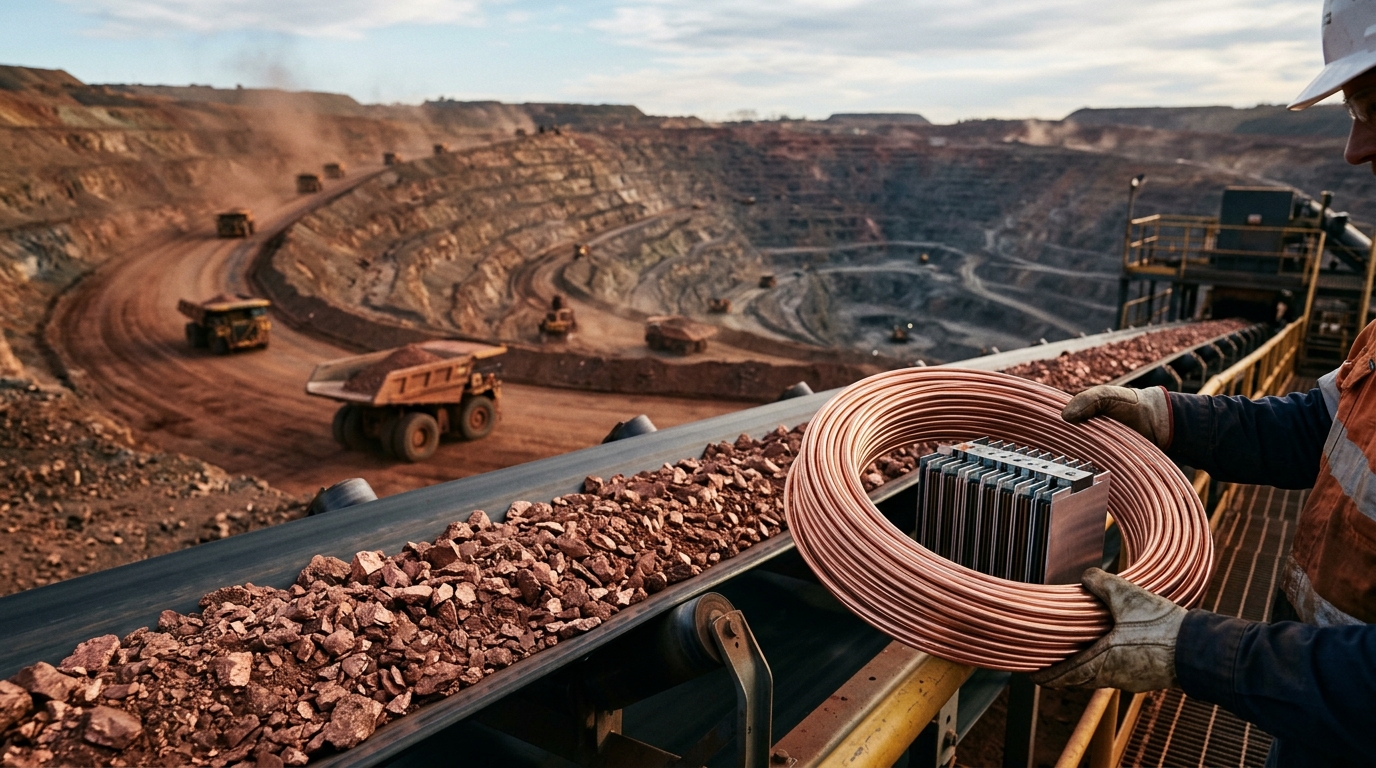
There’s a quiet shift happening that doesn’t fit neatly into tech or macro.
AI data centers aren’t just a software story. They’re a materials story. And the awkward part is that materials don’t scale on the same curve as code.
You can add GPUs in quarters. You add high-grade copper over years. Sometimes a decade.
The result is what I’d call Commodity Convergence: generalist tech investors getting dragged (sometimes reluctantly) into mining and metallurgy because the limiting factor isn’t model accuracy, it’s the physical inputs that make compute possible. Copper is the obvious choke point, but it doesn’t end there. The supporting cast – aluminum, silver, nickel, lithium, graphite, rare earths, even industrial gases – starts to matter once grid expansion, transformers, and cooling hardware become the constraint.
Slight tangent, but it matters: markets love to debate “how many GPUs does a model need?” while skipping the duller question of “how many transformers, how much wire, how many substations, how much switchgear?” The second question is where timelines break.
The Playbook Every Options Trader Should Have!
Do you dream of retirement but it seems like an impossibility? Wish you knew the best moves to get you there sooner?
It’s closer than you think and you won’t have to work overtime to get it!
Hi! I’m Dave Aquino, expert options trader and my e-book, “How To Master the Retirement Trade” has helped thousands reach their goals!
Follow the link to get your copy and see what you’ve been missing!
Macro first: electricity growth is back (and it isn’t a straight line)
For most developed markets, electricity demand used to be the boring line item. Efficient appliances, offshoring, and slow population growth made it feel mature.
Now two forces are stacking:
- Electrification of transport, heating, and industry (EVs, heat pumps, process electrification).
- Compute intensity from AI training and inference, plus the cooling and power conditioning that come with it.
Here’s what matters: grids are capital goods. They don’t stretch elastically. When demand surprises to the upside, you don’t “optimize” your way out of copper, transformers, and switchgear. You build.
And building grids is copper-heavy. Every step – generation interconnects, transmission, distribution, substations, and the last mile into industrial loads – leans on conductive metals. You can substitute at the margin (aluminum in some lines, different busbar designs, higher voltages), but you cannot remove the conductor from the system.
Sector zoom: why AI data centers are copper-and-cooling machines
The visible bill-of-materials is the GPU. The invisible bill-of-materials is the power delivery and heat removal around it.
Think about a modern AI hall in terms of flows:
- Power in: high-voltage interconnects, transformers, switchgear, bus ducts, cabling, PDUs, UPS systems.
- Heat out: air handlers or liquid cooling (cold plates, CDUs), pumps, valves, piping, heat exchangers, chillers, cooling towers.
Copper sits in both flows: electrical conductors and motors, plus significant copper content in many cooling components and compressors. Even when facilities lean into aluminum where feasible, the total metal intensity remains large because the power density is large.
What’s interesting is that AI doesn’t just add demand. It changes where the demand hits: data centers concentrate load into specific grid nodes, and that forces expensive, metal-intensive upgrades. A city can grow gradually; an AI campus can arrive like an industrial plant.
Data section: copper supply is large, but “available copper” is smaller than it looks
Start with the headline numbers, then adjust for realism.
Global refined copper demand is roughly in the mid-to-high 20 million metric ton range per year. Mine production is of similar magnitude, but the system runs tight because inventories are not designed to buffer multi-year demand shocks. When inventories get pulled down, the marginal buyer competes harder for prompt material.
Then there’s ore grade and project timelines. Average copper grades have drifted lower over decades in many producing regions, which means more rock moved per ton of copper produced – more energy, more water, more capex, more permitting complexity. In plain terms: even if the “resource” is there, the rate of production increase is constrained.
Here’s the mechanical problem that keeps showing up in company reports across the space: a new copper mine is typically a multi-billion-dollar asset with a long lead time. From discovery to first production can easily run 7–15 years depending on jurisdiction and scale. Brownfield expansions are faster, but still measured in years.
That timeline mismatch is the core of the copper squeeze. It’s not that copper “runs out.” It’s that demand can step higher faster than supply can respond, especially when grade declines and disruptions (weather, labor, permitting, power, water) are frequent.
Markets don’t need perfect forecasts. They only need one uncomfortable constraint that arrives early.
Why this turns tech investors into mining investors
At first glance, copper seems like a slow, cyclical commodity – a China/PMI proxy with a construction overlay.
But that mental model misses the current layering:
- Electrification adds structural demand (EVs, charging networks, renewables interconnect, grid hardening).
- AI build-out adds concentrated demand in power infrastructure and cooling.
- Defense and reshoring add localized capex intensity (factories, chip fabs, industrial parks) that are also copper-heavy.
The punchline is simple: a GPU cluster is not just semiconductors. It is an electrical project. And electrical projects are conductor projects. That’s why copper starts behaving less like a “construction input” and more like a “compute enabler.”
And once you accept that, the equity layer changes. Instead of only asking whether a hyperscaler will spend $10B or $50B on capex, you start asking: what portion of that capex is bottlenecked by metals, and who captures the scarcity rent? That’s where miners, smelters, and recyclers show up on the same screen as AI infrastructure plays.
Battery metals: the “second-order” constraint that can become first-order fast
Copper gets the spotlight because it’s everywhere in electrification. But battery metals are where volatility can spike because supply chains are narrower and processing is often geographically concentrated.
Key battery inputs to keep on the same dashboard:
- Lithium: demand tied to EV penetration and stationary storage. Prices have historically cycled hard because supply responds in waves, and downstream inventory behavior can amplify moves.
- Nickel: increasingly bifurcated between battery-grade (Class 1) and stainless steel demand. Chemistry shifts (more LFP, high-manganese, sodium-ion experimentation) can change the demand mix faster than mines can adjust.
- Graphite: anode material with heavy processing concentration. Even when synthetic alternatives grow, power costs and feedstock availability matter.
- Manganese, cobalt: smaller in tonnage but important in certain cathode mixes; policy and sourcing constraints can matter as much as geology.
What matters is not whether every EV uses the same chemistry. What matters is that the system is building multiple demand pillars at once: EVs, grid storage, and the grid itself. That multi-pillar demand is why “battery metals” can stop being a niche and start trading like a macro complex.
Here’s where I’m skeptical: investors often assume substitution solves everything. It helps, sure. But substitution often shifts the burden to another input. More aluminum? Then you care about aluminum supply, power prices, and grid reliability. More LFP? Then lithium and phosphate chains matter differently, and copper still doesn’t go away because the vehicle and the charger still need conductors.
How to think about “who wins” without guessing the exact copper price
Commodity equity returns are rarely about being right on the spot price for a week. They’re about operating leverage, cost position, jurisdiction, and capital discipline.
Three buckets worth separating:
- Major diversified miners: typically lower single-asset risk, but copper is one slice of a broader portfolio (iron ore, coal, aluminum, etc.). Upside is smoother; downside is also diversified.
- Pure-play copper producers: more direct sensitivity to copper, but also more exposure to single-country issues, single-asset disruptions, and capex risk.
- Developers: highest torque if financing and permits line up, but also the widest range of outcomes. In tight capital markets, many developers become “long duration options” on copper.
If you want a quick reality check, focus on a few numeric levers in filings and presentations:
- Production profile: annual copper output (and whether it’s rising, flat, or declining).
- All-in sustaining costs and cash costs (watch fuel, acid, labor, and royalties).
- Capex per incremental ton for expansion projects.
- Balance sheet: net debt to EBITDA through the cycle, not at peak pricing.
- Reserve grade trends and sustaining capital needs.
The part people skip: smelting and refining capacity can be its own constraint. Treatment and refining charges, concentrate availability, and smelter utilization can swing margins across the chain. In some environments, the miner isn’t the only beneficiary – processing capacity holders can gain leverage too.
Options market analysis☰
Options on copper-linked equities and ETFs can be useful here because the path can be messy. Commodities don’t move in straight lines, and mining equities can overshoot both directions.
Rather than anchoring on one “correct” price target, the more repeatable approach is to frame the range and the timing:
- Implied volatility (IV): when IV is elevated relative to the past year, premium-selling structures can become more attractive (but only with defined risk).
- Skew: when puts carry unusually high IV versus calls, it can indicate hedging pressure or downside fear.
- Expected move: the at-the-money straddle gives a rough market-implied range into key events (earnings for miners; macro data for copper proxies).
- Open interest concentration: crowded strikes can matter around expiration, especially in ETFs.
Because the user asked for numbers: the exact IV rank, IV percentile, and expected-move math depends on the specific ticker and date. If you tell me the instruments you care about (for example: a copper ETF, a major copper miner, and one developer), I can produce a table with current IV, 30-day IV vs 1-year range, put/call open interest ratios, and a 1–2 expiration expected-move map. Without tickers, I’m keeping this section structural instead of pretending precision.
The Rare Earth Stock Boom: Even Bigger Gains Could Hit Soon
Tiny rare-earth miners are exploding: 200%, 300%, even 500% gains in just months. But while everyone piles into the same names, I’ve uncovered the next wave of this $3 trillion resource story…a breakthrough that could make today’s miners obsolete. I’m expecting the big announcement any day now.
Structured trade framework (templates, not instructions)
This is not about predicting the next 3% move in copper. It’s about matching a view to a structure that survives the noise.
Bullish bias (directional, defined risk)
If you believe demand growth plus constrained supply keeps upward pressure on copper-linked equities, a call spread (buy a call, sell a higher strike call) can reduce premium outlay versus a naked call. The trade-off is capped upside, which may be acceptable if your view is “up, but not infinite.”
Bearish / hedged (defined risk)
If you believe the cycle gets hit by a growth scare or a risk-off shock, a put spread can express downside with capped risk. Another approach is pairing long copper-exposed equities with a partial macro hedge (for example, an index hedge) if your worry is broad beta rather than copper fundamentals.
Neutral / range-bound (premium structures with guardrails)
If you believe copper-linked equities churn while fundamentals tighten slowly, defined-risk premium-selling structures (like iron condors or credit spreads) may fit, but only when strikes are set outside the implied move and position size respects gap risk around earnings and macro shocks.
Small but important note: miners are equity first, commodity proxy second. Operational surprises, politics, weather, and cost inflation can overwhelm copper direction for long stretches. That’s why defined risk matters more here than in many other sectors.
Risk analysis: where this thesis breaks (or at least bends)
There are at least five ways the “copper squeeze” pressure eases, and it’s worth naming them clearly:
- Global growth air pocket: a sharper slowdown can hit copper demand quickly, even if long-term demand is intact.
- China property weakness: copper is still exposed to construction and infrastructure cycles.
- Supply response: high prices can accelerate scrap flows, brownfield expansions, and project financing.
- Substitution and efficiency: aluminum substitution in some applications; higher voltages; improved cooling efficiency lowering incremental metal per unit compute.
- Policy and permitting shifts: supportive policy can speed projects; hostile policy can delay and raise costs. Jurisdiction matters more than most models admit.
And one more that is under-discussed: if AI capex becomes more selective (fewer redundant builds, more consolidation, better utilization), the growth rate of power-hungry build-outs could cool without AI “going away.” That would change the slope of incremental copper demand even in a bullish AI world.
Forward outlook: what to watch over the next 6–18 months
If Commodity Convergence is real, you should see it in three places before you see it in price:
- Grid hardware lead times: transformers, switchgear, and related equipment staying tight is a signal that electrification is pressing on physical capacity.
- Scrap and refining indicators: rising scrap flows can cap rallies; falling inventory cushions can accelerate them.
- Mining capex and permitting milestones: watch whether majors commit to large copper projects or keep prioritizing buybacks and dividends. Capital discipline can be bullish for scarcity, even if it looks “boring.”
The market doesn’t need everyone to agree. It only needs the marginal buyer to decide that copper exposure is no longer optional for an AI infrastructure portfolio.
And if that sounds like an odd sentence, good. That’s the point. Tech and mining used to live in different universes. They’re colliding in the most practical place imaginable: the power bill and the conductor.
America’s Economist: The Crazy Reason I Bought 10,000 Shares of a Tiny Stock (And You Should Too)
Russia, China, and Indonesia control 80% of one vital resource.
But one American company just made a massive discovery.
And now… Dr. Mark Skousen says the company could be the Trump administration’s next big stock buy.
Action checklist (quick and tactical)
- Pick one copper proxy (ETF or producer) and track: price, inventories, and weekly positioning indicators.
- Pick two miners and maintain a simple dashboard: production trend, unit costs, capex guidance, net debt, jurisdiction risk.
- For options traders: record current IV, 1-year IV range, and the next two expirations’ expected move. Update monthly.
- Keep a “constraint watchlist”: transformers, switchgear, high-voltage cable capacity expansions, and major mine permitting decisions.
- Decide your bias (bull, bear, range) and only use structures with defined risk that match your timeframe.
Worth a look: if you send me 3–5 tickers you want this built around (one copper ETF, two miners, one battery-metal name, plus any AI infrastructure stock you like), I’ll convert this into a fully quantified dashboard with current IV metrics, expected moves, earnings dates, and a clean comparison of expectations versus reported numbers.
–
About the Author