April 27, 2026
SpaceX Goes Public in Six Weeks. The Valuation Math Is Uncomfortable.
Project Apex is officially in motion — roadshow starts June 8, retail gets an unusually large slice, and the cheapness question is genuinely complicated
Let’s start with the number that doesn’t make sense on first read: $1.75 trillion.
That’s the floor of SpaceX’s IPO valuation range, with bankers quietly circulating figures as high as $2 trillion during early book-building conversations. For context — on listing day, SpaceX would enter the public market sitting roughly alongside Amazon in the global rankings of most valuable companies. Not after five years of post-IPO compounding. Day one.
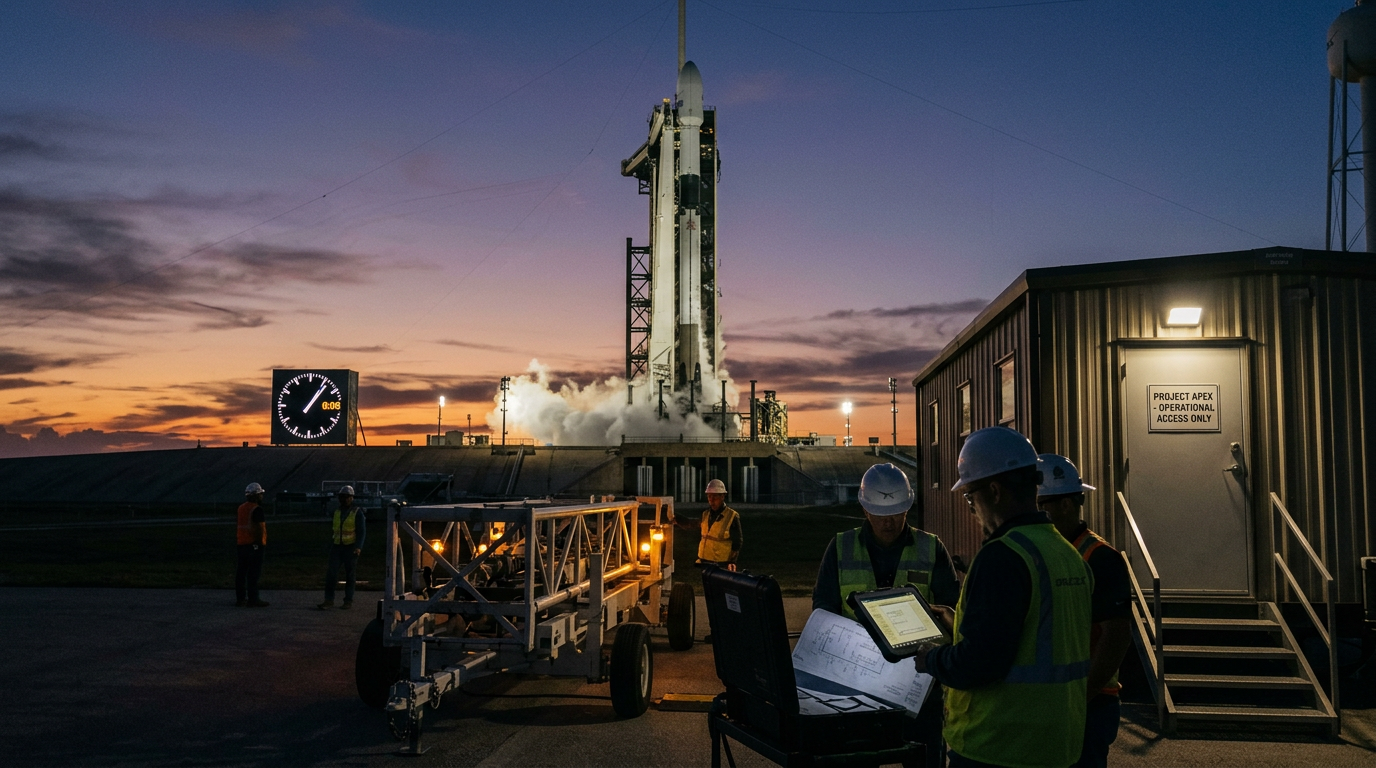
The confidential SEC filing dropped April 1. Roadshow begins June 8. Pricing lands the week of June 15. Twenty-one investment banks are on the syndicate — Morgan Stanley, Bank of America, Citigroup, JP Morgan, and Goldman Sachs as active bookrunners. The deal is codenamed Project Apex. Investment bankers aren’t known for their subtlety.
This thing is real. The question worth spending time on is whether the price is too.
1.5M People Ditched Their Monitors
That’s not a marketing claim. It’s what’s actually happening. All thanks to Immersed.
Immersed built a virtual environment where professionals do their actual jobs without limiting themselves to a single screen. It’s not a prototype or PRE REVENUE. 1.5M people use it as their primary workspace right now. Even Fortune 500 companies run daily operations inside it.
The business is real and gaining momentum. Even big tech is getting involved. Partnerships with Meta, Intel, Qualcomm, and Samsung don’t just happen. Speaking of Meta, it’s the No. 1 productivity app in the Meta Quest Store.
Former Intel CEO Pat Gelsinger invested. In total $28M+ raised from 7,000+ investors and the NASDAQ ticker reserved is: $IMRS.
Immersed is running a Regulation A+ offering to get more people involved. It’s the same structure that allows retail investors to get in on a raise that would traditionally require institutional access. Pre-IPO shares are $0.72. Early investors can qualify for up to 20% bonus shares.
Round ends May 14th and the price won’t stay at $0.72 forever.
Join the 7k+ investors in this workplace revolution
Disclosure: This is a paid advertisement for Immersed Regulation A+ offering. Please read the offering circular at https://invest.immersed.com/
What You’re Actually Buying
Most people still think of SpaceX as the rocket company. That framing was probably accurate in 2019. It isn’t anymore.
Following the February 2026 merger with xAI — Musk’s artificial intelligence venture, which also controls the platform formerly known as Twitter and the Grok chatbot — SpaceX is now effectively a conglomerate. Three distinct businesses, very different margin profiles, and one unified IPO price tag trying to capture all of it simultaneously.
The launch segment is the legacy core: reusable Falcon 9 rockets, Starship development, government contracts. ARK Invest notes that SpaceX has reduced cost per kilogram to orbit from roughly $15,600 in 2008 to under $1,000 today. A fully operational Starship targeting sub-$100 per kilogram would open markets that don’t currently exist. That’s the long-duration thesis for the rocket business.
Starlink is where the near-term cash flow story lives. The satellite internet constellation has surpassed 10 million active subscribers globally as of early 2026, with 2026 revenue projected to exceed $20 billion. ARK puts the total addressable satellite connectivity market at roughly $160 billion annually at scale. Starlink is adding customers faster than any telecom network in history — which, to be fair, is the kind of stat that also describes every network before it hits saturation.
Then there’s xAI. The AI division competing directly with OpenAI and Anthropic. The xAI piece is the hardest to price because its financials are still opaque, and the entire thesis rests on assumptions about large-language model monetization that haven’t been stress-tested at enterprise scale.
The space launch market alone is projected to reach $70 billion annually by 2035. At a $2 trillion valuation, you are paying roughly 100x that entire projected market just for the rocket segment. The multiple is a bet on Starlink’s compound growth, xAI’s eventual dominance, and an orbital infrastructure buildout that is, at best, a decade away from being legible to Wall Street analysts.
The Timeline
The S-1 prospectus is expected to go public between May 15 and May 22 — the SEC requires registration statements at least 15 days before any marketing begins, and the June 8 roadshow creates a hard backstop. Approximately 125 financial analysts from the 21 underwriting banks are scheduled to meet with SpaceX management the day before the roadshow launch. On June 11, SpaceX plans to host roughly 1,500 retail investors at what has been described internally as a major investor event. Pricing targets the week of June 15. Listing follows shortly after.
Slight tangent, but it matters: Kalshi currently shows 83% of participants believe the IPO closes before July 1. Prediction markets on Polymarket put the probability of an IPO completing by September 30 at 93%. The market has essentially priced in the IPO happening — what hasn’t been priced yet is the post-listing behavior.
That 180-day lockup expiration falls between December 15 and December 27. Mark it. That’s when insiders and early employees can sell freely, and that window historically creates meaningful selling pressure regardless of how enthusiastic the IPO narrative was.
The Retail Allocation Story
Here is genuinely unusual: most large IPOs allocate 5–10% of shares to retail investors. SpaceX CFO Bret Johnsen told the full bank syndicate that retail would play a larger role in this IPO than any in history — targeting up to 30% of the offering for individual investors. International retail access is also built in, with participation slotted for the UK, EU, Australia, Canada, Japan, and Korea.
What that actually means in practice — in terms of allocation mechanics, minimum purchase sizes, and broker access — remains unclear until the S-1 is public. The intention is real. The execution details aren’t visible yet.
You’re Time to Invest In SpaceX is Running Out
Elon has reportedly filed to take SpaceX Public… in an IPO that’s expected to hit a $1.75 trillion valuation.
The biggest in Wall Street history…
And you know who’s going to make all the money? The banks brokering the deal. The hedge fund managers. The billionaire insiders. The same “already rich” 1%’ers.
After the IPO, everyone else will be left fighting over scraps.
That’s why I’m leveling the playing field.
Pre-IPO Exposure: The Proxy Map
If you don’t want to wait until June — or you want to express a view on the IPO without touching the newly public stock at an unproven price — there are three surfaces worth understanding.
Alphabet (GOOGL). Regulatory filings confirm Alphabet holds approximately 6.1% of SpaceX. At a $1.75 trillion valuation, that stake is worth north of $100 billion — sitting quietly on Google’s balance sheet against a roughly $4 trillion market cap. The SpaceX position represents less than 4% of Alphabet’s total market cap, which is both the limitation and the appeal depending on what you want. For traders expecting a first-day pop, long GOOGL call spreads offer defined-risk exposure to an event-driven re-rating without touching the IPO directly. The IV environment on GOOGL is currently more rational than what SpaceX options will look like at listing, when implied volatility on a newly public mega-cap will almost certainly be elevated and expensive.
ARK Venture Fund (ARKVX). Carries roughly a 17% SpaceX weight and has generated approximately 151% cumulative returns since September 2022. The tradeoff: quarterly redemption windows only, and a 2.9% net expense ratio. Liquidity is the cost of the pre-IPO access.
Space sector ETFs and pure-play adjacents. The Procure Space ETF (UFO) is up nearly 28% year-to-date, outperforming the S&P 500 meaningfully. Rocket Lab (RKLB), AST SpaceMobile (ASTS), and Planet Labs (PL) have all caught IPO sentiment tailwinds — RKLB up roughly 350% over the past year. These are high-beta expressions of the same theme, not substitutes for SpaceX itself.
The Options Framework
SpaceX won’t have listed options at IPO. That’s standard — options typically don’t begin trading until 30 or more days after listing, once the exchange has enough price history and open interest to support a functioning chain. But that doesn’t mean you can’t construct an options-informed view right now using proxies, and it doesn’t mean you should ignore what the options market will look like the moment SPCE (or whatever the ticker becomes) chains go live.
What’s interesting is how the market tends to behave around mega-IPO listings. Implied volatility on the newly listed stock almost always opens elevated — often in the 80th–95th IV percentile range for the first few weeks. That creates a specific dynamic: buying calls on listing day tends to be structurally expensive. You’re paying for realized volatility that may or may not materialize, and the IV crush that happens as the stock settles tends to punish long premium holders even when the directional thesis is right.
Three structured frameworks to hold in your head for when the chain goes live:
- Bull Case – Defined Risk: If you believe SpaceX compounds post-IPO and you want to participate without unlimited downside, a long call spread 30–45 days out from listing (once IV begins normalizing) is the cleanest expression. Target strikes that give you 2:1 or better reward-to-risk. The goal is to avoid buying peak IV on day one. Wait for the first consolidation.
- Bear Case / Lockup Play – Defined Risk: The most asymmetric options opportunity around this IPO may not be at listing at all. It may be buying modest put exposure 90–120 days out, targeting the lockup expiration window of mid-to-late December. Lockup expirations on mega-cap IPOs have historically created selling pressure, and at a $1.75–$2T valuation with a dual-class structure concentrating voting control, insider selling is a reasonable assumption. A December put spread on SpaceX — sized small, defined risk — is worth monitoring once the chain opens.
- Neutral / Volatility Play: For traders expecting significant price swings in both directions without a directional conviction on where SpaceX ends up, a short iron condor placed 45–60 days after listing — when IV has partially normalized but realized vol remains elevated — could capture premium decay. This requires careful strike selection given the stock’s likely wide bid-ask at that point.
On the proxy side: GOOGL’s options market is currently functioning and liquid. For traders expecting an IPO-driven re-rating of Alphabet’s $100B+ SpaceX stake, a June or July GOOGL call spread — defined risk, relatively low IV cost — lets you express that view without touching the IPO itself. The IV rank on GOOGL has been reasonable, making long premium plays more structurally sound here than they’ll be on the SpaceX chain at open.
The Cheapness Problem
Here’s where I have to be straight with you. SpaceX is not cheap. It is one of the most expensive assets ever offered to the public market.
The $1.75T target represents a massive step up from the $1.25 trillion combined valuation set at the February xAI merger, which was itself a step up from the $800 billion December 2025 tender offer price. The valuation has more than doubled in roughly five months — not because the fundamentals changed dramatically, but because the IPO process creates its own momentum. Bankers are paid to build a book, not to optimize entry price for retail investors.
There’s also a structural wrinkle worth flagging. The dual-class share structure reportedly gives Musk outsized voting control. You’re not just paying for the business — you’re paying for the business with limited governance recourse if capital allocation decisions go sideways. This is not unique to SpaceX. It is a risk that should be in your model.
The bull case is genuine: Starlink keeps compounding toward a $160B TAM, xAI becomes a real contender, and reusable launch economics create a cost moat that no competitor can match in the next decade. The multiple looks expensive until it doesn’t — the way early Amazon looked expensive every year from 2001 to 2015. That framing is real and intellectually honest.
The bear case is equally real. Multiple compression hits hard post-lockup. xAI’s competitive position erodes as OpenAI and Anthropic — both targeting late 2026 listings themselves — absorb the AI narrative. And you bought the story at peak IPO enthusiasm, which is historically the worst entry point in the asset’s life cycle.
Both are true simultaneously. That’s actually the hard part.
The Data Snapshot
- IPO target: June 2026 – roadshow begins June 8, pricing week of June 15
- Valuation range: $1.75T–$2T (up from $800B in Dec. 2025, $1.25T post-xAI merger in Feb. 2026)
- Expected raise: $50B–$75B (would be largest IPO raise in history, eclipsing Saudi Aramco’s $30B in 2019)
- Retail allocation: up to 30% — vs. typical 5–10% for large IPOs
- International retail access: UK, EU, Australia, Canada, Japan, Korea
- S-1 prospectus expected: May 15–22
- Lockup expiration: December 15–27, 2026
- Starlink: 10M+ active subscribers, 2026 revenue projected >$20B
- Government contracts: >$22B as of 2024 (per Gwynne Shotwell)
- Space launch market TAM: ~$70B annually by 2035
- Alphabet stake: ~6.1% – worth $100B+ at $1.75T valuation
- ARK Venture Fund SpaceX weight: ~17% of net assets
- Pre-IPO proxy options: GOOGL (liquid options, re-rating play), ARKVX, space ETF UFO (up ~28% YTD)
- On-chain pricing signal: ~$1.54T (consistently below banker estimates)
Here’s where I’m at. SpaceX might be the most important company to go public in a generation. It also might be one of the most expensive. Those two things can coexist without contradiction. The question a bargain hunter actually asks isn’t whether the business is extraordinary — it clearly is. The question is whether the price you’re being asked to pay at IPO leaves enough margin for something to go right that the market hasn’t already priced in.
At $1.75T, a lot has already been priced in. That’s the part people skip when they get excited about roadshows and retail events.
The S-1 goes public in three to four weeks. That’s the first time anyone outside the bank syndicate will see actual audited financials. Until then, every valuation argument — including this one — is intelligent speculation built on incomplete data. Watch for the S-1. Watch the revenue composition between Starlink and launch. Watch what the xAI segment looks like when it has to disclose itself to the public for the first time.
That document will tell you more than any roadshow ever will.
Your Free Options Book Is About to Vanish
In case you missed it… make sure you get your free “Simple Options Trading For Beginners” book before your link expires.
I eventually plan to charge money for this training, so do yourself a favor and download it now…
That way, no matter what it costs in the future, you’ll have a free copy.
Sound good?
Tactical Checklist
- Read the S-1 when it drops (May 15–22). Focus on Starlink revenue, xAI segment disclosure, and government contract concentration risk.
- If you want pre-IPO exposure via options today: evaluate GOOGL call spreads targeting June/July as a defined-risk re-rating play on the $100B+ SpaceX stake.
- Do not buy SpaceX calls on listing day — IV will be structurally elevated. Wait for first consolidation before entering long premium positions.
- Mark December 15–27 as the lockup expiration window. Monitor for put spread opportunity as that date approaches.
- For traders expecting volatility without directional conviction: revisit short premium structures (iron condors) 45–60 days post-listing once IV normalizes.
- Track the on-chain pricing signal (~$1.54T) vs. banker target ($1.75T–$2T). The gap is a real-time sentiment spread worth watching as pricing week approaches.
- If allocated IPO shares: define your exit thesis before June 15. The post-lockup behavior of this stock is the real trade — not the listing day pop.
About the Author