
June 3, 2026
The $22.7B Backlog
Symbotic (SYM) and the Automation of Global Logistics
First a note from Banyan Hill Research
Dear Reader,
Something strange just happened in Washington…
And, according to research by tech visionary Ian King, “it could hand the world’s richest man an unprecedented amount of power…
While making his backers a fortune.”
To explain all the details, King just released a stunning new presentation.
If his research proves correct, a single move by Elon Musk could reshape the monetary system… beginning in a matter of weeks.
In other words, Elon is about to ‘flip the switch.’
And investors who act today could see the single greatest wealth-building opportunity in decades.
We recently sat down with King – who’s called just about every twist and turn of Musk’s career… including an early bet on Tesla that returned up to 1,000% in a little over a year.
For the time being, you can get his take on Musk’s latest innovation, free of charge, right here.
Regards,

Sarah Williams
Associate Editorial Manager, Banyan Hill Publishing
The $22.7B Backlog
The shift is already underway. Quietly, methodically, and largely below the noise of macro headlines, the global logistics industry is undergoing a structural rewiring. Cheap, centralized overseas manufacturing built on the assumption of perpetually low labor costs is giving way to something more permanent: automated, regional distribution networks that can absorb wage inflation without margin collapse. This is not a trend. It is an infrastructure overhaul, and the capital commitments being made right now are locking in winners for the next decade.
The global warehouse automation market was valued at approximately $21.7 billion in 2024 and is projected to reach $90.7 billion by 2034, growing at a CAGR of roughly 15.1%. That trajectory is being driven by something structural – chronic labor shortages, rising wage floors in logistics, and the demand for faster, more accurate fulfillment across both e-commerce and brick-and-mortar retail. North America alone accounted for more than 44% of global revenue in 2024, underpinned by nearshoring investment and an accelerating push to regionalize supply chains that were over-extended during the pandemic years.
One company is positioned almost directly in the center of this overhaul.
Symbotic Inc. (NASDAQ: SYM) – What the Numbers Actually Say
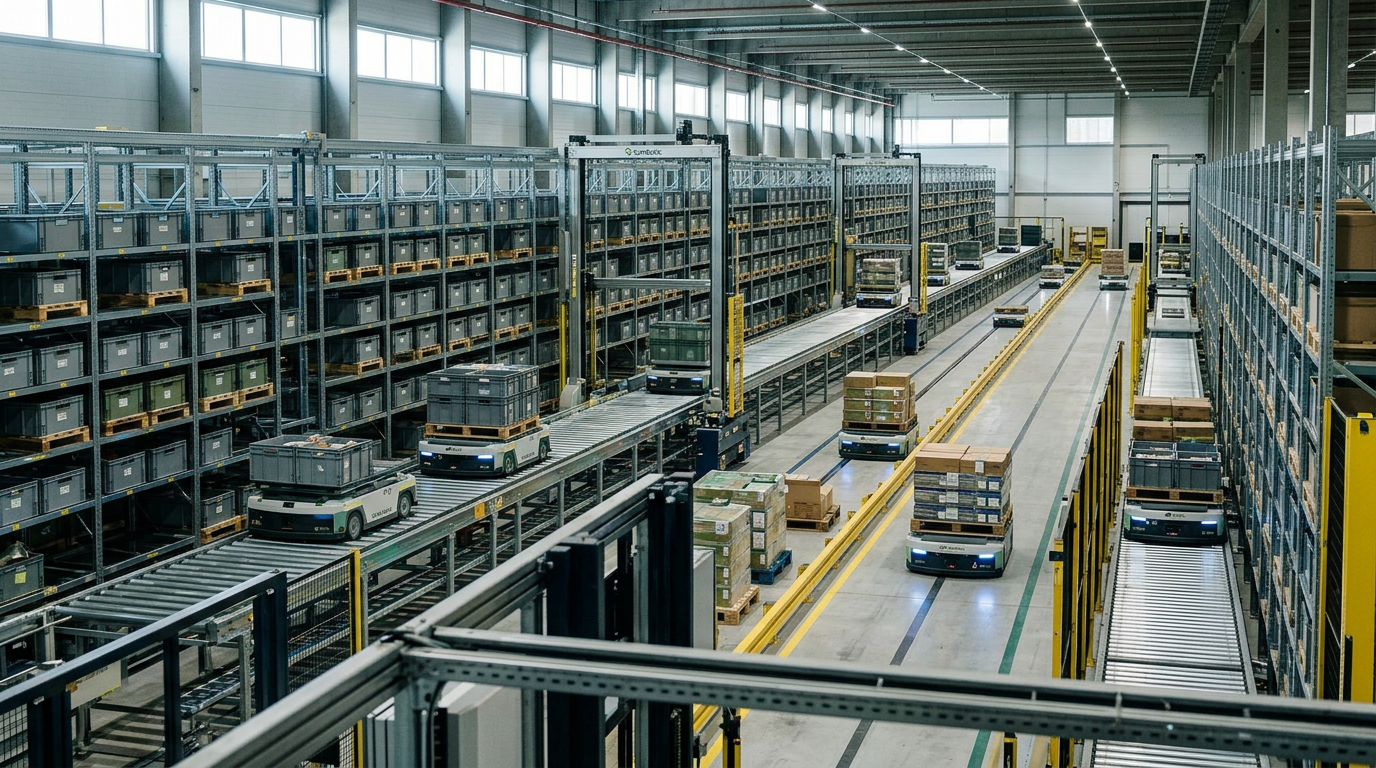
Symbotic builds high-speed, AI-powered robotics systems that automate the physical movement of inventory inside massive distribution centers. Depalletizing, storage, selection, palletization – the full physical workflow, orchestrated by proprietary software and a fleet of autonomous bots operating inside a purpose-built infrastructure. Their clients are not small operators experimenting with automation. They are the largest retail and logistics enterprises in the world.
The fiscal year 2025 numbers are worth sitting with. Symbotic reported full-year revenue of $2.247 billion, reflecting 26% growth year-over-year. Q3 FY2025 alone came in at $592 million in revenue, versus $470 million in the same quarter the prior year. Adjusted EBITDA for Q3 reached $45 million, compared to $3 million in Q3 FY2024 – a near-complete transformation of the profitability picture in twelve months. For the full fiscal year, adjusted EBITDA landed at $147 million. The company still carries a net loss, which matters for valuation frameworks, but the direction of the underlying operating economics is unambiguous.
Cash and equivalents ended fiscal year 2025 at $1.245 billion – up $467 million from the prior quarter alone. That is a company that is not burning cash recklessly. It is generating operational momentum and holding liquidity.
The backlog is $22.7 billion as of March 2026. Anchored by long-term contracts with blue-chip customers, with Walmart and Exol comprising the vast majority of committed future revenue. That number is not a projection. It is contracted work sitting in the pipeline.
Important SpaceX PREDICTION
The biggest IPO in stock market history could go live as soon as June 12th – and trading legend Jon Najarian says everyone’s about to make the same mistake.
The real story isn’t SpaceX. It’s a strange new FCC filing Elon quietly submitted earlier this year – one Morgan Stanley estimates could be worth $40 trillion.
Bigger than Tesla, xAI, Starlink, X, Neuralink, and SpaceX combined.
The Walmart Relationship – Bigger Than It Looks
Symbotic has been embedded in Walmart’s supply chain since 2017. By 2025, it was actively deploying its platform across all 42 of Walmart’s regional distribution centers in the U.S. That alone would be a significant business. But in January 2025, the relationship expanded in a way that changes the total addressable market calculation entirely.
Symbotic acquired Walmart’s Advanced Systems and Robotics business and signed a commercial agreement covering the development and deployment of automation systems for Walmart’s Accelerated Pickup and Delivery centers at stores. Under the agreement, Walmart is committed to purchasing and deploying systems for 400 APD locations over a multi-year period, with the option to expand. The development program is funded by Walmart – $520 million total, including $230 million paid at closing.
The potential backlog addition from this deal alone exceeds $5 billion. And the addressable market expansion it unlocks – moving automation from large distribution centers into the store-level micro-fulfillment layer – adds more than $300 billion to Symbotic’s total addressable market in the U.S. alone. Slight tangent, but worth noting: 90% of the U.S. population lives within 10 miles of a Walmart store. That geographic density is not irrelevant when you are building fulfillment automation designed to reduce last-mile delivery costs.
The Structural Case – Why This Is Not Cyclical
What matters here is the difference between cyclical demand and structural demand. Warehouse automation is increasingly the latter. Wage inflation in logistics is not going away. Labor availability in major metro distribution markets is a genuine constraint. And the consumer expectation for faster, more accurate fulfillment is only compressing further. Companies are not automating because it is trendy. They are automating because the math on human labor no longer works at scale.
Over 33% of logistics companies have already transitioned toward fully automated sorting and packaging operations. Implementation of robotics-based picking systems has increased by nearly 41% in recent years. These are adoption curves that do not reverse.
For Symbotic specifically, the business model is built around this reality. Systems are deployed under long-term contracts with milestone-based payment structures, followed by recurring software maintenance and support revenue. Software maintenance and support margins exceeded 65% in Q2 FY2025. The recurring layer of the business is high-margin and durable – it does not go away once systems are installed. It compounds.
Risk Factors – Read These Before Moving On
Customer concentration is real. Walmart and Exol comprise the vast majority of the $22.7 billion backlog. That is a structural dependency, not a minor footnote. If the Walmart relationship were to change materially – delayed deployments, contract modifications, or shifts in Walmart’s internal capital allocation – the revenue profile of SYM changes significantly. The company acknowledges this risk explicitly in its filings.
There is also the revenue lumpiness issue. System starts depend on both Symbotic and its customers being operationally ready. CFO Carol Hibbard noted in Q2 FY2025 that system starts will continue to be uneven by quarter. A next-generation storage structure launched in late FY2025 created a short-term scheduling shift – management was clear this does not affect the backlog, but it does introduce near-term revenue variability.
Tariffs are a factor. Symbotic guided that tariff impacts would increase revenue as pass-through costs, affecting gross margins. The net effect on profitability requires monitoring. And while the company carries $1.245 billion in cash, it is not yet consistently GAAP profitable. Net loss for FY2025 was $91 million.
Options Market Framework
SYM is a mid-cap, high-growth industrial technology name. That profile tends to produce elevated implied volatility relative to the broader market – particularly around earnings. For traders evaluating options structures, the key metrics to track are IV rank (where current implied vol sits relative to its 52-week range), IV percentile, and the expected move priced into the nearest expiration cycle. High IV rank environments – generally above 50 – favor premium-selling structures or defined-risk spreads rather than outright long premium. Low IV rank environments favor long premium or debit spreads for directional exposure.
For traders with a constructive view on SYM’s long-term revenue ramp, a defined-risk bull call spread on a longer-dated expiration – 60 to 90 days out – limits downside to the debit paid while capturing upside if the stock responds to continued backlog conversion and margin expansion. The width of the spread should reflect the expected move and the conviction level behind the catalyst. If you believe the $22.7 billion backlog and accelerating EBITDA trajectory justify higher valuation, that structure gives you exposure without open-ended risk.
For traders concerned about customer concentration risk or near-term margin pressure from tariff pass-throughs, a defined-risk bear put spread or a long put position with a defined expiration captures downside without requiring a short stock position. The key is sizing relative to the binary nature of the catalyst – quarterly system start variability can move the stock sharply in either direction.
Neutral traders – those who believe SYM trades sideways while the backlog converts slowly – can look at short iron condors in elevated IV environments, collecting premium on both sides while keeping risk defined. As always, implied volatility crush post-earnings is the primary risk to net short premium positions.
5 Little-Known Stocks Behind Today’s Defense Tech Shift
Behind the headlines, a major transformation is underway.
Modern warfare is being driven by AI, autonomous systems, and next generation technology. A handful of lesser known companies are helping power this shift.
This report uncovers five stocks quietly playing a critical role in the future of defense.
Forward Outlook
Q1 FY2026 guidance called for revenue of $610 million to $630 million, with adjusted EBITDA of $49 million to $53 million. Q2 FY2026 came in at approximately $676 million, up from $550 million year-over-year, with adjusted EBITDA of roughly $78 million – more than double the prior year figure. Free cash flow for the trailing twelve months through Q2 FY2026 was $787.9 million. These are not the numbers of a company struggling with its model. They are the numbers of a company moving through the early stages of a long-duration revenue build.
The $22.7 billion backlog does not convert overnight. That is actually the point. It is a multi-year, contracted revenue stream that provides visibility most industrial technology companies would not be able to claim. As Symbotic expands its deployment cadence, brings the next-generation storage structure online, and continues to build out its micro-fulfillment layer through the Walmart APD agreement, the compounding effect on both top-line revenue and operating margins becomes increasingly visible in the numbers.
The question for traders and investors is not whether warehouse automation is a real trend. That is settled. The question is whether Symbotic can execute against a backlog that is, by any measure, enormous relative to its current revenue run rate – and whether the customer concentration risk is adequately priced into the stock. Those are the two variables worth tracking closely into each earnings release.
Tactical Checklist
- FY2025 full-year revenue: $2.247 billion (+26% YoY). Adjusted EBITDA: $147 million.
- Q2 FY2026 revenue: ~$676 million (+23% YoY). Adjusted EBITDA: ~$78 million, more than double the prior year.
- Backlog: $22.7 billion as of March 2026 – contracted, not projected.
- Cash position: $1.245 billion at end of FY2025. Free cash flow for trailing twelve months through Q2 FY2026: $787.9 million.
- Walmart APD deal: Up to $5 billion in additional backlog potential. 400 store locations committed, with option to expand. $520 million in development funding from Walmart.
- Software maintenance and support margins exceeded 65% in Q2 FY2025 – this is the recurring, high-margin layer of the business.
- Key risk: Customer concentration. Walmart and Exol represent the vast majority of backlog. Monitor for any shift in Walmart’s capital priorities.
- Key risk: Revenue lumpiness. System starts are milestone-dependent and uneven by quarter.
- Options consideration: Track IV rank before positioning. High IV environments favor defined-risk spreads. Low IV environments favor debit structures for directional exposure.
- Bull structure: Long-dated bull call spread if you believe backlog conversion and margin expansion continue.
- Bear structure: Defined-risk bear put spread if customer concentration or tariff margin pressure is the primary thesis.
- Watch: Next quarterly earnings for system start cadence, gross margin trajectory, and any update to the Walmart APD deployment timeline.