June 10, 2026
This IPO Could Dwarf SpaceX (Read Before June 16)
Featured: Domestic Midstream Moats: The Case for ONEOK
Editor’s Note: Marc Chaikin made one of Wall Street’s most popular indicators… found on every Bloomberg and Reuters terminal in the world. Now he’s pounding the table on Silicon Valley’s most popular startup, a breakthrough AI lab that recently surged 80X in a single quarter. Click here for the full details, or read below to learn more…
Dear Reader,
This AI lab planned for 10X growth in 2026.
Instead, its revenue soared 80-fold in one quarter.
In fact, it’s on track to outsell OpenAI and SpaceX put together.
And – to top it all off – it’s on the verge of achieving its first profitable quarter – a milestone it didn’t expect to celebrate until 2028.
This company didn’t exist a few years ago. Now it’s the front-runner in the AI race.
I’ve been investing for 60 years, and I’ve never seen a growth story like this.
Last week, this red-hot startup finally filed to go public. It’s expected to make its big debut this fall.
But on June 16, I believe it’s going to make an announcement that could make its already enormous $965 billion valuation climb sharply higher.
Leaked source code refer to this plan as Project Tengu, and I expect it to spark a 42-fold investment boom – not to mention a $500 trillion wealth transfer.
Nvidia CEO Jensen Huang calls this technology “incredible.”
And a senior Google engineer said it recreated a year’s worth of work in one hour.
When I showed one of my colleagues a short, 30-second demonstration of Tengu, it left her stunned.
She said, “This makes ChatGPT look like a simple parlor trick.”
I believe Tengu could turn this startup into the most valuable company in the world by the end of the decade.
Best part?
You don’t have to wait until its IPO to get a piece of the action.
I’ve discovered a $40 “backdoor” into this company that anyone with an internet connection can take advantage of.
Click here for the full details (must read before June 16).
Regards,
Marc Chaikin
Founder, Chaikin Analytics
P.S. U.S. businesses are now adopting this firm’s software at a faster rate than OpenAI. In fact, it’s become a trusted AI powerhouse for over 300,000 companies worldwide. But this is just the beginning. Click here to find out what I anticipate for June 16.
Domestic Midstream Moats: The Case for ONEOK
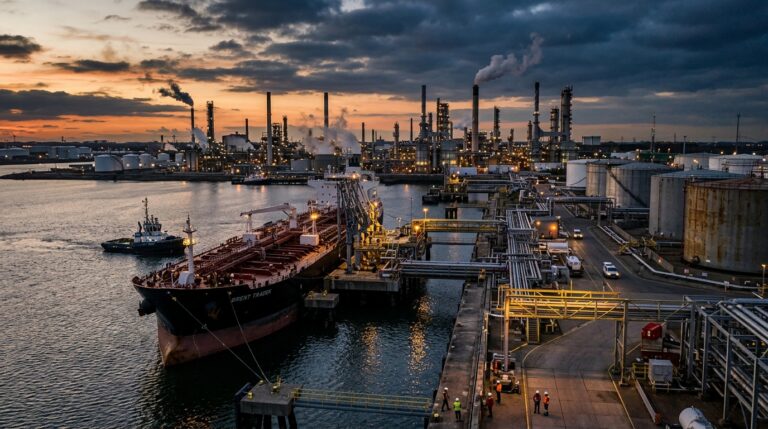
Here is what most energy coverage is missing right now. Everyone is focused on crude price swings, Brent spreads, and whatever OPEC said last week. What they are not focused on is the infrastructure layer underneath all of it. The physical pipes. The gathering systems. The fractionation facilities. The domestic network that simply does not care whether a tanker can clear the Strait of Hormuz or not.
That distinction matters more today than it has in years.
The Chokepoint Is Real
The Strait of Hormuz handled roughly 20 million barrels of crude oil and oil products per day in 2025, representing around 25% of total global seaborne oil trade. That corridor is now effectively closed to commercial traffic following the outbreak of the U.S.-Israel conflict with Iran that began in late February 2026. Traffic through the strait has plunged by more than 95%. The IEA’s Executive Director has described the combined impacts as “the greatest threat to global energy security in history.” That is not hyperbole from a think tank. That is the world’s foremost energy watchdog putting a number on what a closed Strait means in real time.
The gap cannot simply be rerouted. Saudi Arabia and the UAE have pipeline alternatives, but bypass capacity is constrained, those land routes have come under drone and missile attack, and the volume math does not add up. Middle Eastern producers are scrambling. Gulf states have told CNBC that Iran’s behavior has created a trust gap that may never be repaired. Meanwhile, Brent futures were sitting roughly one-third above pre-conflict levels in late May.
This is where it gets interesting for North American midstream. The world needs oil and gas. The Middle East corridor is impaired. That means domestic production from the Permian and Bakken basins carries more weight on the global supply ledger than at any point in recent memory. And that production cannot move without pipelines.
ONEOK: The Infrastructure Nobody Can Replicate
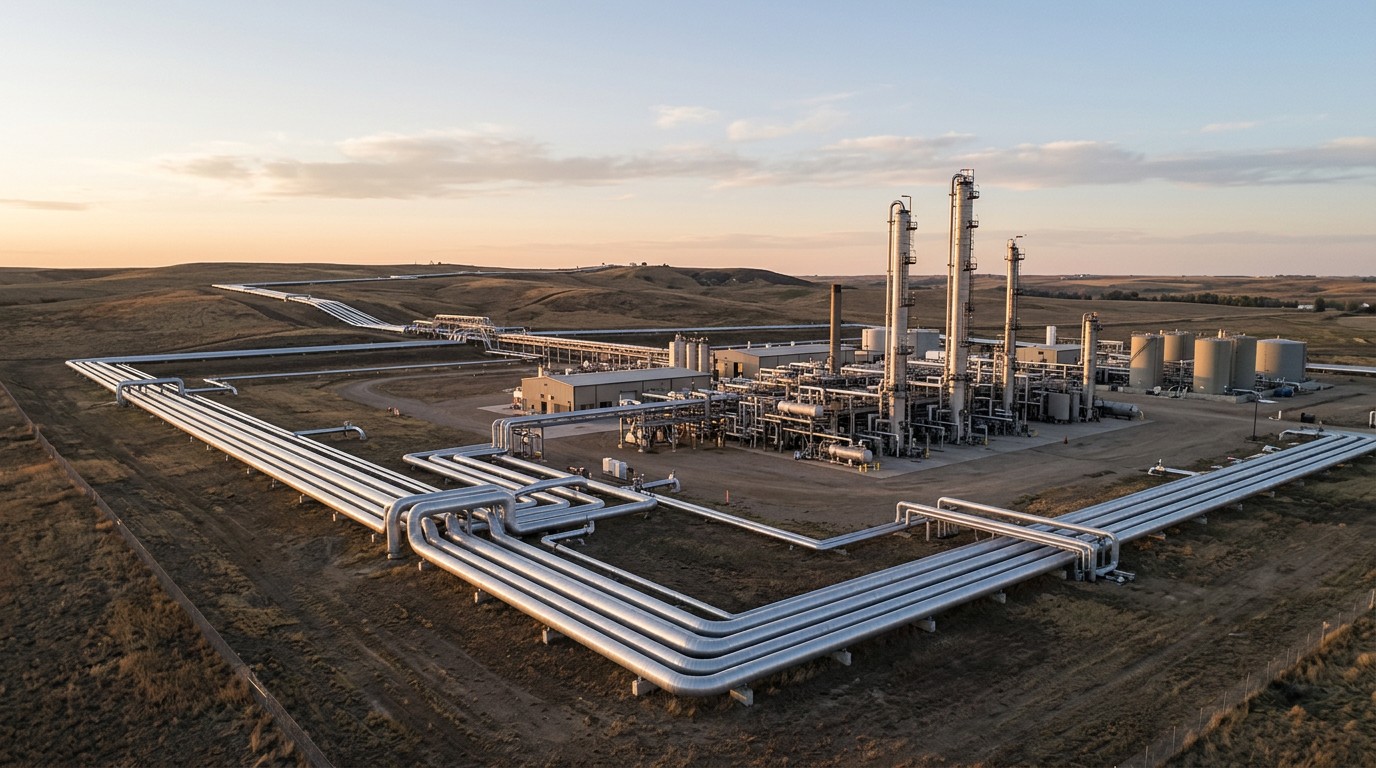
ONEOK, Inc. (NYSE: OKE) operates a roughly 60,000-mile pipeline network for transporting natural gas, natural gas liquids (NGLs), refined products, and crude oil across North America. The network connects Bakken and Permian supply to Gulf Coast and Mid-Continent demand centers. That footprint expanded substantially in January 2025 when ONEOK completed its acquisition of EnLink Midstream, adding infrastructure in the Permian Basin, Louisiana, Oklahoma, and North Texas. It expanded again in May 2025 when ONEOK acquired the remaining 49.9% interest in Delaware Basin JV for $940 million, adding more than 700 million cubic feet per day of processing capacity in the Delaware Basin alone.
Slight tangent, but it matters: ONEOK is also a partner in the newly announced Eiger Express Pipeline, a 450-mile, 42-inch natural gas line designed to move up to 2.5 billion cubic feet per day from the Permian Basin to the Gulf Coast region near Houston. Expected completion is mid-2028. That pipeline is supported by firm transportation agreements with contract terms of ten years or longer. This is not a company sitting on legacy infrastructure. It is actively building the next generation of domestic takeaway capacity while simultaneously collecting fees on the current generation.
One Shark Missed Billions… Another Saw This Coming
Imagine turning down Uber at a valuation of $10 million, only to watch it go public at over $80 billion.
That’s exactly what happened to Mark Cuban… a 799,900% return, gone.
But original Shark Tank investor Kevin Harrington built his career doing the opposite: spotting asymmetric opportunities before they go mainstream.
Like Uber turned vehicles into income-generating assets, Mode Mobile is turning smartphones into income streams.
They were named the #1 fastest-growing software company by Deloitte and have already helped their users earn and save over $1B.
Kevin Harrington invested early.
And at just $0.52/share, you can still get in before their potential IPO. But this window will not stay open for long.
Secure shares at $0.52 while the pre-IPO window is still open.
Please read the offering circular at invest.modemobile.com. This is a paid advertisement for Mode Mobile’s Regulation A Offering.
The Numbers Behind the Moat
Full-year 2025 results confirmed the growth trajectory. ONEOK delivered adjusted EBITDA of $8.02 billion, up 18% year over year, and net income of $3.39 billion, up 12%. Q4 2025 revenue came in at $9.07 billion, up 29.5% year over year. Q1 2026 revenue hit $9.62 billion, up 20% versus Q1 2025, with net income of $774 million, up 22%. Revenue beat analyst estimates by 17% in that quarter.
The company also extinguished nearly $3.1 billion of long-term debt during 2025, including $1.75 billion in Q4 alone, while capturing $475 million in cumulative synergies from the EnLink and Medallion acquisitions. Management guided 2026 net income of $3.19 billion to $3.71 billion, or EPS of $5.04 to $5.87. Capital expenditure guidance for 2026 sits between $2.70 billion and $3.20 billion.
What makes those numbers durable is the revenue architecture. ONEOK targets 90% to 95% fee-based earnings across all segments. More than 90% of 2025 revenues were fee-based. The Natural Gas Pipelines segment relies on firm transportation and storage contracts where customers pay for reserved capacity regardless of actual usage. This structure significantly reduces commodity price exposure. When crude drops $15 a barrel, ONEOK’s toll revenue does not drop with it. Volumes move. Fees accrue. That is the model.
The Dividend Argument
In January 2026, ONEOK’s board raised the quarterly dividend 4% to $1.07 per share, bringing the annualized payout to $4.28 per share. The company has guided for 3% to 4% annual dividend growth going forward. ONEOK has grown its adjusted EBITDA more than 16% annually over the past eleven years. The dividend is not paid from commodity speculation. It is paid from fee-based tolls on volume, underwritten by long-term contracts with producers who have no alternative but to move their gas and liquids through existing infrastructure.
The Bakken connection is worth noting specifically. ONEOK’s Elk Creek Pipeline, a 900-mile NGL line running from eastern Montana to Bushton, Kansas, completed an expansion at the start of 2025 adding 135,000 barrels per day of capacity. Volumes on that pipeline jumped nearly 100,000 barrels per day through September 2025, according to FERC filings. Rocky Mountain region NGL raw feed throughput volumes were up 17% year over year in Q3 2025. These are not incremental gains. They are structural volume growth from one of the most productive basins in North America.
Options Market Context
Midstream infrastructure names like OKE tend to attract income-oriented positioning rather than high-IV speculative flow. The fee-based model compresses earnings variance, which in turn suppresses implied volatility relative to pure-play E&P names. For traders evaluating defined-risk structures, that low-IV environment can favor long premium approaches during periods of macro volatility, where OKE’s relatively stable earnings underpin a tighter expected move versus broader energy sector names.
- Bull case: If you believe North American midstream volumes continue growing as domestic production fills the global supply gap left by Hormuz disruption, a long position in OKE – or a defined-risk bull call spread targeting the $95 to $110 range – captures volume-driven EBITDA expansion alongside the 4.28-per-share annual dividend.
- Bear case: If you believe a rapid Hormuz resolution materially reduces domestic production urgency, and macro conditions compress capital spending by Permian and Bakken producers, a defined-risk bear put spread or reduced position size manages downside. The 90%+ fee-based structure limits, but does not eliminate, volume-risk sensitivity in a significant activity slowdown.
- Neutral case: A covered call overlay against a long OKE position monetizes the low-IV environment while the $4.28 annualized dividend provides an income floor. Appropriate for traders expecting range-bound price action while awaiting clarity on 2026 producer activity levels.
What If the Rising Prices at the Gas Pump Paid YOU?
Every time you fill up, someone’s getting rich, and it’s not you. A former hedge fund manager has a way for regular folks to come out ahead when oil and gas prices climb. Anyone can do this – without buying oil stocks.
Risk Factors
This is not a risk-free position. ONEOK’s 2026 guidance assumes a WTI crude oil price of roughly $55 to $60 per barrel. A prolonged collapse in commodity prices does constrain producer drilling activity, which eventually constrains volumes, which eventually constrains fee revenue, even within a predominantly contracted structure. Management has already flagged a cautious macro environment in its forward guidance. The payout ratio, currently around 0.77, is elevated by historical standards, though it has been as high as 2.05 over the past thirteen years. Leverage is being actively reduced, but debt remains material.
Execution risk on acquisitions is also real. ONEOK has absorbed EnLink and Medallion in rapid succession, and while $475 million in cumulative synergies have been captured through end of 2025, integration complexity at this scale carries operational risk that does not show up cleanly in quarterly EBITDA numbers until something slips.
Forward Outlook
The Hormuz closure does not last forever. But the structural shift it accelerates almost certainly does. Global buyers of oil and gas are now actively building contingency plans that depend less on a single chokepoint and more on diversified supply. North American production, moving through North American infrastructure, is the most politically stable version of that contingency available at scale. ONEOK sits at the center of that system.
The Eiger Express Pipeline joint venture, targeting mid-2028 completion, adds another leg of Permian-to-Gulf-Coast capacity supported by decade-long firm contracts. The Delaware Basin JV acquisition, now fully owned, deepens Permian processing reach. The Elk Creek expansion is filling faster than expected. The dividend is growing. The balance sheet is improving. What’s interesting is that none of this depends on oil prices staying elevated. It depends on volumes moving. And volumes are moving.
STOP SELLING On Fridays…
Every late Friday afternoon like clockwork, traders close their positions for the week. But not this veteran trader.
He’s loading up knowing breaking after-hours news is about to drop that’ll have you desperate all weekend and scrambling to buy back shares on Monday morning at twice… even triple what you sold them for.
All the while he gets to bank as much $16,159 or more just for holding shares over the weekend.
Action Checklist
- Monitor ONEOK Q2 2026 earnings for volume growth trends in Rocky Mountain and Permian segments, and synergy capture progress toward the $150 million incremental 2026 target
- Watch Elk Creek NGL utilization rates via FERC filings as a leading indicator of Bakken production momentum
- Track Hormuz shipping developments – partial reopening compresses the macro premium in domestic midstream names; full closure extension expands it
- For defined-risk structures: assess OKE’s implied volatility relative to sector peers before entering options positions; low IV favors long premium in high-uncertainty macro environments
- Dividend reinvestment at current yield levels ($4.28 annualized) compounds meaningfully if the 3% to 4% annual growth guidance holds through 2027 and beyond
- Review 2026 WTI assumptions in ONEOK’s guidance ($55 to $60 per barrel) against current strip pricing to assess whether producer activity guidance carries upside or downside revision risk
The part people skip when looking at midstream: you do not need to predict commodity prices. You need to predict whether producers keep drilling and whether molecules keep moving. Right now, both answers point in the same direction.
Worth a closer look.
– The Editorial Desk