June 26, 2026
TSLA Has Two Catalysts in 20 Days
Featured: TSLA Has Two Catalysts in 20 Days
If you still haven’t downloaded my “Smart Trade Options Checklist”…
…please take a few seconds and download it right now before your new temporary download link expires.
Most traders wreck their accounts because they skip the 7 checks in this report.
I eventually plan to charge for this checklist, so do yourself a favor and download it now…
That way, no matter how much it is in the future, you’ll have a copy on your computer already.
Make sense?
FREE: Smart Trade Options Checklist << Download Now
Good Trading,
Bill Poulos
FEATURED
TSLA Has Two Catalysts in 20 Days
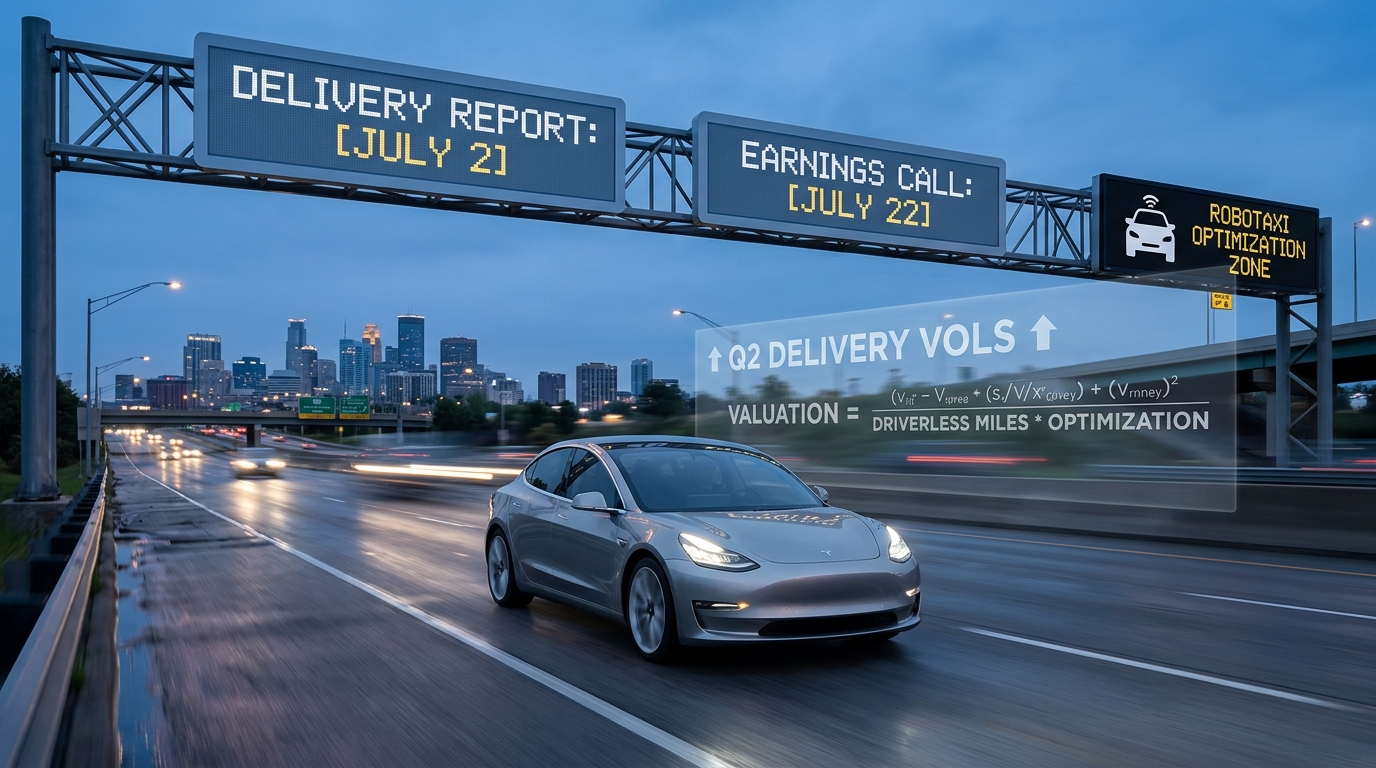
Two catalysts are stacked right on top of each other for Tesla. The first one lands in about a week.
Q2 delivery figures are expected around July 2. Analyst estimates are scattered in ways that matter. Goldman Sachs raised its Q2 forecast to 420,000 units, citing roughly 85-90% year-over-year registration growth in Europe through May and solid China momentum. RBC is at 405,000. Baird sits at 392,900. Barclays expects around 418,000, above the Visible Alpha consensus of approximately 400,000. That spread is wider than it looks on the surface. A miss against even the low end of that range hits sentiment at exactly the wrong time, three weeks before earnings.
Then July 22 arrives.
Q2 EPS consensus sits near $0.45 per share (non-GAAP), with some estimates clustering in the $0.42-$0.45 range. That would mark improvement from Q1, where Tesla posted non-GAAP EPS of $0.41, beating the consensus by a meaningful margin. Revenue for Q2 is expected to come in around $24.3 billion, up from $22.39 billion in Q1. Gross margin in Q1 came in at 21.1% on a GAAP basis, up 478 basis points year-over-year and the strongest in several quarters. Q1 free cash flow was positive at $1.44 billion, better than what the market had expected given the capex ramp. Q2 is a different story. The company is spending aggressively, and every quarter of heavy investment creates more scrutiny around whether the autonomy revenue model is materializing fast enough to justify it.
This Elon-Backed Startup is Growing Like Crazy
Time magazine called this startup that’s backed by Elon Musk (click here to get the name)…
“The Most Disruptive Company in the World…”
And said that it “holds the keys to perhaps the most powerful technology of all time.”
No wonder its CEO is projecting growth of up to 8,000% for this year.
It just filed the paperwork to go public in what’s set to be the next hot IPO on Wall Street. But you do NOT have to wait until the IPO.
Click here and Jeff Brown will show you how to claim your pre-IPO stake for as little as $50.
Worth noting: the post-Q1 stock reaction was actually positive. Shares rose roughly 3.6% in after-hours trading the night of the April 22 report, driven by the margin rebound and the free cash flow figure turning positive when the market expected negative. That context matters for how you frame Q2 expectations. A beat on the headline numbers is not automatically a green day. What moves the stock is where management stands on the 2026 capex story and whether the robotaxi rollout has any new specifics attached to it.
Slight tangent, but it matters. Tesla has guided to roughly $25 billion of capex in 2026, a sharp step-up versus 2025, tied to AI compute and manufacturing capacity. The income statement is not the right lens here. The capital allocation story is. Every dollar Tesla spends on AI and autonomy infrastructure is a bet that the autonomous revenue model arrives before the free cash flow picture gets structurally uncomfortable. So far, the market has been patient. July 22 is another moment where that patience gets tested.
The Autonomy Premium Is Already in the Multiple
Tesla’s forward P/E is approximately 185x based on next twelve months estimates. The trailing P/E is closer to 340x. The market cap sits around $1.41 trillion. No auto business justifies that number. No energy business does either. What gets you there is the assumption that autonomy and a fleet-based model eventually generate something closer to platform-style economics than manufacturing-style economics. That is the bet.
The stock is up roughly 16% over the past year. It has traded between $288.77 and $498.83 over the 52-week range. At around $371-375 as of this writing, it is sitting in the lower third of that range. Not cheap by any traditional measure, but well off the December 2025 highs. Analyst consensus targets range from roughly $395 to $421 depending on the source, with a low near $25 from the most bearish firm and a high of $600 from Wedbush. That spread alone tells you this is not a valuation story. It is a conviction call on whether the technology actually lands.
The analyst community has been shifting fast. JPMorgan, historically one of Tesla’s most reliable institutional bears, upgraded TSLA from Underweight to Neutral on June 5 and raised its price target from $145 to $475, citing vertical integration advantages and the physical AI opportunity. UBS moved from Sell to Neutral earlier in the spring, raising its target to $364, calling the risk-reward more balanced after the stock’s sharp decline. RBC remains Outperform with a delivery estimate above consensus. Goldman holds a Neutral rating at $375. Barclays is cautious but still expects a delivery beat. The institutional view is fractured in ways that create real options opportunity.
Options Market Structure
With two layered catalysts in a 20-day window, the options market is pricing for a wide range of outcomes. Tesla’s beta sits around 1.83. It has historically delivered outsized post-earnings moves relative to what the at-the-money straddle implies, and the dual-catalyst structure here adds complexity that single-event models do not fully capture.
The delivery number on July 2 functions as a pre-earnings tell. If Q2 deliveries come in at or above the 400K consensus, the stock likely holds into earnings. If deliveries miss meaningfully, the earnings date arrives with the stock already under pressure and expectations already recalibrated lower. That sequencing matters for how you size and time any position.
Bull case framing: For traders who believe Q2 deliveries come in near or above the 400K-420K range and that July 22 earnings show the autonomy strategy beginning to show up more clearly in reported results, a bull call spread targeting the $420-$450 range through August expiration captures upside without full premium exposure at elevated implied volatility. IV compression post-announcement can be sharp given how much premium the dual-event window is carrying.
The AI Launch 57X Bigger than the SpaceX IPO
Elon Musk could take SpaceX public in 2026, at an estimated $1.75 trillion valuation.
The IPO would include Elon’s AI model, Grok. But according to Louis Navellier, a radical new AI model will launch this year… kicking off a $100 trillion revolution.
The company behind this new tech could outperform SpaceX in the process, too.
Click here for full details (including Louis’ new pick – free).
Bear case framing: If Q2 deliveries disappoint at sub-390K and EPS guidance gets trimmed on capex pressure, the stock revisits the $330-$350 zone. A put spread in the $370-$340 range through July expiration captures that scenario with defined risk. The NTSB safety probe into the June 19 Texas crash is a live wildcard that adds headline risk independent of the fundamental picture.
Neutral framing: With two events stacked in a 20-day window, a short strangle or iron condor becomes attractive for traders who believe the stock oscillates but does not break cleanly outside its 2026 range. The risk: one of these events is a genuine catalyst. Given the autonomy timeline and the regulatory environment, that is not a small risk to carry.
Risk Factors
- Q2 deliveries could disappoint on domestic EV demand softness; U.S. deliveries were tracking down mid-teens year-over-year through May, with international markets carrying most of the recovery
- Free cash flow risk increases as capex steps up; Tesla has guided $25 billion in 2026 spending, and Q2 margins will reflect more of that ramp than Q1 did
- The NTSB has opened a safety investigation into a fatal June 19 Texas crash involving a Tesla with an automated driver-assistance system engaged; NHTSA is also involved
- Unsupervised FSD regulatory approvals in new markets are not guaranteed, which creates a ceiling on the robotaxi expansion story regardless of what management says on the July 22 call
- A potential SpaceX-Tesla merger, flagged by Baird as possible within 12-18 months, is both a potential positive and a significant distraction for the fundamental model
- Digital asset mark-to-market impacts remain a reconciling factor in Tesla’s GAAP vs. non-GAAP results and can add noise to headline EPS
What to Watch Between Now and July 22
The delivery number around July 2 is the first tell. Anything at or above 400K and the stock likely holds or bounces into earnings. Anything below 390K and the path to July 22 gets murkier.
The real question on July 22 is not the EPS number. It is whether management can show, in actual dollars, that the autonomy and fleet strategy is generating recurring revenue at a meaningful scale. The market has been funding the vision for years. At some point it needs to start funding results. July 22 might be that moment, or it might extend the runway another quarter. Either way, the answer will move the stock.
That is where the trade lives.