June 28, 2026
The Market Nobody Is Watching
Manufacturing just hit a 4-year high. The S&P 500 barely noticed.
The Nasdaq is down four straight days. Tech is bleeding. And the headlines are all about AI valuation concerns and Apple price hikes.
Meanwhile, something completely different is happening underneath all of it.
63% of S&P 500 stocks are now trading above their 50-day moving average. That number was 50% at the start of June. The equal-weighted S&P 500 is outperforming its cap-weighted counterpart. The Russell 2000 has surged over 12% year-to-date while the S&P 500 has gained roughly 1.5%. Large-cap value beat large-cap growth by a wide margin this month. Advancing shares outnumbered decliners in the S&P 500 even on days when the overall index fell.
This is not noise. This is a structural shift that has been building for months and is now accelerating as mega-cap tech cracks under its own weight.
A bet that doesn’t fit the pattern
A wealth manager overseeing $31.7 billion owns hundreds of stocks, mostly the names you’d expect.
Then there’s one exception: a small industrial company they’ve poured roughly $705 million into. The position is so large they must disclose every move. Their latest filing wasn’t a sale.
They bought more.
The PMI Number Nobody Talked About
The S&P Global US Manufacturing PMI hit 55.7 in June 2026. That is the highest reading since May 2022. It beat the consensus estimate of 54.8. It beat May’s already-strong reading of 55.1. Production growth accelerated at the fastest pace since July 2021, and new orders surged at the strongest rate since April 2022.
Think about that for a second. While every financial anchor is debating whether Nvidia’s valuation is stretched, the actual factory floor of the American economy is expanding at a pace not seen in four years. This is not a soft number dressed up in seasonal adjustments. This is a hard, sustained, accelerating trend.
The manufacturing sector has improved continuously since last August, with the rate of growth steadily accelerating from a low point in February. The ISM Manufacturing PMI registered 54% in May 2026 — its highest reading since May 2022 — and the New Orders sub-index expanded for the fifth consecutive month, registering 56.8%. Of the six largest manufacturing industries, four reported increased new orders in May. Across the full survey, 16 of 18 industries expanded. That is the kind of broad-based factory strength that historically precedes a multi-quarter earnings cycle for industrials that most institutional models have not fully priced.
Slight tangent, but it matters: input inventories recorded their biggest increase since May 2025 in the June PMI data, representing the second steepest rise in the history of the survey. Companies are building safety stock against Middle East shipping disruptions and tariff risk. That precautionary restocking is creating an order surge that looks like pure demand even when some of it is defensive. Supplier delivery times also lengthened to their greatest extent since August 2022. The input price inflation that comes with all of this is running at the fastest pace in nearly four years.
One thing worth flagging: manufacturing employment actually declined sharply in June — the steepest drop since May 2020. Companies are running lean on headcount while ramping production. That divergence between output strength and employment softness is worth watching as Q2 earnings calls roll in.
Why It Is Happening Now
Three distinct forces are converging at once, and their combination is more powerful than any single one of them individually.
First, the OBBBA tax regime. The One Big Beautiful Bill Act permanently restored 100% bonus depreciation for qualifying assets, allowed immediate domestic R&D expensing under new IRC Section 174A, and reverted the business interest deduction limit back to 30% of EBITDA rather than the more restrictive EBIT calculation. That EBITDA shift is a massive deal for capital-intensive manufacturers. Companies that borrow to buy heavy equipment can now deduct significantly more interest, effectively lowering their after-tax cost of capital. The OBBBA also introduced a new manufacturing facility deduction based on square footage and payroll thresholds, and raised Section 179 expensing to $2.5 million with phase-outs beginning at $4 million. For domestic manufacturers carrying floating-rate debt and depreciation-heavy balance sheets, this is the most favorable tax environment since the mid-1980s.
Elon Musk, Larry Fink & Brian Armstrong Are ALL Piling Into This
It’s not AI, robotics, crypto, or rocket ships.
But Elon, Larry Fink, and Coinbase CEO Brian Armstrong are all quietly piling in.
Robinhood founder Vlad Tenev calls it a “freight train” that will “eat the entire financial system.”
Jeff Brown says it will unleash an impact 1,900 times bigger than Bitcoin…
90 times bigger than AI…
And will reshape the kinds of homes, cars, and investments you can own – in a way we haven’t seen in 400+ years.
Click here to uncover the $2 investing move Jeff is recommending.
Second, the reshoring imperative. Tariff policy established punitive duties on Chinese goods and a 10% global baseline surcharge that survived legal challenges. The combination of import cost pressure and generous domestic investment incentives has made the domestic manufacturing model economically rational for the first time in decades. A persistent labor shortage of roughly 500,000 manufacturing workers is forcing accelerated adoption of industrial automation, which itself drives orders for machinery, robots, and industrial software.
Third, supply chain inventory restocking. Supplier delivery times lengthened to their greatest extent since August 2022 in the June PMI data. That is largely tied to shipping disruptions from the Middle East conflict and tariff friction. Companies are building safety stock. That precautionary restocking is creating an order surge with real implications for industrial earnings over the next two quarters — even if some of that demand proves temporary once warehouses are sufficiently stocked.
Sector Breakdown
The market has been so fixated on the AI infrastructure theme that entire sectors are sitting at valuations that have not adjusted to reflect a manufacturing expansion of this magnitude.
Industrials: Already outperforming in 2026, but the earnings revision cycle for this sector typically runs 6-9 months behind PMI inflections. The Q2 earnings season, beginning in mid-July, will be the first quarter where industrial companies report the full compounding effect of OBBBA depreciation benefits alongside a PMI that has been above 52 for five straight months. Rockwell Automation (ROK) sits at the intersection of factory automation and domestic reshoring demand. Parker Hannifin (PH) benefits from both factory build-outs and increased production runs across its diversified industrial motion and control portfolio. Caterpillar (CAT) is seeing a surge in domestic construction and machinery orders.
Financials and regional banks: Regional banks are the single largest sector within the Russell 2000. They benefit from a steepening yield curve, resurgent middle-market M&A activity, and the loan demand surge that comes when small-cap industrials start building out capacity. Capital is actively seeking a home outside of the AI trade, and domestic financials are absorbing a meaningful portion of those flows. Private equity firms that were sidelined during the high-rate environment are beginning to target Russell 2000 companies again. The improved tax math makes leveraged buyouts more attractive, which could drive a wave of consolidation.
Materials: With input inventories building and supply chain delays widening, pricing power for domestic materials producers is improving. The tariff-protected domestic market combined with restocking-driven demand is a rare positive for a sector that spent years under margin pressure.
Mega-cap tech: The headwinds are real and structural. Apple fell on announcements of MacBook and iPad price increases driven by higher chip costs. Microsoft dropped on EU antitrust findings and margin concerns. AI capital expenditure is consuming cash that used to fund buybacks. The S&P 500 forward P/E remains historically elevated at 20.1x, above both the 5-year average of 19.9x and the 10-year average of 19.0x. The sectors feeling gravity are the ones that dominated the decade-long run. That gravity is not resolved in a single week.
The Valuation Disconnect
By late 2025, the valuation gap between small and large caps had reached a 30-year extreme. The Russell 2000 was trading at roughly 18x forward earnings while the S&P 500 sat near 22x. That gap has been compressing all year. The Russell 2000’s total market capitalization increased from $2.7 trillion at the 2025 annual reconstitution to $3.5 trillion in 2026. The market-cap threshold for Russell 2000 membership jumped 24%, from $4.6 billion to $5.7 billion. The average small-cap stock has gotten meaningfully larger, which means many of today’s Russell 2000 plays have the balance sheet durability that used to be associated with mid-caps.
S&P 500 consensus earnings estimates now call for 24% growth for full-year 2026, per the latest FactSet data — up significantly from the 17-18% projection at the start of the year. The estimated Q2 2026 earnings growth rate alone has risen to 23.1%, up from 18.8% at the start of the quarter. But the distribution of that growth is shifting. Industrials are reporting the OBBBA impact on effective tax rates for the first time in Q2. Manufacturers are expensing capital that was previously depreciated over five to seven years. The earnings surprise potential in the real economy sectors going into July is being systematically underestimated by models still anchored to the AI trade.
Billionaire Trader Warns: Get Out of Stocks
Billionaire trader Ray Dalio has made more money for his clients than any hedge fund manager in history.
Technical and Trading Framework
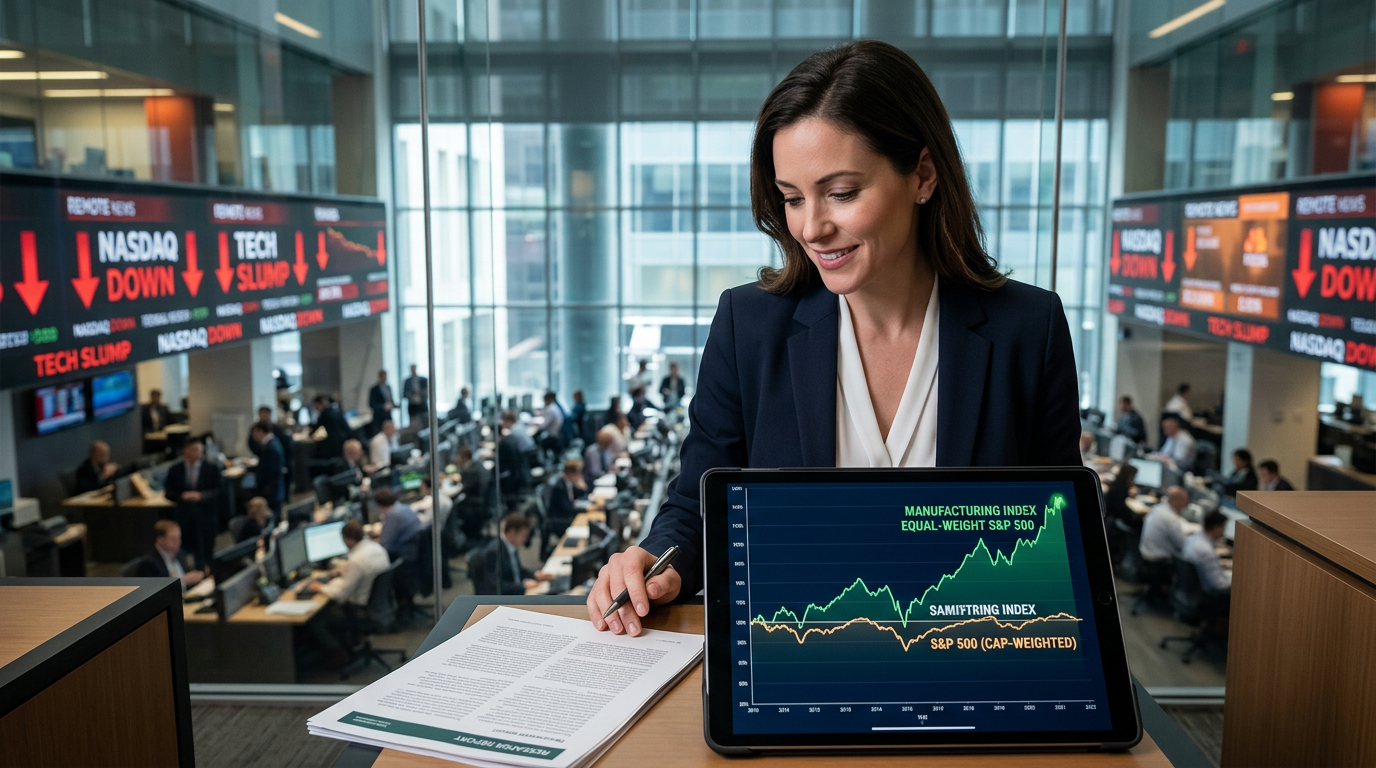
The equal-weighted S&P 500 (RSP) has been gaining ground on its cap-weighted counterpart in 2026. RSP’s quarterly rebalancing mechanism systematically trims momentum winners and adds to laggards, which means every quarter it mechanically sells peak-valuation mega-cap tech and buys the average S&P stock. In a broadening market, that mechanic is a structural tailwind.
Key levels worth monitoring: The Russell 2000 (IWM) has surged over 12% year-to-date and recently traded above 3,000 for the first time. The June reconstitution week added an estimated $150 billion in index rebalancing flows. Post-reconstitution price action will be telling — if small caps hold up after those one-time flows fade, that is signal, not just noise. The 10-year Treasury yield is currently sitting near 4.37-4.40%. That level matters because it defines the rate environment small-cap floating-rate borrowers are operating within. Approximately 32-40% of Russell 2000 debt is floating-rate. Any move higher in the 10-year creates incremental margin pressure that partially offsets the OBBBA benefit. Any move lower would be disproportionately beneficial to small caps relative to large caps.
The breadth signal from April 2026 is historically significant. IWM surged over 11% in April 2026 alone, closing higher in 12 of 13 sessions. Based on 30-plus years of historical data, that kind of post-correction momentum recovery carries a meaningful base rate for continued outperformance over a 12-month horizon. That is a distributional fact, not a prediction. But it is the kind of base rate that disciplined traders do not ignore when building probability-weighted frameworks into Q3.
Scenario Modeling
Bull Case
Q2 earnings from industrials and regional banks confirm OBBBA tax benefit flow-through with quantified guidance. Manufacturing PMI holds above 55 in July’s reading. Treasury yields drift toward 4.20% as PCE inflation stabilizes. Private equity resumes buyout activity in Russell 2000 targets, adding a takeover premium layer to the valuation compression story. The equal-weighted S&P 500 continues to outperform as rotation out of mega-cap tech accelerates. IWM base targets: $300 to $330.
Base Case
Manufacturing PMI softens modestly from its June peak as some of the inventory restocking effect fades but remains above 53. Industrials and financials deliver solid Q2 beats with modest guidance raises. Tech stabilizes but does not reclaim leadership. The rotation continues in waves rather than a clean directional move, with the equal-weighted index slowly compressing the valuation gap to the cap-weighted benchmark. Most probable outcome through August.
Bear Case
PCE inflation is already running at 4.1% headline and 3.4% core as of the latest May 2026 data — well above the Fed’s 2% target. Markets are currently pricing roughly a 62% probability of a Fed rate hike by September. If the 10-year yield breaks above 4.70% in response to a hawkish Fed signal, it reverses the EBITDA-deduction benefit for floating-rate small-cap borrowers. The inventory restocking cycle peaks abruptly, dragging the PMI back below 53. In this scenario, the real economy rotation unwinds sharply and the Russell 2000 returns to the lower end of its 2026 trading range. Primary risk catalyst: A July or September Fed statement that explicitly introduces rate hike language.
Active Trader Framework
The tactical opportunity here is not about chasing any single stock. It is about recognizing that we are in a regime shift that has already produced meaningful returns for those positioned correctly, and that still has multiple quarters of runway if the macro conditions hold.
For traders positioning into Q2 earnings, the highest information content will come from industrial and regional bank earnings calls in mid-to-late July. Listen specifically for quantified commentary on OBBBA tax benefit flow-through and forward capital expenditure guidance. Companies that have clarity on their depreciation benefit and are translating it into accelerated domestic investment are the ones institutional money is moving toward.
Volatility expectations are moderate in this environment. Positioning in RSP over SPY reduces single-stock risk while capturing the breadth theme directly. For those preferring individual names, the IJR ETF (S&P SmallCap 600) applies profitability screens that exclude companies without positive earnings — a quality filter that makes small-cap exposure more durable in a higher-for-longer rate environment. Roughly 40% of IWM constituents are unprofitable. IJR does not have that problem.
Risk management note: A meaningful portion of the June PMI order surge is defensive inventory building, not fundamental demand growth. If that distinction becomes apparent in company-level guidance, the high end of PMI-implied earnings estimates may need revision. Size positions to reflect that ambiguity.
The headline S&P 500 is down 3% in June. The story underneath it is completely different. That divergence between the index you see and the market that is actually moving — that is where the next trade is hiding.