July 6, 2026
Every Factory Being Built Needs to See First
Reshoring created a hidden toll booth. One company sits right in the middle of it.
Summary
- America’s reshoring wave is producing a second-order demand surge in factory automation and machine vision that most investors are not tracking
- Cognex Corporation (NASDAQ: CGNX) is the dominant pure-play in industrial machine vision, coming off its strongest quarterly beat in years
- Q1 2026: Revenue of $268.4M, up 24% year over year, crushing the $246M consensus. Adjusted EPS of $0.34 beat the $0.25 estimate by 36%
- Q2 2026 guidance: $280M-$300M revenue and adjusted EPS of $0.40-$0.44, implying roughly 68% EPS growth year over year at the midpoint
- Adjusted EBITDA margin hit 26.9% in Q1, up 1,010 basis points year over year. That’s seven consecutive quarters of margin expansion
- CGNX trades around $68 as of early July 2026, with a 52-week range of $31.77-$72.88 and a market cap near $11.3 billion. The stock is up roughly 110% over the past year
- Q2 earnings report expected July 28-29, 2026. The consensus average analyst price target is approximately $75-76
- Two new AI vision platforms launched in Q1 2026: the In-Sight 6900 (NVIDIA-powered) and In-Sight 3900 (Qualcomm Dragonwing). Both integrate with the OneVision cloud-to-edge platform
- Defined-risk options structures for the July earnings window are outlined below
- Key risks: valuation at roughly 80x trailing earnings, Asian hardware competition, Apple supply chain exposure, and cycle timing on reshoring capex
Run This 7-Point Check Before Your Next
Ever been right about a stock’s direction and still lost money on the trade?
It happens to almost every beginner. And it’s almost never bad luck – it’s a checkpoint you skipped before you placed the trade.
I put the 7 that matter most on one page.
It’s called the Smart Trade Options Checklist. Normally $29.97. Free today.
Run it before any options trade. About 30 seconds. You’ll catch the bad ones before they cost you.
Start with the force, not the stock.
America is in the middle of the largest domestic manufacturing build-out in a generation. Reshoring and foreign direct investment brought 244,000 announced manufacturing jobs back to the U.S. in 2024 alone — the second-highest annual figure on record — and the pace has not slowed. Since 2010, the cumulative total has surpassed 2 million jobs. That’s not a trend. That’s a structural reset.
Here’s what most investors are missing about those numbers.
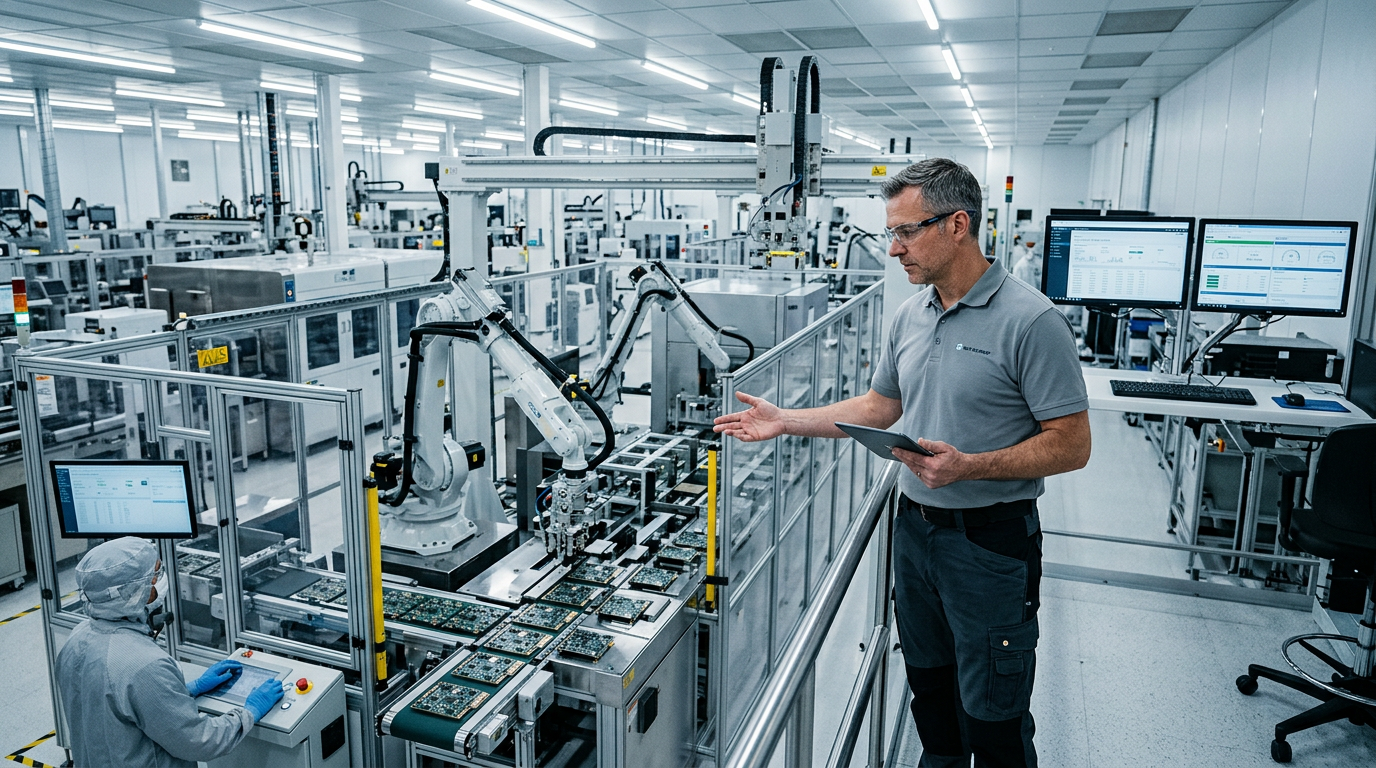
These aren’t assembly line jobs from the 1970s. 88% of the jobs announced in 2024 were classified as high-tech or medium-high-tech manufacturing. These facilities run advanced robotics, AI-driven quality systems, and connected production lines from day one. They don’t hire a hundred workers to inspect parts by hand. They buy machines that see.
That’s the second-order effect nobody is pricing correctly.
The first-order headlines are about which chipmaker is reshoring, which EV battery plant just broke ground, which semiconductor fab just received CHIPS Act funding. Those stories are everywhere. What isn’t in those stories is the infrastructure that every single one of those facilities has to purchase before a single product rolls off the line. And at the very top of that list, quietly and without fanfare, is machine vision.
The Factory Has to See Before It Can Work
Think about what a modern factory actually does. It assembles things, tests things, moves things, and rejects defective things. Every step in that chain requires the facility to perceive its environment with precision that no human worker can match at scale. A robot arm grabbing a semiconductor component needs to know the exact position and orientation of that part. A production line at a battery plant needs to catch a defective cell at 2,000 units per hour without slowing down. A reshored electronics facility producing for a major tech customer needs zero-defect output or it loses the contract.
All of that runs through machine vision: the cameras, sensors, and AI software that give factory equipment the ability to see, identify, inspect, and decide.
The market is not small. The factory automation and machine vision space represented a $90 billion global market in 2024 and is projected to reach $150 billion by 2033, growing at roughly 6% annually. But that top-line figure masks something important: the growth rate is accelerating at exactly the moment when the largest wave of new factory construction in decades is hitting. You’re not just getting baseline demand. You’re getting a pull-forward from thousands of facilities that need to be equipped from scratch.
Slight tangent, but it matters: the labor math is making this worse, not better. The U.S. construction industry requires an estimated 425,000 new workers in 2026 alone just to balance supply and demand in the skilled trades. Manufacturers are facing chronic shortages in exactly the people who would traditionally do manual inspection. That accelerates the decision to automate quality control. Every worker shortage is a machine vision sale.
The Company Most Positioned to Capture It
There’s one company that has been doing this longer than anyone else, holds the dominant market position, and is in the middle of a strategic transformation that Wall Street has been slow to recognize.
Cognex Corporation (NASDAQ: CGNX) is the global leader in industrial machine vision. Its vision systems and barcode readers guide robots, check quality on production lines, and track goods through logistics. The business was built over four decades on a simple proposition: factories need eyes, and Cognex builds the best ones.
For a few years, the stock was in purgatory. The logistics boom of 2021-2022 created outsized demand, then cooled sharply. Consumer electronics and semiconductor customers pulled back. The stock fell roughly 60% from peak to trough, and a lot of investors walked away assuming the cycle had simply peaked.
That assumption is being dismantled in real time.
The Numbers That Change the Conversation
Cognex reported Q1 2026 results on May 6, and the numbers were not subtle. Revenue increased 24% year over year, reaching $268.4 million and surpassing consensus estimates of $246 million. Adjusted EPS of $0.34 beat the $0.25 estimate by 36%. Those are not incremental beats. They represent a genuine inflection in demand.
What’s interesting is the margin story running alongside the revenue story. Adjusted EBITDA margin reached 26.9%, expanding 1,010 basis points year over year, marking the seventh consecutive quarter of margin improvement. Gross margin expanded to 71.1% from 66.8% a year earlier. The business was running lean through the downcycle, and now volume leverage is hitting hard as demand returns.
Management guided Q2 2026 revenue of $280 million to $300 million, with adjusted EPS of $0.40 to $0.44. That EPS range implies roughly 68% year-over-year growth at the midpoint. Adjusted EBITDA margin guided to 28%-31% for Q2, another step up from Q1’s 26.9%. The company also expects to achieve $35-40 million in annualized net cost reductions by end of 2026, which hasn’t fully shown up in consensus models yet.
Four consecutive earnings beats. Seven straight quarters of margin expansion. Adjusted EPS more than doubled year over year in Q1, up 113%. This isn’t a bounce. It’s a rerating in progress.
As of early July 2026, CGNX trades around $68 per share, with a 52-week range of $31.77 to $72.88 and a market cap of approximately $11.3 billion. The stock has more than doubled over the past year. The consensus average price target across 29 analysts sits near $75-76, with KeyBanc at $80, Bernstein and Stephens at $75, and Truist at $71. The full-year 2026 revenue consensus has moved to roughly $1.07 billion.
The AI Layer That Makes This More Than a Cyclical Recovery
The part people are underweighting is what Cognex just built on top of its hardware business.
In Q1 2026, the company launched two AI vision platforms: the In-Sight 6900, powered by NVIDIA Jetson technology, and the In-Sight 3900, an embedded AI vision system powered by Qualcomm Dragonwing platforms. Both integrate with OneVision, Cognex’s cloud-to-edge AI ecosystem, which allows manufacturers to develop and deploy vision models once and push them across hundreds of global production sites simultaneously. More than 100 customers globally have used OneVision since its June 2025 beta launch, and adoption is accelerating from single-line pilots to multi-site rollouts.
Here’s where it gets interesting. The historical bottleneck in machine vision wasn’t the hardware. It was the deployment. You needed specialized engineers to program the detection rules for every single inspection task. That constraint limited how broadly vision could be deployed, especially in smaller facilities. OneVision’s Edge Learning platform is eliminating that bottleneck: a line operator presents a handful of good parts and bad parts to the camera, and the device trains itself in minutes. No data scientist required.
That changes the addressable market. Millions of inspection points that were previously too expensive to automate are suddenly viable. And Cognex is building the ecosystem lock-in to own that expansion.
CEO Matt Moschner at Automate 2026 in Chicago stated plainly that the company’s objective is to become the number one provider of AI-powered machine vision. That’s not repositioning language. That’s a description of what the product roadmap now actually supports.
A U.S. “birthright” claim worth trillions – activated quietly
A tiny government task force working out of a strip mall just finished a 20-year mission.
And with almost no media coverage, they confirmed one of the largest U.S. territorial expansions in modern history…
A resource claim worth an estimated $500 trillion.
Thanks to sovereign U.S. law, this isn’t just a national asset.
It’s an American birthright.
That means every citizen now has the legal right to stake a claim…
But very few even know the opportunity exists.
If you want to see how you can get in line for your portion of this record-breaking windfall…
I’ve assembled everything you need to see inside a new, time-sensitive briefing:
Get all the details here – while the claim window remains open.
Why Isn’t CNBC Talking About This
Fair question. A few reasons.
First, Cognex is an $11 billion market cap company: large enough to avoid the speculative conversation, small enough to miss the mega-cap coverage cycle. It doesn’t make headlines at a scale that feeds the algorithm.
Second, the last story attached to Cognex was the logistics boom collapse. Investors who got burned in 2022-2023 aren’t in a rush to revisit. The mental model is stale.
Third, the real story here is derivative. Cognex doesn’t benefit directly from a tariff announcement or a chip fab groundbreaking. It benefits three steps later, when that facility needs to be equipped. Those second-order effects take months to show up in order books, and Wall Street is not patient enough to track them before they materialize in earnings.
The reshoring build-out is creating a multi-year capex cycle across thousands of domestic manufacturing facilities. Every one of them needs vision systems. Many of them are being designed from scratch with automation at the core. That’s not a quarterly story. It’s a structural demand driver that hasn’t been fully reflected in a stock still trading below its 2021 peak.
Options Market Context
Cognex’s Q2 2026 report is scheduled for July 28-29. Management guided a range of $280 million to $300 million in revenue, with adjusted EPS of $0.40-$0.44. The stock moved roughly 8-9% following the Q1 beat on May 6, and has gained approximately 40% since the end of March as the market gradually adjusts to the new fundamental picture. CGNX carries a beta near 1.5, and with earnings less than four weeks out, implied volatility in near-term options is beginning to expand.
What’s interesting is that the options market has been pricing in meaningful move potential around upcoming catalysts. A November 2026 $40 Call recently registered among the highest implied volatility readings across all equity options, signaling traders are positioning for continued price movement well beyond the near-term earnings window.
For traders evaluating structure ahead of the July 28-29 report, here is a breakdown of three defined-risk frameworks based on different directional views. These are analytical templates only, not recommendations.
Defined-Risk Trade Framework
Bull Case: Long Call Vertical (Debit Spread)
For traders expecting CGNX to continue higher through and after the Q2 report.
- Structure: Buy the August 15, 2026 $70 Call / Sell the August 15, 2026 $80 Call
- Rationale: With the stock near $68, this spread positions for a move toward and through the average analyst price target cluster of $75-80 following a strong Q2 beat. The short $80 call caps upside but funds most of the premium cost
- Max gain: $10.00 per share ($1,000 per contract) if CGNX closes at or above $80 at expiration
- Max loss: Net debit paid (typically $2.50-$4.00 depending on IV at entry), fully defined
- Break-even: $70 plus net debit paid at entry
- Key variable: If Q2 revenue hits the high end of guidance ($300M) and margins continue expanding, the $80 target becomes plausible within the August expiration window
- IV consideration: Enter before the final pre-earnings IV expansion spike. Spreads are less sensitive to IV crush than outright long calls because the short leg offsets some of the vol decay
Bear Case: Long Put Vertical (Debit Spread)
For traders expecting a miss, guidance cut, or macro-driven selloff around Q2 results.
- Structure: Buy the August 15, 2026 $65 Put / Sell the August 15, 2026 $57 Put
- Rationale: At roughly 80x trailing earnings, CGNX does not have much room for disappointment. Any miss on revenue or a guidance reduction would likely compress the multiple quickly. The $65/$57 spread captures a retracement toward the pre-Q1 trading range
- Max gain: $8.00 per share ($800 per contract) if CGNX closes at or below $57 at expiration
- Max loss: Net debit paid (typically $2.00-$3.50), fully defined
- Break-even: $65 minus net debit paid at entry
- Key variable: Watch macro backdrop into earnings. A broad industrial demand slowdown or tariff escalation affecting capital spending would increase downside probability
Neutral / Vol Case: Iron Condor
For traders who believe the stock stays range-bound after an in-line Q2 report and IV compresses post-earnings.
- Structure: Sell the $75 Call / Buy the $80 Call (short call spread) AND Sell the $62 Put / Buy the $57 Put (short put spread), same August 15 expiration
- Rationale: Collects premium from both sides. Profitable if CGNX stays between $62 and $75 through expiration. CGNX’s 52-week high is $72.88, so the $75 short call sits above recent resistance
- Max gain: Total net credit received if stock closes between $62 and $75 at expiration
- Max loss: Width of either spread ($5.00) minus net credit received, on either side
- Break-even: Net credit collected defines the upper and lower break-even prices
- Key variable: IV crush post-earnings is the primary profit driver. If CGNX reports in-line and gaps less than 8-10%, both short legs expire worthless and the credit is retained
- Note: CGNX is more volatile than 75% of U.S. stocks, typically moving around 5% per week. Size positions accordingly
All three structures above use August 15 expiration to capture the post-earnings move while allowing time for the reaction to play out. Verify current bid/ask spreads and live implied volatility before entering any position. Option prices change rapidly in the days before an earnings report.
The Playbook Every Options Trader Should Have!
Do you dream of retirement but it seems like an impossibility? Wish you knew the best moves to get you there sooner?
It’s closer than you think and you won’t have to work overtime to get it!
Hi! I’m Dave Aquino, expert options trader and my e-book, “How To Master the Retirement Trade” has helped thousands reach their goals!
Follow the link to get your copy and see what you’ve been missing!
Risk Factors
- Valuation: CGNX trades near 80x trailing earnings and roughly 56x normalized earnings. The bull case depends entirely on forward execution. Any stumble in Q2 guidance compresses the multiple fast
- Competition: Asian machine vision competitors are undercutting on hardware pricing. The OneVision ecosystem is the moat, and its durability depends on execution of the software transition
- Customer concentration: Cognex has historically had meaningful exposure to the Apple supply chain. Any iPhone production shift creates near-term volatility
- Cycle timing: Reshoring facilities take 18-36 months from groundbreaking to equipment purchase. The full demand pull may not hit until 2027-2028. The stock may be pricing some of that forward already
- Macro sensitivity: CGNX carries a beta of roughly 1.5. In a broad risk-off move, it will fall harder than the market. Capital expenditure spending by manufacturers is the first thing cut in a slowdown
- Management guided caution on H2 visibility: Despite strong Q1 and Q2 guidance, management maintained a cautious tone on the second half of 2026 due to macro uncertainty and limited order book visibility beyond the current quarter
The part people skip: Cognex is the only pure-play, publicly traded, large-scale AI machine vision company in North America. Every robot deployed in every reshored factory needs guidance. Every automated quality inspection line needs eyes. The physical AI wave Jensen Huang keeps talking about runs on sensor infrastructure that Cognex has spent four decades perfecting.
The factory of the future is getting built right now. It just needs to see first.
Action Checklist
- Mark July 28-29, 2026 on your calendar. That is the expected Q2 earnings window. Watch revenue vs. the $280-300M guidance range and EBITDA margin vs. the 28-31% target
- Monitor IV expansion in CGNX options over the next two weeks. As earnings approach, implied volatility typically rises. Debit spreads become relatively more attractive earlier; credit structures improve after the event
- If considering a bull call spread, the $70/$80 structure using August 15 expiration keeps max loss fully defined while targeting the analyst consensus price target range
- Track OneVision customer expansion numbers. Management has cited 100-plus customers in beta. Any Q2 commentary on accelerating multi-site rollouts is a forward indicator for software revenue growth
- Watch for H2 2026 guidance tone. The company has been cautious on second-half visibility. An upgrade to full-year guidance on the Q2 call would be a meaningful positive catalyst
- Check gross margin direction. Q1 came in at 71.1%. If Q2 holds above 70%, operating leverage continues compounding. A drop below 69% would be a yellow flag
- Size all options positions with defined-risk structures only. CGNX moves roughly 5% per week under normal conditions. Earnings windows can produce outsized moves in either direction