
July 16, 2026
VLO Call Flow Is Leaning August
The strike and timing point to a longer window than earnings day.
Hey Trader,
Before the market opens again, read this…
My top trader, Thomas Wood, just released a new strategy he calls Opening Bell Trades.
This simple system is designed specifically to help regular investors generate income from his #1 trade setup.
I’m talking about finding monster winners like these…
- 113% on GOOGL
- 240% on META
- 70% on CAG
- 37% on MCD
- 139% on GLD
Best of all, he looks for these trades every morning starting at 9:30 AM and by 10 he’s done.
Everything you need to know about how this works is in a free report called “The Opening Bell Trade Guide”…
Take a few seconds and download FREE right now before this link stops working.
This report won’t be free forever, so grab it now while you can.
Once it’s on your computer, you’ll have it for good-no matter what we charge other traders for it later.
No credit card required. No strings attached.
>> Get Your FREE “Opening Bell Breakouts” Trade Guide Here
This guide shows you the exact 15-minute window trade he uses, and how to spot the setups the big funds are watching.
FREE: Discover One Simple Options Trade You Can Make Each Morning – and Be Done by 10 AM.
To better trading,
Drew Day
Founder & CEO
Base Camp Trading
P.S. Inside, you’ll see why Thomas uses weekly options and how to use them to trade stocks like GOOGL, META, and TSLA with as little as $75. Go here to save a copy of the “Opening Bell Trade Guide” before its taken down.
VLO Call Flow Is Leaning August
The options market is doing that thing again where it stops whispering and starts pointing.
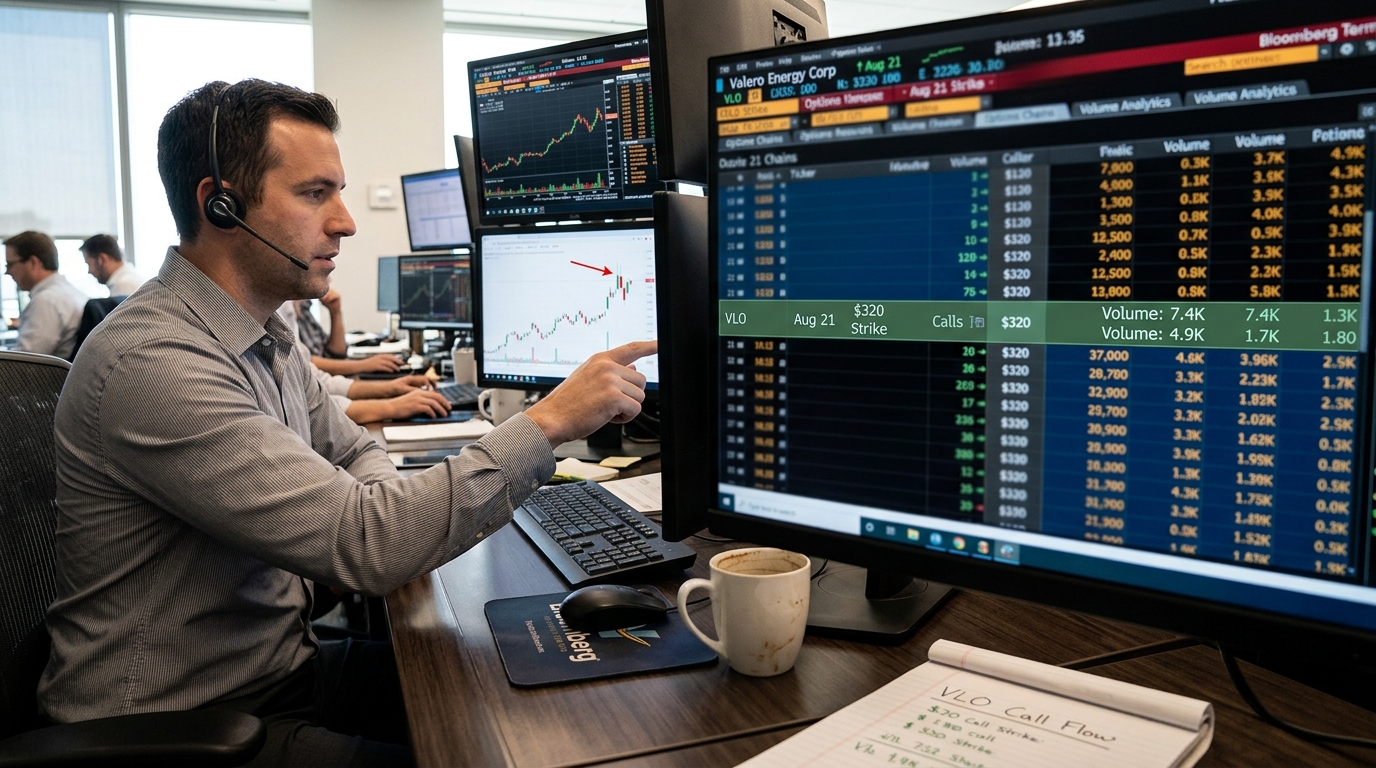
Not in some tiny, illiquid name either. In Valero (VLO), a cluster of Aug 21 $320 calls traded in size late on July 15, with the reported volume massively outpacing existing open interest. The same strike showed up more than once, including blocks around 4,900 contracts and 7,400 contracts in the Benzinga unusual activity feed. That kind of repeat behavior matters more than a single headline trade because it suggests intent, not a one-off punt. ([benzinga.com](https://www.benzinga.com/calendars/unusual-options-activity))
The signal
The “tell” here is the calendar choice.
Valero is expected to report Q2 results on July 30, 2026 before the open. If someone only cared about the earnings pop, you would normally expect the action to concentrate in the weekly options expiring July 31 (or even July 25, if positioning early). Instead, the flow showing up in August is a different bet: it buys time for a second step after earnings, like guidance digestion, macro oil movement, crack spread shifts, or just a gradual rerating that takes weeks, not hours. ([tipranks.com](https://www.tipranks.com/stocks/vlo/earnings?utm_source=openai))
Why it matters
When you see far out-of-the-money calls trade with extreme volume versus open interest, the easy mistake is to read it as “someone knows VLO is going vertical.” That is rarely the clean truth.
It can also be part of a multi-leg structure where the calls are only one visible component. It can be overwriting against stock. It can be a volatility position. But regardless of motive, it is still a message about attention and time horizon. The strike is aggressive, the expiry is patient.
The company behind the signal
Valero is a refining and fuels business, so the stock’s “fundamentals” in any single quarter tend to be less about a tidy product story and more about commodity-linked operating conditions. That makes it a natural options vehicle for investors who want convex exposure to a macro swing without committing to a large common-stock position.
The most recent confirmed company-reported numbers (Q1 2026) show Valero reported net income attributable to shareholders of $1.3 billion, or $4.22 per share, versus a loss in Q1 2025. The company also raised its quarterly dividend to $1.20 per share (announced Jan. 22, 2026). Those facts matter because they anchor the “floor” story: this is not a distressed equity where options activity is just binary survival math. ([investorvalero.com](https://investorvalero.com/news/news-details/2026/Valero-Energy-Reports-First-Quarter-2026-Results/default.aspx?utm_source=openai))
Market expectations
For earnings specifically, the options market is currently implying a move of about 7.9% into the July 31 weekly expiration around the July 30 report, according to Optionslam’s earnings move estimate. That is the market’s baseline “earnings risk budget.” ([optionslam.com](https://www.optionslam.com/earnings/weekly/VLO?utm_source=openai))
Now zoom out a bit. The unusual calls that drew attention are dated Aug 21. That is deliberately beyond the earnings week. So the real question is not “is 7.9% too high or too low?” The better question is: what path is being priced for the 3-week window after the earnings event, and is the market underestimating how long the post-earnings drift can last when the macro backdrop cooperates?
One more detail that frames the risk: expected-move estimates by expiration also show the market is continuously repricing uncertainty across the curve, with near-term ranges much tighter than the earnings week. That term structure shape is exactly where calendar and diagonal structures can either shine or quietly fail, depending on how volatility behaves after the report. ([thetaowl.com](https://thetaowl.com/options/VLO/expected-move?utm_source=openai))
Strategic considerations
Here’s where I’m at: the August timing makes me think the cleanest way to interpret the flow is not “all-in lotto calls,” but “define risk and own time.” That leans toward spreads, not outright long premium at a single strike.
If you believe the market is underestimating how long a bullish post-earnings move can persist, a defined-risk call debit spread dated after earnings (for example, in the Aug 21 cycle) can express that view while avoiding the unlimited premium burn of chasing far out-of-the-money calls. The trade-off is obvious: you cap upside. But you also reduce volatility and time-decay sensitivity compared with a naked long call.
If, instead, you think the options market is overpaying for earnings week fear and the stock is likely to stay in a range after the number, defined-risk premium-selling structures can fit better, but only if you are comfortable with the reality that earnings can gap through “reasonable” ranges. (This is not the place for false comfort.)
- Long premium view: post-earnings drift higher into mid-August, with volatility holding up longer than usual.
- Range view: earnings resolves uncertainty quickly and volatility comes in hard after the report.
- Bearish view: earnings week move is fine, but guidance or margins disappoint and the stock fades in early August.
Key risks
- Volatility crush risk: even if the stock moves in your direction, option premiums can deflate after earnings.
- Path risk: the stock can move “event-correct” but too slowly for long calls to pay.
- Macro risk: refiners can trade with crude, product cracks, and rates in ways that overwhelm the company-specific quarter.
What to watch
Between now and July 30, I’d watch for three confirming signals:
- Does open interest grow at or near that Aug 21 $320 line after July 15, suggesting the volume was opening, not closing?
- Does implied volatility stay bid in the August line, not just in the earnings week? That would support the “longer window” read.
- Do we see related flow in peers or in energy ETFs, suggesting a sector expression rather than a single-name bet?
Slight tangent, but it matters: when the flow picks a month past earnings, I stop treating it like an earnings trade and start treating it like a volatility-and-time-horizon trade. Different scorecard. Different mistakes.
Worth a look: pull up VLO’s chain for Aug 21, check how the call skew behaves as you move from ATM to those higher strikes, and see whether the market is quietly paying more for upside than it was a week ago.
– Options Trading Report