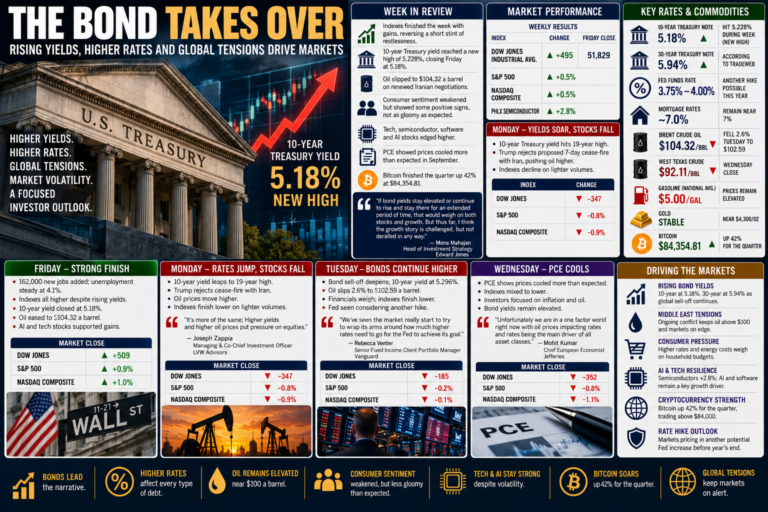
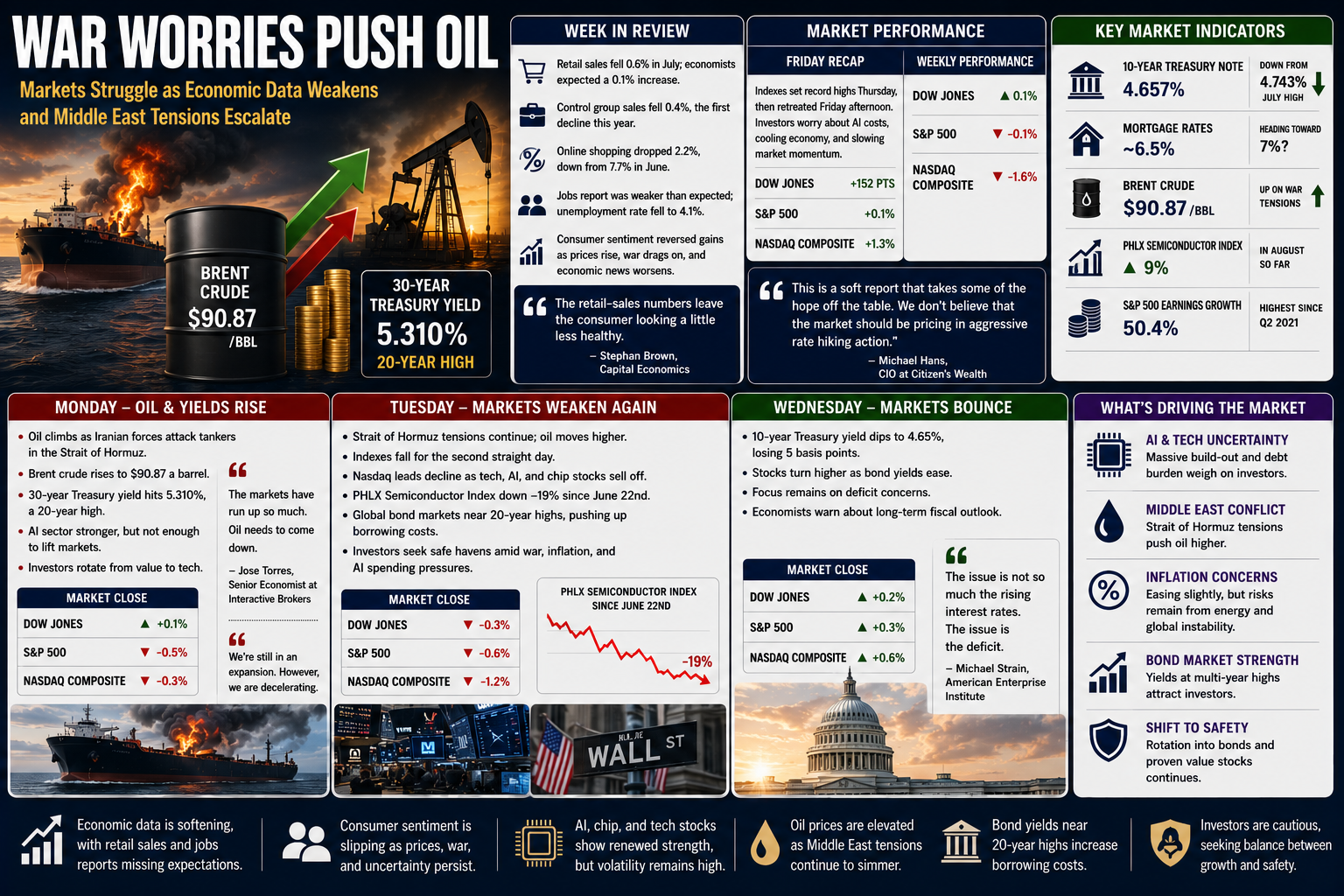
The Commerce Department on Friday reported retail sales slipped 0.6% last month. Economists had predicted a 0.1% increase. Coupled with the weaker jobs report, “negative economic data,” and a slight decrease in inflation, expectations for a Fed rate adjustment cooled. “Sales in the ‘control group’ categories of everyday products that economists track closely fell by 0.4%, the first such decline this year,” as noted by Wall Street Data. Online shopping fell 2.2% in July, down from a 7.7% sales increase in June, alarming economists. According to Stephan Brown, an economist at Capital Economics; “The retail–sales numbers leave the consumer looking a little less healthy.” Adding to the recent negative economic concerns, The University of Michigan’s monthly survey showed consumer sentiment “has reversed recent gains so far this month, “as price increases, the lingering war and negative economic news” plagues the U.S. shoppers.
Stocks retreated Friday afternoon with all three indexes setting record highs on Thursday. Both the Dow Jones Industrial Average and heavy–tech Nasdaq Composite skidded lower as investors and traders languished over prolonged artificial intelligence financial concerns and an cooling economy fearing a loss of stock–market momentum.
Oil and bond yields climbed…stocks declined on Monday’s open. Market worries spilled over to all sectors gripping U.S. investors. Brent crude rose to $90.87 a barrel, pushed higher as a result of the Strait of Hormuz skirmishes by Iranian forces attacking several tankers. There was no U.S. response, irritating many area countries, as President Trump ‘stood pat’ electing to use diplomatic means rather than military action. The benchmark 30–year Treasury note yield reached a 20 high of 5.310%, (Yields rise when bond prices fall). “The markets have run up so much. Oil needs to come down,” said Jose Torres, senior economist at Interactive Brokers. He added, “If oil doesn’t come down, then rates stay too elevated and we are subject to a correction.” The Artificial intelligence sector was stronger Monday, however it was not enough to boost the markets as the indexes struggled all session. The blue–chip Dow Jones index was a victim of rotation as investors leaving value stocks increased, moving to AI and heavy techs. For the day the indexes were flat, with both the S&P 500 and Nasdaq off 0.5% and 0.3% respectively. The Dow Jones finished up slightly. Quarterly retail sales figures have come in sluggish with several large–cap retailers yet to report expected weaker numbers. Several economists have noted signs of ‘cracking’ in economic growth, suggesting the Fed will need to respond to the trend. As Jose Torres said; “We’re still in an expansion. However, we are decelerating.”
Stocks were weaker Tuesday with all three indexes falling. The Nasdaq led the decline, off 1.2% as techs and AI and semiconductor stocks sold off. The PHLX Semiconductor Index was down, now off 19% since June 22nd. The exploding Bond markets, domestic and worldwide, are all near 20 year highs, driving up borrowing costs across the board affecting governments, businesses and consumers. Bond ‘safety’ has become a stalwart for many investors as the Middle East conflict, creeping inflation, and the AI build–out pressures force investors and traders to seek ‘safe–havens’ of investments. Stocks turned positive Wednesday with bonds the focal point as the 10–year Treasury note yield dipped to 4.65%, losing 5 basis points. There are continuing concerns about the growing deficit as Michael Strain, director of economic policy studies at American Enterprise Institute said; “The issue is not so much the rising interest rates. The issue is the deficit. If we can only be concerned about one thing, that one thing should be the 10–year deficit outlook.”
RUMBLINGS ON THE STREET
Mark Hackett, Chief market strategist at Nationwide, WSJ – “The earnings are about as good as we’ve seen. The breadth of the strength is incredibly wide. Plus, you have this almost built–in buy-the-dip mentality of investors that’s really a good sign for bulls.”
Jay Hatfield, Chief executive officer and portfolio manager at Infrastructure Capital Advisors, WSJ – “Rate hikes are off the table, but rate cuts are also off the table. We need rate cuts to really fuel the S&P to our target of 9000. Otherwise we’ll probably stall out in the low 8000,s.
Jeff Buchbinder, Chief equities strategist at LPL Financial, WSJ – “The 10–year yield has remained uncomfortably high. While that is good for the bond buyers, stock investors would prefer they keep drifting lower.”