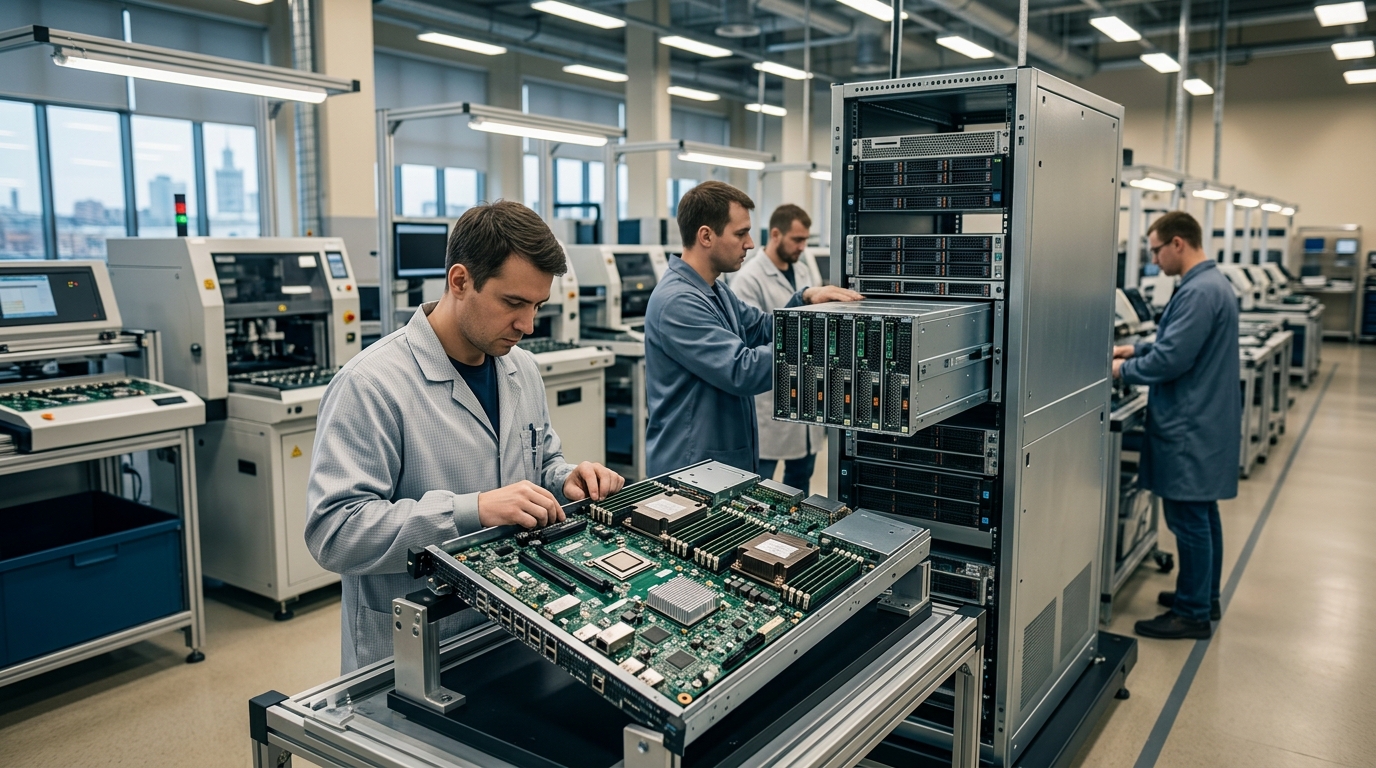
Jabil is not a household name. It is the company that builds the hardware your household name hyperscalers run their data centers on. And right now, that is exactly the kind of business the market rewards.
The St. Petersburg-based electronics manufacturing services provider is expected to report its fiscal Q4 2026 results before the open on September 24. Wall Street is looking for approximately $4.06 in EPS on roughly $9.6 billion in revenue, which would represent another strong year-over-year advance. Over the prior three quarters, Jabil beat EPS estimates in each one, and its full-year fiscal 2026 guidance now stands at $35 billion in revenue and $12.70 in core EPS.
That $35 billion guide is up from approximately $32.4 billion earlier in the fiscal year, reflecting multiple guidance increases driven largely by one segment: Intelligent Infrastructure, which houses AI-related programs, networking, and data center work. In Q3, that segment grew 21% year over year. Core margin in the segment hit 6.1%, 80 basis points above the prior year.
The AI Revenue Story
Management raised its fiscal 2026 AI-related revenue target to approximately $13.6 billion in June, $500 million above what it had forecast in March. Jabil also said it won its third hyperscale customer in Q3, expected to generate initial revenue in the hundreds of millions in fiscal 2027 before expanding toward $1 billion and beyond in fiscal 2028.
Management said on the Q3 call that fiscal 2027 AI revenue growth in percentage terms should be similar to fiscal 2026’s roughly 50%. That is a preliminary view, not formal guidance, and full fiscal 2027 numbers are expected to come with the September 24 report. But 50% growth off a $13.6 billion base would imply around $20 billion in AI-related revenue next year, a figure that would make Jabil’s Intelligent Infrastructure segment a dominant driver of the entire business.
Adjusted free cash flow for fiscal 2026 is expected to exceed $1.4 billion, raised from the prior guidance of more than $1.3 billion. The company has also said it intends to complete its current $1 billion share repurchase authorization in fiscal 2026.
What Could Go Wrong
Jabil’s overall Q3 result beat consensus, but the stock slipped briefly after the announcement, a reminder that the market has already priced in significant AI execution. Supply chain challenges in high bandwidth memory and high-density interconnect PCBs remain a constraint. The automotive segment is still volatile, and Connected Living and Digital Commerce face a mixed consumer environment.
Any signal in the September 24 report that hyperscaler customers are delaying orders or that AI infrastructure spending is pausing would reset the FY2027 growth expectations that currently support the stock.
The Bottom Line
The September 24 report matters not just for Q4 numbers but because it is expected to include the first formal fiscal 2027 guidance. Jabil has earned credibility with three consecutive beat-and-raise quarters, a third hyperscaler added, and an AI revenue forecast lifted at multiple updates this year. If the FY2027 AI revenue trajectory holds at or near the 50% growth rate management signposted, this stock has a re-rating argument. The report in 18 days is when that case gets tested or confirmed.