Skip to content
Options Trading Report

Options Trading Report

Primary Menu
  • Home
  • Business
  • Economy
  • Top News
  • Newsletters
  • Home
  • 2026
  • September
  • Everyone remembers January’s silver spike. Then what?
  • Newsletters

Everyone remembers January’s silver spike. Then what?

Editor September 29, 2026 4 minutes read
712c3677-d5e1-40fb-9057-30ea99be373b

September 29, 2026

Bonus Content: Dark Stores Are Taking Over Retail Space. The Math Explains Why.


A note from our friends at i2i Marketing Group(ad)

Silver is up more than 50% in a year. Nobody is watching.

Silver ran to a record in January and half the world noticed. Then it gave back roughly half the move, and most of them left.

One explorer continued working while the crowd was elsewhere.

See what they are onto!


Bonus Article

Dark Stores Are Taking Over Retail Space. The Math Explains Why.
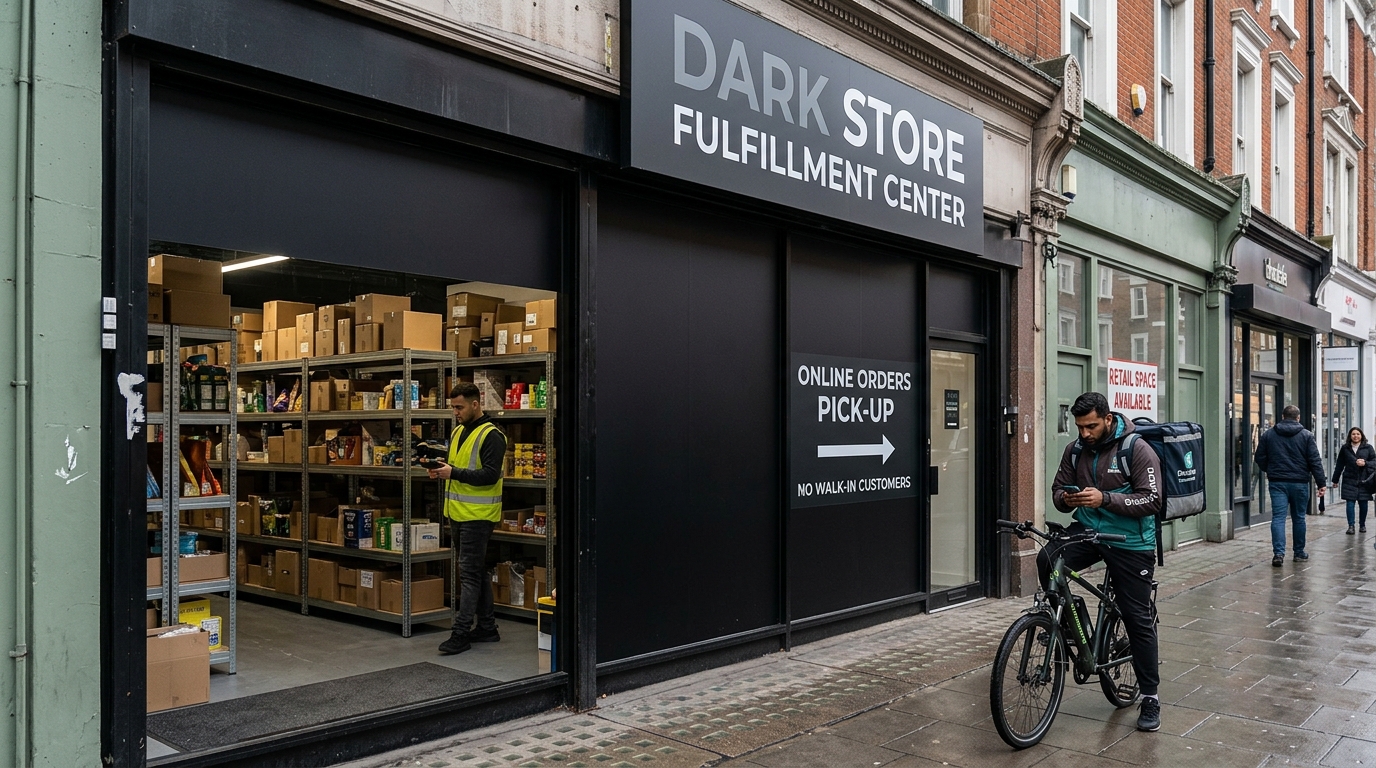
The storefront is still there. The address is the same. But the lights are off, the aisles are rearranged for picking speed rather than browsing, and no customer will ever walk through the door again. This is not a story about retail failure. It is a story about deliberate conversion, and it is accelerating faster than most real estate investors have priced in.

Credible forecasts do not support a single clean set of numbers for the global dark store market in 2025 to 2026, but they do agree on the direction: rapid growth. For example, Grand View Research estimates the global dark store market at about $15.27 billion in 2023 and projects roughly $129.25 billion by 2030. Other market trackers cluster in the same broad range for 2030, but the point is consistent: the category is scaling from “pilot” to “infrastructure.” Those figures are not driven by niche operators. Walmart, Amazon, Kroger, and Target are commonly cited as major competitive forces reshaping this segment right now.

Amazon’s move is the sharpest signal. In May 2026, Amazon rolled out its 30-minute delivery service, Amazon Now, making it widely available in Atlanta, Dallas-Fort Worth, Philadelphia, and Seattle, with availability also expanding into parts of dozens more cities including Austin, Denver, Minneapolis, and Phoenix. Prime members pay $3.99 per order, with an additional small-order fee on carts under $15. The infrastructure behind that promise is a network of smaller, local fulfillment nodes placed close enough to reduce the last-mile cost that destroys margin at longer distances.

The labor math is unambiguous. A picker navigating a live supermarket aisle assembles roughly 60 to 80 units per hour. A dark store can push that to about 120 to 150 units per hour, and more automated micro-fulfillment systems can run faster still. That gap, multiplied across thousands of weekly orders, is the difference between a grocery delivery operation that bleeds margin and one that survives. Grocers that treated delivery as a bolt-on to existing stores encountered a structural ceiling: in-store picking clogs aisles, competes with walk-in customers, and caps throughput at a level that cannot support same-hour economics.

The commercial real estate consequence is measurable, but it is not uniform by market. Research firms tracking industrial fundamentals have repeatedly flagged small-bay infill space as an outlier: infill warehouses roughly in the 10,000 to 50,000 square foot range have been running at mid-single-digit vacancy rates, materially tighter than larger bulk industrial. Vacant big-box footprints are being converted into fulfillment hubs as landlords chase the tenant category that is still expanding its square footage requirements. A single automated MFC is commonly cited in the low single-digit millions up to the high single-digit millions in capital cost, which means operators with real balance sheets are the ones signing leases, not marginal tenants.

The model does have a structural ceiling of its own. Quick-commerce dark stores often carry roughly 1,500 to 4,000 SKUs, a fraction of a full supermarket’s assortment. When orders spike unexpectedly, a constrained node cannot absorb the volume. Scaling requires adding locations rather than expanding any single footprint, which compounds real estate costs across dense urban grids where the best sites are already spoken for.

What this shift means for retail real estate is not a simple vacancy crisis. It is a reclassification. The question property assessors, zoning boards, and REIT managers have not yet answered cleanly: is a micro-fulfillment center inside a former supermarket industrial space or retail space? That classification determines tax treatment, permitted use, and lease comparables. The market has moved faster than the regulatory framework has followed, and that gap is where near-term risk concentrates for investors holding legacy retail assets in dense urban corridors.


Post navigation

Previous: Raytheon and Lockheed Have the Orders. Missiles Lag
Next: Five Numbers That Could Reset October Rate Odds

Related Stories

51f8488a-b36c-4bee-9931-8b588484504f
  • Newsletters

Carnival Reports Today. The Quarter Is Not the Problem.

Editor September 29, 2026
61ae1509-c984-4deb-83ad-4c78a072963c
  • Newsletters

Your Retirement Is at Risk Here’s How to Protect It

Editor September 29, 2026
ea802198-68e5-4759-8b35-c648e6ab1923
  • Newsletters

Warner Bros. Is Pinned to a $31 Deal Price as a Judge Weighs Approval

Editor September 28, 2026

Live Market Pulse

The charting technology is provided by TradingView. Learn how to use theTradingView Stock Screener.

Want More Market News?
Add your email address below to get up to date market news and more!
By submitting your email address, you'll receive a free subscription to Options Trading Report newsletter (Privacy Policy). These newsletters are completely free - and always will be. You will also receive occasional offers about products and services available to you from our affiliates. You can unsubscribe at any time.

Recent Posts

  • Carnival Reports Today. The Quarter Is Not the Problem.
  • Your Retirement Is at Risk Here’s How to Protect It
  • Five Numbers That Could Reset October Rate Odds
  • Everyone remembers January’s silver spike. Then what?
  • Raytheon and Lockheed Have the Orders. Missiles Lag
  • Warner Bros. Is Pinned to a $31 Deal Price as a Judge Weighs Approval
  • See the #1 Company to Own Before December 8th

Search

Categories

  • Business
  • Economy
  • Market News
  • Newsletters
  • Top News

You may have missed

51f8488a-b36c-4bee-9931-8b588484504f
  • Newsletters

Carnival Reports Today. The Quarter Is Not the Problem.

Editor September 29, 2026
61ae1509-c984-4deb-83ad-4c78a072963c
  • Newsletters

Your Retirement Is at Risk Here’s How to Protect It

Editor September 29, 2026
2ae59444-ab23-45a7-8d91-3f5dd1668d6b
  • Economy

Five Numbers That Could Reset October Rate Odds

Editor September 29, 2026
712c3677-d5e1-40fb-9057-30ea99be373b
  • Newsletters

Everyone remembers January’s silver spike. Then what?

Editor September 29, 2026
  • About Us
  • Disclaimer
  • Privacy Policy
  • Terms of Service/Use Agreement
  • Contact Us
Copyright 2026 © All rights reserved | Options Trading Report | optionstradingreport.com SITE_OK
Manage Consent
To provide the best experiences, we use technologies like cookies to store and/or access device information. Consenting to these technologies will allow us to process data such as browsing behavior or unique IDs on this site. Not consenting or withdrawing consent, may adversely affect certain features and functions.
Functional Always active
The technical storage or access is strictly necessary for the legitimate purpose of enabling the use of a specific service explicitly requested by the subscriber or user, or for the sole purpose of carrying out the transmission of a communication over an electronic communications network.
Preferences
The technical storage or access is necessary for the legitimate purpose of storing preferences that are not requested by the subscriber or user.
Statistics
The technical storage or access that is used exclusively for statistical purposes. The technical storage or access that is used exclusively for anonymous statistical purposes. Without a subpoena, voluntary compliance on the part of your Internet Service Provider, or additional records from a third party, information stored or retrieved for this purpose alone cannot usually be used to identify you.
Marketing
The technical storage or access is required to create user profiles to send advertising, or to track the user on a website or across several websites for similar marketing purposes.
  • Manage options
  • Manage services
  • Manage {vendor_count} vendors
  • Read more about these purposes
View preferences
  • {title}
  • {title}
  • {title}