Markets don’t need a surprise to gap. They only need one metric to miss the story the price already assumes. For Tesla heading into Wednesday’s close, that metric is not earnings per share. It is not revenue. Both are largely solved. The company delivered 486,532 vehicles in Q3, with Wall Street expecting adjusted EPS of $0.45.
Tesla reports Q3 results on Wednesday, October 21, after market close, with the conference call scheduled for 5:30 PM ET. Ahead of the earnings, Tesla stock rose in Friday’s pre-market trading after the October 15 unveiling of its second-generation Roadster. The new Roadster uses SpaceX thruster technology to hover in the air, though Musk said the vehicle would not enter production until 2028 and did not reveal a price. That caveat matters: the Roadster is theater, not revenue. Wednesday’s call is where the numbers meet the story.
What the Data Actually Says
In the same quarter a year ago Tesla reported $0.50 per share on revenue of $28.10 billion. Last quarter it posted $0.33 per share and missed consensus, with operating margin falling to 1.4%. Against that low bar, consensus for Q3 implies some recovery, with EPS of $0.45 representing a 10% year-on-year decline on revenue essentially flat to prior-year levels.
Tesla delivered 486,532 vehicles in Q3 2026. After Q2’s disappointing drop in automotive gross margin (ex-credits) to 16.3% and free cash flow turning negative at about $1.1 billion, Tesla needs to prove that weakness was a one-off. Capital expenditure is expected to exceed $25 billion for fiscal 2026, with management explicitly pointing to AI initiatives and infrastructure as key drivers. The delivery print cleared the low hurdle. Margin and cash burn are what Wednesday prices.
The Re-Rate Variable
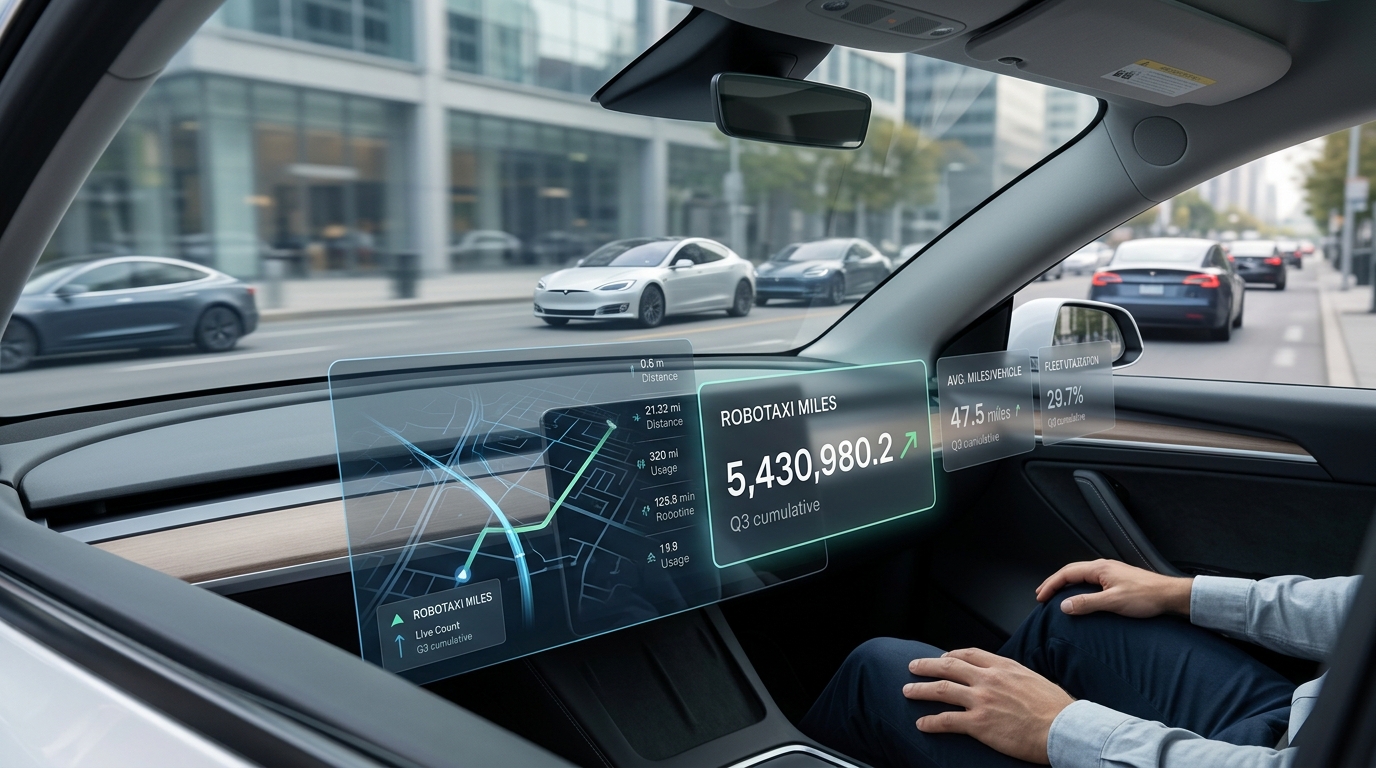
This is not about cars. It is about cumulative paid robotaxi miles, and how fast that number is compounding. Tesla previously reported cumulative paid robotaxi miles reaching roughly 1.7 million by the end of Q1 2026, and investors will look for the Q3 update to show meaningful sequential acceleration. Robotaxi rollout continued in the U.S. and the company has discussed operating across multiple cities. Active FSD subscriptions expanded to about 1.48 million by Q2 2026, and Tesla has said roughly 55% of its North American deliveries had an FSD subscription enabled at delivery.
At roughly $1.4 trillion in market capitalization, TSLA is not trading on $0.45 in quarterly EPS. It is trading on a software-and-autonomy multiple that requires exponential robotaxi scaling to justify. Robotaxi and FSD are scaling, but monetization is still nascent; investors will look for updates on regulatory progress, fleet size, and revenue contribution. Any deceleration in paid miles, or absence of a Q3 figure that shows meaningful sequential acceleration, deflates the only line in the model that supports the current multiple.
Options Market Analysis
Options price a ±7.6% move for TSLA’s October 21, 2026 earnings report, as of October 16. Tesla’s shares have fallen after each of its last three earnings reports, including a 14.52% drop following July results. The expected move is above TSLA’s average post-earnings move of 5.95% over the past four quarters. TSLA’s typical 10-year earnings move averages ±9.6%, with the 95th-percentile tail at ±16.3%, making double-digit reactions a regular feature, not an outlier.
Options expiring this week carry an implied volatility of 42%, slightly above the historical average of 33%, with a put/call volume ratio of 0.53, indicating more bullish positioning. With IV rank in the low-to-mid range by TSLA’s own historical standards, the regime favors debit structures over naked premium sales heading into an event where actual moves have exceeded the implied move 69% of the time over the past 16 reports.
Structured Trade Framework
Bull case: For traders expecting a constructive robotaxi update, strong margin recovery, and FSD subscriber acceleration, a defined-risk call vertical or ATM debit call spread in the Oct 24 expiration captures upside inside the implied move while limiting exposure to post-event IV contraction.
Bear case: If you believe margin disappointment persists and robotaxi commentary underwhelms, a put debit spread below the current strike, targeting the lower bound of the ±7.6% implied range, frames a defined downside with capped premium at risk.
Neutral/Straddle case: Given TSLA’s 10-year history of exceeding its implied move, a long ATM straddle captures a move in either direction if the robotaxi disclosure becomes a genuine catalyst. The risk is paying elevated front-week IV into a report that resolves tightly, as the three most recent reports came in under the implied range.
Risk Analysis and Forward Outlook
TSLA stock has declined about 21% year-to-date. Barclays analyst Dan Levy has maintained an Equal Weight rating with a $370 price target in 2026, citing upside from autonomy and AI while warning that elevated investment spending can weigh on forward estimates. Wall Street’s Moderate Buy consensus carries an average price target of $404.87.
Wednesday also lands the same night as earnings from Meta, Lam Research, and IBM, compressing capital and attention across the desk. Any macro or sector shock from those reports can distort TSLA’s reaction independent of its own numbers. Size defined-risk structures accordingly.
Action Checklist
- Confirm the Q3 paid robotaxi miles figure versus the last reported cumulative level of roughly 1.7 million by the end of Q1. Acceleration matters more than the absolute number.
- Monitor automotive gross margin. A recovery above Q2’s 16.3% is the minimum the bulls need on the income statement.
- Track FSD subscriber count versus Q2’s roughly 1.48 million and Tesla’s stated ~55% North American attach rate at delivery.
- Watch free cash flow guidance. Negative FCF at elevated CapEx narrows the multiple justification.
- Size all defined-risk structures to the ±7.6% implied move. TSLA’s tail is wide, but the three most recent reports resolved inside it.
- Monitor Meta and Lam Research results simultaneously. Sector volatility from those reports opens or closes TSLA’s risk envelope before Thursday’s open.