Dear Friend,
I’m giving you a free stock pick today.
It’s not Tesla. It’s not SpaceX.
It’s the American company sitting on the one metal Elon can’t launch without.
Silver.
Every solar panel on every Starlink satellite is printed with it.
And Elon just filed to launch 1,000,000 satellites.
On January 1st, a deadline Congress set squeezes Chinese suppliers out of America’s solar factories.
American silver becomes the prize.
Dylan’s found the company with a legendary silver mine and a refinery 1 mile away.
He believes this stock takes off January 1st.
See today’s free silver pick here >>
The Buck Stops Here,
Kelly Maguire
Behind the Markets
P.S. It trades on the NYSE, so a few clicks in any brokerage account and it’s yours. Just don’t wait past January 1st.
Apple Hit a Record $355 While Nvidia Burned. Options Market Speaks.
Markets don’t reward the loudest spender. Wednesday proved it again.
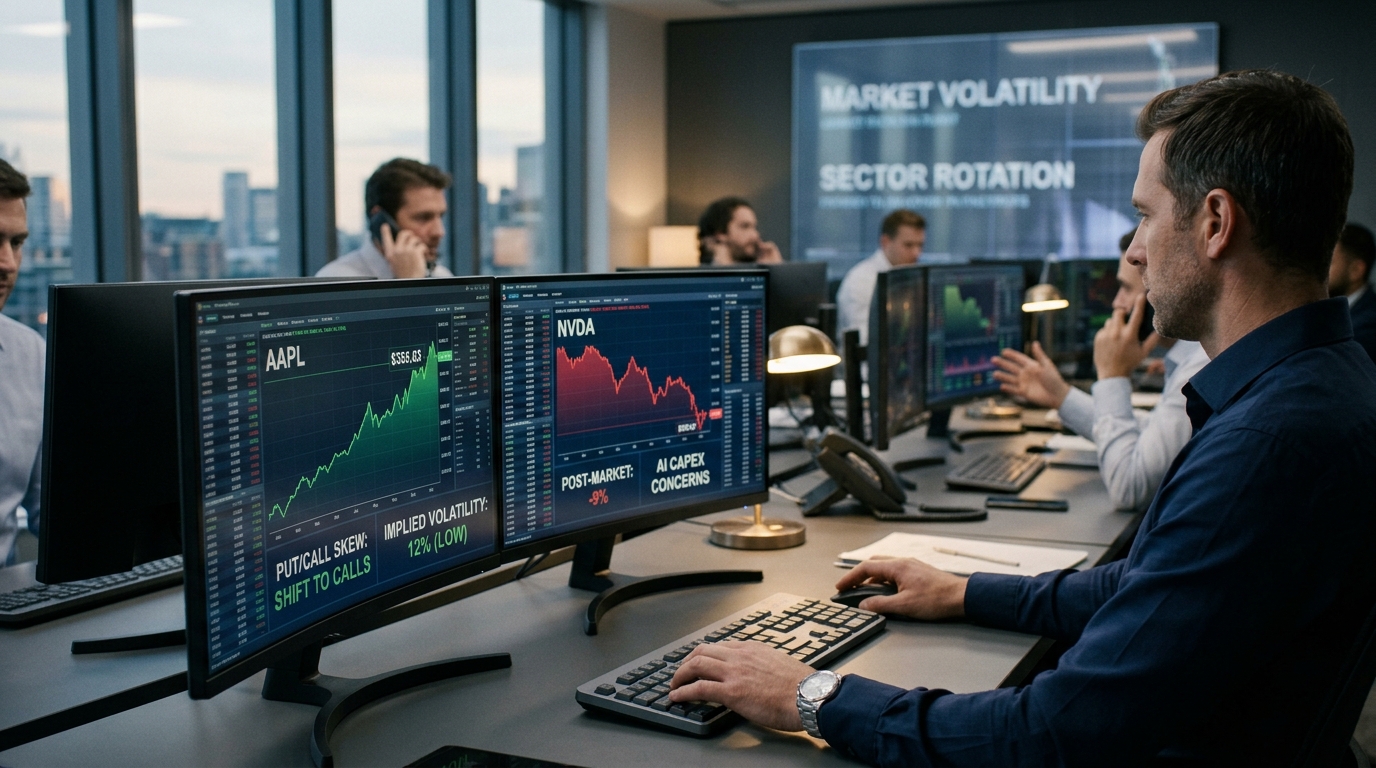
Apple rose $7.12, or 2.04%, to $355.63, hitting a new all-time closing high on November 11, the same day Nvidia shares sank about 9% in after-hours trading as reports said its board met to discuss Jensen Huang’s future. That juxtaposition is not coincidence. It is a live referendum on two competing capital-allocation theories playing out in real time.
Apple is not budgeting anything like the hyperscalers are for AI infrastructure. Apple relies on contract manufacturers, and its model keeps hard infrastructure intensity far below the GPU-and-power buildout now dominating Big Tech boardrooms. The hyperscalers committing tens of billions annually to data centers are defending that decision to shareholders who have watched multiples compress. Apple is not.
The Numbers That Matter
Apple’s Q4 fiscal 2026 revenue came in at $114.477 billion, up 12% year over year. Diluted EPS was $2.10, up 14% year over year. The full fiscal year produced $478.834 billion in revenue, up 15% year over year.
The stock sold off briefly after those results, then recovered all of it and added more. Apple extended its 2026 rally to roughly 30% from its January low. The catalyst on Wednesday was partly fundamental. China Renaissance upgraded AAPL to Buy and lifted its target to $425, arguing a foldable iPhone catalyst could reset the upgrade cycle and create a new growth platform. The $425 target stands well above the broader Street consensus, where recent averages have clustered nearer the mid-$300s.
What the Options Flow Reveals
This is not about whether Apple is cheap. It is about what the derivatives market is pricing into the move.
On November 11, Apple options positioning leaned call-heavy by open interest, with the put/call open-interest ratio around 0.87. That is a meaningful rotation. A ratio above 1.0 signals defensive hedging dominates; below 1.0 and falling, the market is repositioning for continuation rather than a fade.
The put/call ratio is also being cited in the high-0.7s across some dashboards, depending on whether the measure is based on volume, open interest, or a filtered slice of expirations. Thirty-day implied volatility was about 23% around the session, and options were pricing roughly a ±$11.20 move (about ±3.2%) over the next week.
Sector Context: The AI-Light Megacap Wins This Round
Apple’s market cap now stands around $5.17 trillion. Nvidia shares fell as much as about 10% in late U.S. trading as investors weighed the possibility of CEO Jensen Huang leaving, with market commentary noting the company also faces headline risk tied to China scrutiny and deal cadence. Every AI infrastructure name trades on Nvidia’s headline now. Apple does not. That structural independence from the AI capex cycle is precisely what Wednesday’s options flow was rewarding.
The Nvidia headline risk runs deeper than a leadership question. Nvidia has moved into guaranteeing billions in debt financing for AI data centers, creating credit exposure that chip-company multiples have never had to price.
Trade Framework
Bull case. A put/call open-interest ratio around 0.87 and a Street-high $425 target from China Renaissance argue for call spreads. A defined-risk structure such as a December or January $360/$390 call spread captures further upside into the foldable iPhone catalyst without requiring a directional bet on the broader market. For traders expecting continued outperformance versus AI-heavy names, long AAPL / short NVDA as a pairs structure expresses that relative view with capped risk.
Bear case. Apple’s trailing P/E ratio is roughly 39.6x. GuruFocus’ GF Value model has also been cited as showing AAPL modestly above its estimated fair value. For traders who believe the valuation expansion has overshot the earnings trajectory, a put spread below $330 defines the risk. The 52-week low of $243.42 is a distant reference point; the more relevant technical floor sits in the $330 to $335 range where earnings were originally absorbed.
Neutral case. With IV near the lower end of its one-year range and a roughly ±3.2% expected weekly move, iron condors centred around current levels offer premium collection if the stock consolidates between $340 and $370 into December expiration.
Risk Factors
The Nvidia leadership crisis is still live. Futures were lower overnight in early Thursday trade, and a broad risk-off session could drag AAPL lower regardless of its relative positioning. Insider selling has also been flagged across some trackers over the last three months, a data point that sits uncomfortably alongside the new all-time high.
Action Checklist
- Put/call open-interest ratio: ~0.87 and declining. Directional lean: calls.
- Implied volatility: about 23%. Premium is not elevated. Favors defined-risk debit structures over aggressive credit.
- Expected weekly move: about ±$11.20 (±3.2%). Size positions accordingly.
- Key upside reference: China Renaissance $425 target. Street consensus: mid-$300s.
- Key risk event: any Nvidia board resolution that triggers broad AI-sector relief could narrow the AAPL/NVDA spread quickly.
- Monitor insider activity and daily options positioning. A reversal back above 0.90 on puts would signal the hedging posture is rebuilding.
All trade templates above are analytical frameworks, not instructions. Options trading involves substantial risk of loss. All figures cited reflect data available as of November 11 to 12, 2026.