
April 30, 2026
‘Dark Energy’ Could Replace Foreign Oil
Featured Article: Caterpillar (CAT): What the 9% Pop Is Really Telling You
Editor’s Note: Please see the following from Professor Joel Litman, a former consultant to the Pentagon and FBI, who just flew a small helicopter near one of the most secure sites in America to uncover what he says could soon become the biggest stock market story of 2026.
Elon Musk’s ‘Dark Energy’ Could Replace Foreign Oil
Confirmed by satellites 300 miles above the Earth’s surface…
Elon Musk is rolling out a breakthrough technology that could replace our need for foreign oil and ignite a $10 trillion boom for the stocks involved.
It’s a new way to power our world that could completely solve the big power bottleneck being reported by outlets like Bloomberg and The Wall Street Journal.
It may sound like science fiction when you first hear about it.
In fact, one of its first uses was for the U.S. military.
It’s a breakthrough I call “Dark Energy.”
Tanks powered by this “Dark Energy” source move almost silently and produce no smoke.
In NATO battlefield exercises, it was described this way by soldiers who witnessed it in action:
One of the [Dark Energy tank] companies charged into a Canadian mechanized infantry company, which was riding into action… The Canadians were ‘wiped out’ before they could react.
Unlike traditional power sources that take five years or more to connect to the grid… “Dark Energy” can be deployed anywhere.
Once installed, it goes online in about 5 minutes.
“Dark Energy” is 326 times more powerful than emergency generators used by hospitals…
And it could soon radically lower power bills across the country.
But it’s not wind, solar, geothermal, nuclear, coal, or anything you’ve probably heard about before. It never uses a single drop of oil.
The catch is…
Elon Musk can’t make this technology by himself.
He has to go through a small group of little-known suppliers to get it.
And these suppliers’ stocks are poised to soar hundreds of percent or more in the days ahead, as this news spreads across the country.
All the wealthiest and most powerful people in tech are piling into this… including names like:
- Nvidia’s CEO Jensen Huang…
- OpenAI’s CEO Sam Altman…
- And even President Trump has stepped in to greenlight this underlying technology on an emergency basis.
Right now, you have the chance to invest in the key stocks that own the rights to this tech before their names show up in major headlines.
And if you act now, I believe this could be one of the most profitable moves you make all year – perhaps all decade.
I’m sharing all the details in a boots-on-the-ground briefing, straight from one of the most secure sites in America – right next to the place where the military builds nuclear weapons.
If you tried to approach this site without clearance, you’d be arrested.
But I got in with permission… to show you the full story about this “Dark Energy” technology and the stocks that could soar as it rolls out nationwide.
For all the details…
Regards,
Joel Litman
Chief Investment Officer, Altimetry
P.S. As reported by Financial Times, OpenAI CEO Sam Altman was heard on an open phone line begging a small company in Colorado to build this tech for him.
Today, I’m sharing this company’s name for free on camera.
Click here to see the supplier that OpenAI’s founder begged them to build “Dark Energy” – for free.
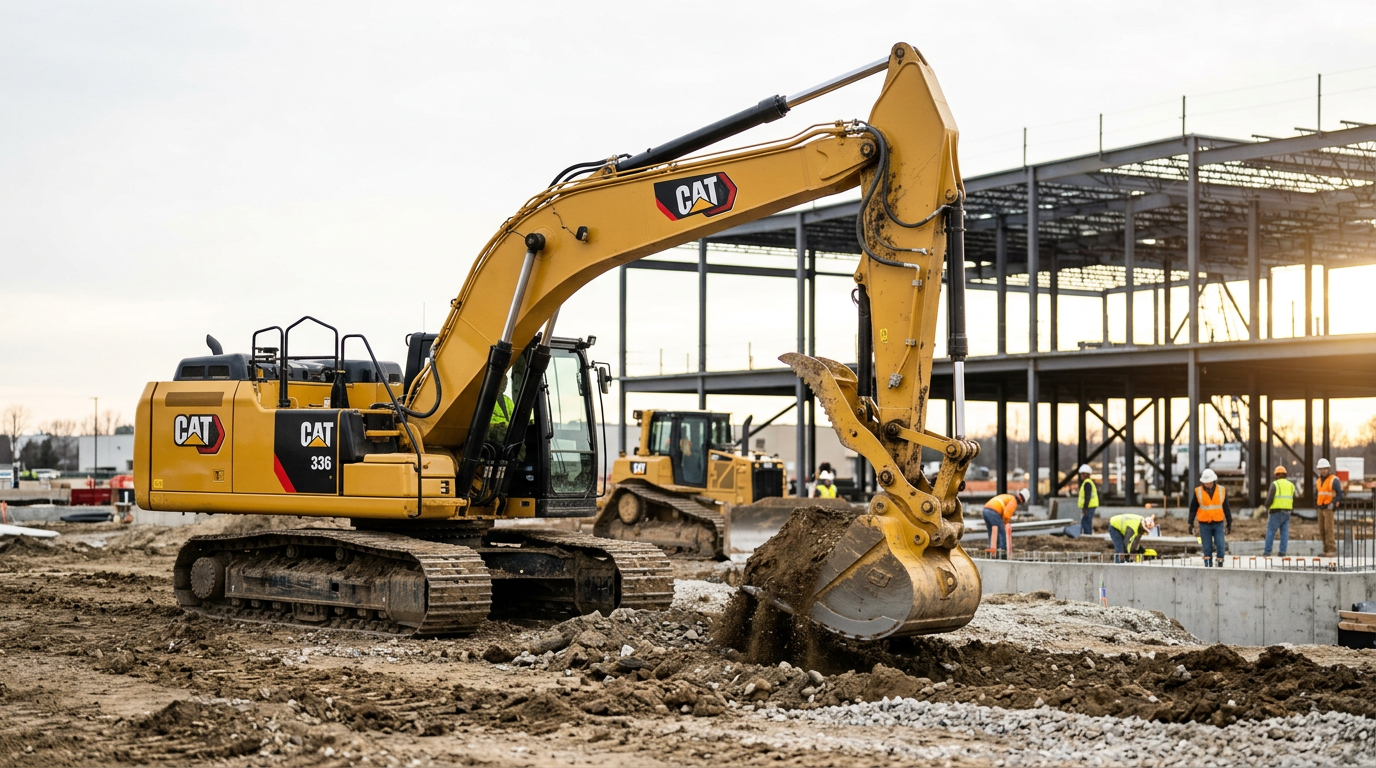
FEATURED ARTICLE
Caterpillar (CAT): What the 9% Pop Is Really Telling You
Q1 2026 Earnings Deep Dive | April 30, 2026
The street was expecting a solid quarter from Caterpillar. What it got was a different animal entirely.
Going into Wednesday morning, consensus had CAT pegged at $4.64 in adjusted EPS on $16.21 billion in revenue. Reasonable expectations for an industrial name navigating a tariff environment that has pressured every manufacturer with global supply chains. The problem with reasonable expectations, though, is that CAT obliterated them. Adjusted EPS came in at $5.54 against that $4.64 estimate, a 19.3% beat. Revenue landed at $17.42 billion, topping the consensus by 7.4% and representing 22.2% year-over-year growth. The stock moved roughly 9% higher on the open. That kind of reaction doesn’t happen because a company posts decent numbers. It happens when the underlying demand signals are rewriting the story investors thought they understood going in.
What’s interesting is that the beat didn’t come from one segment doing most of the work. It was broad. And that changes how you think about what this quarter means beyond the headline.
The Playbook Every Options Trader Should Have!
Do you dream of retirement but it seems like an impossibility? Wish you knew the best moves to get you there sooner?
It’s closer than you think and you won’t have to work overtime to get it!
Hi! I’m Dave Aquino, expert options trader and my e-book, “How To Master the Retirement Trade” has helped thousands reach their goals!
Follow the link to get your copy and see what you’ve been missing!
The Numbers
Here is what Q1 2026 actually produced, sourced directly from the press release filed this morning:
- Total sales and revenues: $17.42 billion vs. $16.21 billion consensus (7.4% beat, +22.2% YoY)
- Adjusted EPS: $5.54 vs. $4.64 consensus (19.3% beat), up from $4.25 in Q1 2025
- GAAP EPS: $5.47
- Adjusted EBITDA: $3.68 billion vs. $3.23 billion estimate (13.8% beat)
- Adjusted operating profit margin: 18.3% in Q1 2025, now 17.7% on a GAAP basis in Q1 2026
- Operating profit: $3.085 billion, up 20% from $2.579 billion in Q1 2025
- Operating cash flow: $1.9 billion for the quarter
- Capital returned to shareholders: $5.7 billion via buybacks and dividends
- Company backlog: record $63 billion, up materially from prior periods
The operating profit expansion was driven by higher sales volume contributing $940 million and favorable price realization of $426 million. Those gains were partially offset by $710 million in unfavorable manufacturing costs, the bulk of which was tariff-related. That tension between volume/price strength and cost pressure is the central story of this quarter.
Segment Breakdown
Construction Industries was the standout. Sales climbed 38% year-over-year to $7.161 billion, driven by dealer restocking and better pricing. Segment profit jumped 50% to $1.535 billion. To put that in context, that segment was running at $1.024 billion just a year ago. The improvement came from $505 million in volume contribution and $356 million in price realization, partially clawed back by $362 million in higher manufacturing costs. Sales to users in Construction grew for the fifth consecutive quarter, up 7%, with North America performing slightly above expectations on the back of non-residential construction activity.
Power and Energy is the segment where the real long-term argument lives. Segment profit reached $1.450 billion, up 13% from $1.288 billion in Q1 2025. More importantly, sales to users in Power and Energy grew 32%, with power generation specifically up 48%, driven by demand for large generator sets and turbines used in data center applications. Oil and gas sales to users increased 16%, led by reciprocating engines and turbines in gas compression. The segment margin came in at 20.6%, down 170 basis points year-over-year, but tariffs alone accounted for roughly 270 basis points of that drag. Excluding tariffs, the underlying margin trajectory improved. The company also announced plans to expand large reciprocating engine capacity to nearly three times 2024 levels to meet data center demand.
Resource Industries is where things got complicated. Sales were $3.797 billion, up just 4% from $3.661 billion a year ago. But segment profit dropped 39%, from $623 million to $378 million. The culprit was manufacturing cost pressure, almost entirely tariff-driven. Mining and heavy equipment cycles tend to be lumpy, and this segment has faced pricing headwinds at a time when input costs are moving the wrong direction. Management indicated pricing improvements are expected as the year progresses, but the Q1 read here is a soft one.
Financial Products, the company’s lending arm, posted revenues of $1.096 billion, up 9%, and segment profit of $245 million, up 14%. Past dues and credit losses remain well-managed, which matters as a leading indicator for equipment demand sustainability.
SpaceX IPO Confirmed: Claim Your Stake Today
Elon Musk is about to take SpaceX public in what’s set to be the biggest IPO ever.
But there’s no need to wait for the company to go public.
You can claim your stake today. The New York Times predicted it “will unleash gushers of cash for Silicon Valley and Wall Street.”
What the Market Expected vs. What It Got
The framing going into Q1 2026 was cautious. CAT had just posted five consecutive quarters of earnings declines on a year-over-year basis. The tariff overhang was real. The Zacks consensus had crept up only 2.5% over the prior 60 days to $4.55 per share, meaning analysts were careful not to get too far over their skis. Revenue expectations at $16.42 billion implied 15.2% growth, which was already an upgrade from prior quarters, but still landed $1 billion short of what actually materialized.
The delta between expectation and reality was widest in construction. Dealer restocking added a substantial volume tailwind that models underestimated. The ISM Manufacturing Index had been running above 50 for three consecutive months heading into the quarter – 52.6 in January, 52.4 in February, 52.7 in March – and that expanding environment fed through to CAT’s order volumes more aggressively than consensus had priced.
There is also a guidance upgrade that matters here. Management raised full-year 2026 sales and revenue expectations to low double-digit growth. That is an improvement versus the prior quarter’s guidance and is supported by Power and Energy tracking ahead of 2026 capacity growth plans, continued North American construction strength, and the record $63 billion backlog, approximately 62% of which is expected to convert in the next 12 months.
One more thing worth noting: the company revised its tariff headwind estimate lower, from $2.6 billion to a range of $2.2 to $2.4 billion for the full year. That reduction, combined with the revenue upgrade, is what gave the stock room to move. The market wasn’t just reacting to a beat. It was resetting expectations for the rest of the year.
Author of Get Rich with Dividends Is Giving Away His Ultimate Dividend Package FOR FREE!
Click Here to Get Marc Lichtenfeld’s Ultimate Dividend Package, Including Details on His #1 Dividend Stock… the Safest 9% Dividend in the World… the Top Three “Extreme Dividend” Stocks… and Much, Much More.
Sector Implications
CAT is not just a construction company. It is a proxy for the global industrial capex cycle. Its three segments – Construction Industries, Resource Industries, and Power and Energy – touch infrastructure spending, mining investment, and energy generation simultaneously. When all three are growing, it says something about the macro that a single GDP reading cannot.
The read-through to adjacent names is meaningful. Cummins (CMI) benefits from similar engine demand trends. Eaton (ETN) and Honeywell (HON) are exposed to overlapping power generation and data center infrastructure themes. Deere (DE) operates in adjacent heavy equipment markets. The CAT quarter, particularly the Power and Energy strength, reinforces that the data center power generation trade is not slowing. It is accelerating. Forty-eight percent growth in power generation sales to users is not a rounding error. It is structural demand.
Slight tangent here, but it matters: CAT’s Atlas Energy Solutions agreement to secure power generation assets through 2029 was signed earlier this year for private grid development. That kind of multi-year contract structure reflects just how locked in the data center power demand cycle has become. Buyers are not shopping quarter to quarter. They are securing capacity years in advance.
Options Market Analysis
Going into today’s report, the options market had priced in meaningful uncertainty. With a 9% realized move on earnings day, traders who bought straddles at-the-money around the event captured a significant payout relative to what was priced. Here is how to think about the current options environment now that the event has passed:
- IV Crush: Post-earnings implied volatility typically collapses sharply. Traders holding long options premium through the event will see that evaporate rapidly now that the binary risk has resolved. This is not the environment to be buying premium unless a specific near-term catalyst exists.
- Put/Call OI Ratio: The current open interest put/call ratio for CAT sits near 0.94, reflecting a modestly bullish tilt in positioning. Readings below 1.0 indicate more call open interest than put open interest. That positioning was in the right direction heading into the beat.
- 30-Day IV: CAT’s 30-day implied volatility had been running around 25% in recent months, elevated relative to its historical baseline. Post-event, expect this to compress toward the low-to-mid teens, which is more typical for a large-cap industrial in a normalized environment.
- Expected Move: The actual realized move of approximately 9% exceeded what ATM straddles were pricing heading into the report, meaning the options market underpriced the outcome. Knowing that, the more relevant question is what near-term expected move looks like from here.
- Flow Behavior: Call flow had been accumulating ahead of the report, consistent with the bullish put/call ratio. Post-event, watch for profit-taking in near-dated calls and potential roll activity into further-dated expirations as new money positions around the guidance upgrade.
‘I Just Flew Over Elon Musk’s Next Big Venture’
A former consultant to the Pentagon was able to enter the airspace near one of the most secure sites in the world. Hidden there, he says, is a potential $10 trillion tech breakthrough that could define the next decade of Elon Musk’s career.
Click here to learn about the stocks tied to Elon Musk’s next big venture.
Structured Trade Framework
This is analysis, not instruction. For traders evaluating CAT at current levels following the earnings gap, here are three defined-risk frameworks depending on your directional view.
Bull Case
If you believe the guidance upgrade to low double-digit full-year growth is sustainable and Power and Energy continues to track above capacity expansion plans, the bullish argument is intact. A defined-risk bull structure would be a call spread in the 60-to-90 day expiration window. Buy the at-the-money call and sell a call 7-10% out of the money to cap the premium outlay. This captures continuation upside while limiting exposure to post-earnings IV crush. The bull case thesis anchors on the $63 billion backlog converting at or above management’s 62% forecast, North America construction remaining resilient, and the tariff headwind moderating below the revised $2.2-$2.4 billion guidance.
Bear Case
For traders expecting a fade of the earnings gap, the bear case centers on Resource Industries margin compression worsening, tariffs exceeding the revised guidance range, and any macro deterioration hitting dealer restocking in Construction. A defined-risk bear structure would be a put spread targeting a retest of pre-earnings levels over 30-45 days. Buy the first out-of-the-money put and sell a lower strike to reduce the cost basis. The bear thesis requires tariff mitigation efforts to fail, margin contraction to spread from Resource Industries to Power and Energy, and North American construction demand to soften.
Neutral / Defined-Range Case
Given the sharp post-earnings move, elevated realized volatility, and the likelihood of near-term IV compression, a neutral defined-risk structure has merit. An iron condor in the 30-45 day window – selling an out-of-the-money call spread above and an out-of-the-money put spread below current price – captures premium decay in an environment where the big binary event has already resolved. The risk is a follow-on move driven by macro developments (Federal Reserve, tariff policy news, or global PMI data) that pushes CAT outside your defined range. Size accordingly.
Risk Analysis
The risks here are real and worth thinking through carefully, not dismissing because the quarter was strong.
- Tariff escalation: Management revised the full-year tariff headwind lower, from $2.6 billion to $2.2-$2.4 billion. That revision is a positive, but it is predicated on current trade policy holding. Any re-escalation in U.S.-China or broader tariff policy could invalidate the guidance upgrade entirely.
- Resource Industries margin deterioration: Segment profit fell 39% year-over-year in Q1. If this segment does not recover through the year as management expects, it becomes a drag on the consolidated picture that volume gains elsewhere cannot fully offset.
- Dealer inventory dynamics: A significant portion of Construction’s revenue surge came from dealer restocking. That is a timing-driven benefit. If end-user demand doesn’t sustain the inventory rebuild, dealers will destoc, and Construction revenues will reverse. CAT experienced exactly this dynamic in 2024 and early 2025 when dealer drawdowns were a primary driver of the 10% revenue decline in Q1 2025.
- Capacity constraints in Power and Energy: The company announced plans to expand large reciprocating engine capacity to nearly three times 2024 levels. That is a significant build-out. The risk is timing, supply chain bottlenecks, and execution on the expansion itself. Demand is not in question. Supply-side execution is.
- Macro sensitivity: CAT is a cyclical industrial. Forward guidance of low double-digit growth assumes a benign macro backdrop. Any meaningful GDP slowdown, particularly in North America, would pressure both volume assumptions and dealer confidence.
Why Some Traders Skip Stocks Entirely
You don’t need a big account to trade options.
In fact, options can give you up to 12 times the leverage of stocks – with a fraction of the capital tied up.
But only if you know which trades to take. And which ones to avoid.
This free guide lays it all out in plain English – from A – Z, with step-by-step examples you can follow in your own account.
Normally $29.97. Today it’s free.
Forward Outlook
Management guided to low double-digit sales and revenue growth for the full year 2026. That is a material upgrade from prior expectations. The growth is expected to be broad-based across all three primary segments, with Power and Energy leading. Adjusted operating margins, excluding tariff costs, are expected to land in the top half of the target range. Including tariffs, they will remain near the bottom. That framing matters because it isolates the underlying business improvement from the policy-driven cost headwind.
Wall Street’s 12-month forward EPS estimate is currently around $20.37, implying 18.8% growth from current levels. If the guidance upgrade holds, that number likely moves higher through the year. At the time of the earnings release, CAT was trading at roughly 17-18x forward earnings, which for an industrial with a record backlog, growing services revenues, and meaningful data center exposure, does not represent an extreme multiple.
The $63 billion backlog is the most important forward indicator in this report. With approximately 62% expected to convert within 12 months, CAT enters the rest of 2026 with significant revenue visibility. That is not common for cyclical industrials, and it limits downside scenario risk in a way that the stock’s historical volatility profile doesn’t always reflect.
What remains uncertain is whether tariff costs continue to moderate or re-accelerate. The revised guidance of $2.2-$2.4 billion for the full year assumes the current policy environment. That assumption could change on any given Wednesday morning.
Action Checklist
- Monitor tariff policy developments closely – the revised $2.2-$2.4 billion headwind estimate is the most fragile assumption in the guidance upgrade
- Track dealer inventory data through Q2 – restocking was a key Construction driver in Q1 and is not guaranteed to repeat
- Watch Resource Industries segment margins for sequential recovery through the year – management expects improvement, but Q1 was a 39% profit decline
- Evaluate Power and Energy capacity expansion progress – plans to scale large reciprocating engine output to nearly 3x 2024 levels carry execution risk
- Post-earnings IV has likely collapsed – avoid buying near-dated options premium unless a specific catalyst exists in the next 30 days
- For defined-risk bulls: consider 60-90 day call spreads targeting the guidance upgrade thesis; avoid uncapped long calls given post-event IV dynamics
- For defined-risk bears: a put spread targeting a potential gap fill is the cleanest structure; keep size modest given the strength of the backlog and guidance revision
- For neutral positioning: an iron condor in the 30-45 day window captures premium decay in a post-binary-event environment
- Monitor adjacent industrials – Cummins, Eaton, Honeywell, and Deere – for confirming or conflicting demand signals over the next two weeks of earnings season
- Full-year EPS consensus of $20.37 is likely to be revised upward by sell-side analysts this week; watch for upgrades and price target adjustments as context for the stock’s near-term risk/reward
The part worth sitting with here is not the beat itself. Beats happen. What’s harder to dismiss is a record backlog, a guidance upgrade, and a tariff headwind that is actively shrinking – all in the same quarter. Whether the stock can hold the gap is a different question entirely. But the underlying business, at least as of this morning, is pointing in a direction the bears will have a harder time arguing against.
– The Editorial Desk
About the Author