
April 22, 2026
The “Ceasefire Dividend” in Crypto
Relief rally now. Volatility math later.
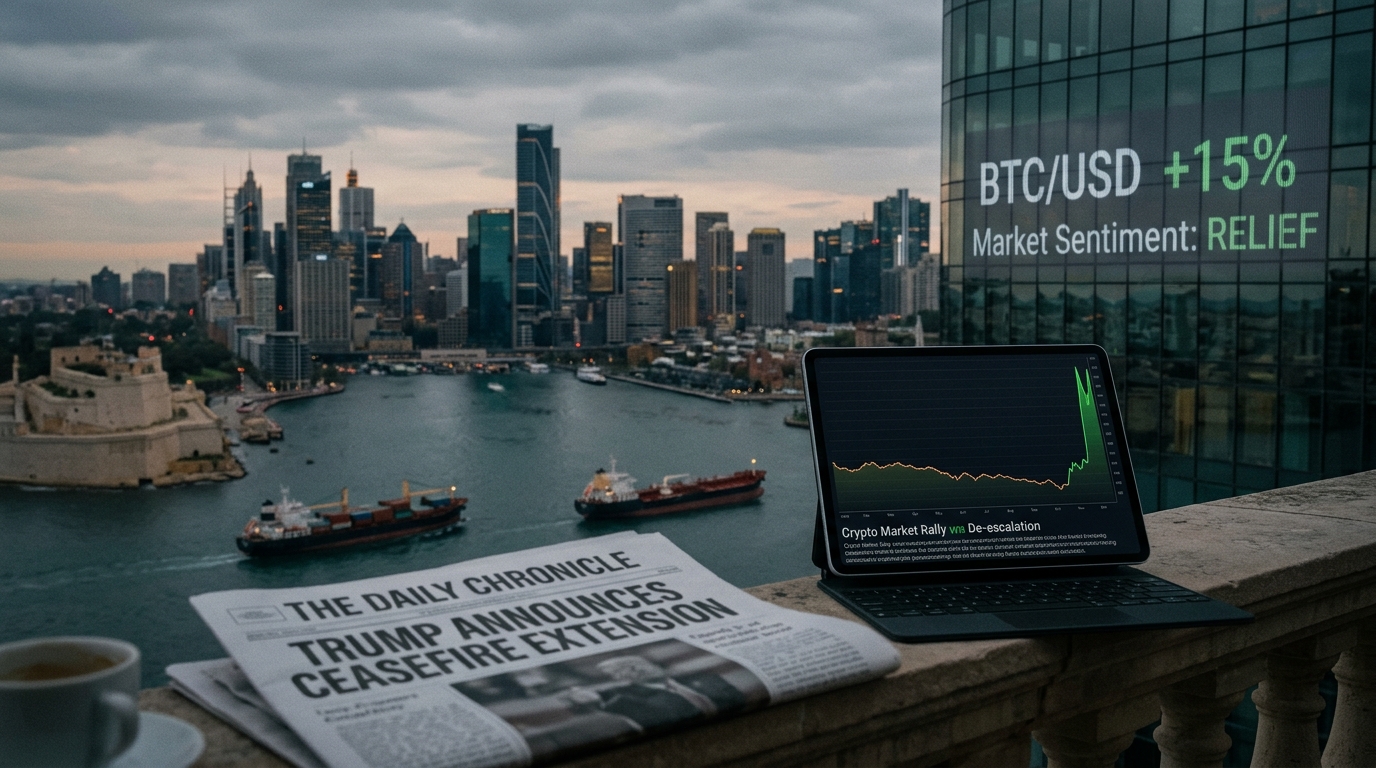
Markets don’t need peace to rally. They only need less fear than yesterday.
On April 21–22, 2026, President Trump announced an indefinite extension of the U.S.–Iran ceasefire, removing a near-term expiration date that traders had been forced to price around. The immediate result looked familiar: oil stayed jumpy, traditional hedges cooled off a bit, and digital assets caught a bid.
Bitcoin and Ethereum moved higher into April 22 as the market digested the headline. BTC is currently around $78,759 and ETH around $2,414 (intraday ranges were wide), which tells you the move wasn’t just a slow grind – it was a volatility event with follow-through.
The phrase making the rounds is “ceasefire dividend.” Fair. But the part people skip is what that dividend really represents: not a sudden love affair with crypto, and not some clean ideological shift into “apolitical” assets – it’s a reduction in one specific tail risk that had been contaminating everything from crude to equities to funding markets. When that pressure eases, the most convex, most liquidity-sensitive corners of the risk universe can respond fast.
A quick note from our friends at crypto 101
A new type of customer is taking over the internet right now.
It doesn’t browse. It doesn’t sleep. It doesn’t use a credit card.
It executes thousands of transactions per second… negotiating prices, purchasing data, booking services… all without a single human involved.
The biggest names in tech are racing to deploy them. Jensen Huang. Sam Altman. Dario Amodei. They all say this is happening faster than anyone expects.
Industry projections put their spending power at over $30 trillion annually.
But here’s the massive problem nobody is talking about…
Traditional banks physically cannot process their transactions. Credit cards charge minimums that make it impossible. Legacy systems flag the activity and shut it down entirely.
These new customers need an entirely new financial system. And one has already been built and tested.
At the center of it sits a single asset that every one of these non-human customers needs to transact.
My team believes this could be bigger than our 2,650% winner. Bigger than our 71,382% winner.
Get instant access before the rest of the world catches on.
By the time this is obvious… the entry point will be gone.
Bryce Paul
Crypto 101
Macro: what changed (and what didn’t)
Start with the obvious: geopolitical headlines don’t have to be “good.” They only have to be less destabilizing than the scenario traders were forced to hedge.
The ceasefire extension mattered for one mechanical reason: deadlines concentrate risk. When a ceasefire has a known expiration date, every market participant knows when the next potential shock can hit. That changes positioning behavior, especially for leveraged investors and systematic strategies that respond to volatility spikes. The indefinite extension dulls that clock – not forever, but for long enough to change near-term hedging demand.
At the same time, it’s not “all clear.” The region can stay noisy even with a ceasefire in place. So this isn’t a clean switch from risk-off to risk-on. It’s closer to: “the worst-case path is slightly less imminent.”
Slight tangent, but it matters: this is why you’ll often see crypto rally even when the newsflow is messy. Crypto is highly sensitive to marginal changes in fear and liquidity conditions. It doesn’t require stability. It requires less instability than was feared.
Why digital assets react so sharply
Crypto tends to behave like a high-beta expression of financial conditions, not a standalone geopolitical commentary. When markets move away from immediate conflict escalation risk, a few sector-level mechanics show up quickly:
- De-risking reversals happen fast. When hedges come off and cash stops being treated as the only safe choice, the “fast money” looks for liquid vehicles that respond quickly. BTC and ETH are still the cleanest, deepest large-cap exposures in crypto.
- Volatility compression can become its own catalyst. If implied volatility had been bid due to event risk, the mere removal of a near-term deadline can lead to selling of short-dated options, which changes dealer positioning and can mechanically influence spot behavior.
- Cross-asset correlation rises when macro dominates. In event-driven weeks, crypto can trade more like an index future than a tech platform. That’s not a criticism. It’s the reality of who holds it and how it’s margined.
Bitcoin and Ethereum in plain numbers
This editorial isn’t about “adoption” in the abstract. It’s about how the two largest assets respond when the world briefly stops demanding protection right now.
Bitcoin (BTC-USD)
BTC is currently around $78,759, up roughly 3.7% on the day, after trading as low as $74,900 intraday. That’s a nearly $3,900 low-to-high swing in a single session.
Ethereum (ETH-USD)
ETH is currently around $2,414, up roughly 4.4% on the day, after trading as low as $2,290.92 intraday. Again: wide range, not a sleepy uptrend.
What’s interesting is not just that both rose – it’s that ETH outperformed on the day. In risk-on bursts, ETH often acts like the higher-octane version of BTC (more sensitivity to speculative rotation, higher volatility, more reflexivity through derivatives). That tendency showed up again.
Expectations vs. reality
If you want to understand the move, ask a dull question: “What did traders have to hedge yesterday that they might not have to hedge today?”
Reality into April 22: the ceasefire extension removed a known expiration date. That matters more than the politics. A deadline converts uncertainty into a scheduled event. A scheduled event gets hedged. When the schedule changes, the hedges change.
The other reality check: “indefinite” does not mean “permanent.” It means “no date you can circle.” That is helpful, but it also means the market has to relearn how to price the probability of flare-ups without the anchor of a calendar. In practice, that can create choppy, mean-reverting behavior after the first push higher.
$1 ‘Magic’ AI Stock
Some are calling it “ChatGPT that can see your real world”-and it could be as game-changing as the iPhone.
Despite partnerships with Meta, Google, Microsoft, and Qualcomm, hardly anyone knows its name.
Even better, there’s a little-known way to get in for under $1 a share.
Energy, rates, and why crypto cared
Energy is still the transmission mechanism here. When investors worry about Middle East escalation, they worry about crude supply routes and inflation impulse. When they worry about inflation impulse, they worry about the path of rates. And when they worry about rates, they tend to punish duration-like assets and anything with leverage embedded in the ecosystem – including crypto.
So no, crypto didn’t rally because it’s “apolitical.” Crypto rallied because the macro stack briefly looked less hostile.
Options: where the real information tends to show up
The cleanest way to think about this week is: spot moved, but derivatives decide whether it sticks.
We don’t need perfect, exchange-by-exchange options telemetry to outline the playbook that usually follows a headline-driven relief rally:
- Front-end implied volatility often softens after the event passes. If traders bought protection into a deadline, an extension can reduce near-term demand for that protection. That can pressure 7D–14D IV more than 30D–90D IV.
- Skew tells you if the market still fears downside. If put skew remains elevated even as spot rallies, it’s the market saying, “Nice bounce, but I still don’t trust it.” If skew relaxes, the fear premium is truly coming out.
- Expected move becomes a sanity check. Compare the actual intraday range to what options were implying. Today’s BTC range (roughly $74.9k to $78.8k) was big enough that it likely met or exceeded what many traders price as a ‘normal’ daily move outside of event windows.
- Positioning can flip quickly. After relief rallies, it’s common to see call overwriting (selling upside) if traders think the spike is done, or call buying if they think the macro tailwind can run for multiple sessions.
Here’s where I’m at: if IV deflates faster than spot gives back gains, it usually suggests the market is transitioning from “event risk” to “trend risk.” If IV stays bid while spot rises, it often signals unresolved uncertainty – traders are participating, but paying up for insurance.
Trade framework (defined-risk templates)
No predictions, just conditional frameworks. The goal is to map belief to structure with defined risk.
Bullish bias (believe risk appetite can extend for days, not hours)
If you believe the ceasefire extension reduces near-term shock probability and liquidity conditions remain supportive, a defined-risk structure would typically lean toward call spreads (rather than naked calls) to avoid overpaying for IV after a big move. The tradeoff: capped upside, but more forgiving breakevens.
Bearish bias (believe the move was mostly headline relief and will mean-revert)
If you believe the market overreacted and the next leg is lower once the initial optimism fades, defined-risk expressions often use put spreads or call credit spreads (if skew/IV makes it attractive). Key idea: avoid unlimited risk in a market that can gap on a single update.
Neutral/volatility seller bias (believe price chops and IV is rich)
If you believe spot will stall and IV is elevated relative to realized movement after the headline, defined-risk premium-selling like iron condors (wider wings, smaller size) can express that view. The constraint: these trades suffer when the market keeps trending.
One practical note: after a sharp relief rally, many traders underestimate how often crypto simply goes sideways for a while. It feels anticlimactic, but it’s common. That’s why structures that rely on time decay can look “easy” right before they don’t – sizing matters more than cleverness.
Risks that can hit fast
This is the portion that gets ignored in the celebration phase.
- Headline whiplash. The same channel that delivered an extension can deliver a reversal, a violation, or a new condition. Indefinite is not irreversible.
- Correlation spikes. If oil jumps and rates respond, crypto can fall even if nothing “crypto-specific” breaks.
- Liquidity gaps. Crypto trades 24/7, but depth is not constant. Moves can exaggerate during low-liquidity hours.
- Volatility decay traps. Options sellers can be right on direction and still lose on timing if the market trends longer than expected.
And the most uncomfortable one: a relief rally can become a bull trap if macro data or central bank expectations shift back toward tighter policy. Geopolitics may have been the spark, but macro still controls the oxygen.
What I’m watching next
Three things, in order:
- Does BTC hold above prior breakout zones on pullbacks? Not the exact level – the behavior. Fast dips that get bought versus slow bleeding.
- ETH relative strength. If ETH keeps outperforming BTC, it usually signals broader speculative rotation and improving risk tolerance.
- Options term structure. Watch whether front-end IV collapses or stays sticky. Sticky IV usually means the market still expects more shocks.
My bias is simple: the ceasefire extension was a catalyst for a move, but follow-through will be earned by conditions staying calm for long enough that volatility sellers feel safe again. When that happens, rallies tend to look less explosive and more persistent.
Action checklist
- Write down your base case in one sentence: “I believe the next 1–2 weeks are ___.” If you can’t, don’t touch options.
- Compare today’s realized range in BTC and ETH to what you think is “normal.” Today wasn’t normal.
- If expressing a directional view, prefer defined-risk structures (spreads) over open-ended risk.
- If selling premium, widen wings and reduce size – headline risk hasn’t disappeared, it just moved off the calendar.
- Watch ETH/BTC and volatility behavior as confirmation signals before assuming the move will persist.
If you’re looking for one clean takeaway: the “ceasefire dividend” in crypto is less about crypto’s philosophy and more about the price of fear coming down. The market can live with uncertainty. It just hates deadlines.
About the Author