
May 9, 2026
Elon’s ‘iPhone’ Could 10x Apple’s iPhone
FEATURED: Gold Near $4,715. The Options Market Is Saying Higher
Dear investor,
Imagine going back in time…
And investing in Apple before the iPhone.
You could have seen a peak gain as high as 7,537%.
If you missed out on that generational run, don’t worry…
Because you’re about to get a 10x bigger opportunity thanks to the world’s richest man.
According to multiple insider sources who’ve been inside Tesla’s secret facilities recently…
Elon Musk is working on HIS ‘iPhone’ – a breakthrough technology that he says will be “10x bigger than the largest product in history.”
Which means it could do $20 trillion in lifetime sales, and potentially make early investors 10x wealthier than Steve Jobs’ iPhone.
And that’s why Nvidia’s CEO just said:
“This is the most important moment we’ve witnessed… It’s going to impact every industry.”
The momentum is undeniable.
And now is the moment to act – before this breakthrough goes mainstream.
Click here now to see the full story behind Elon’s ‘iPhone’ moment – and the small company positioned to ride this wave.
Gold Near $4,715. The Options Market Is Saying Higher
Published May 9th, 2026
Gold doesn’t move like this without a reason. As of May 9, 2026, spot gold is consolidating near $4,715 per ounce — recovering steadily after touching $4,520 in early May — and the macro backdrop driving it is anything but quiet. A US-Iran conflict that began in late February has effectively shuttered the Strait of Hormuz, oil prices have surged nearly 40% above pre-war levels, inflation expectations have re-accelerated, and suddenly the metal that was supposed to be “overbought” at its $5,589 all-time high on January 28 looks strategically compelling again to institutional desks.
This is not a typical gold story. It never is when geopolitics are the engine.
Here’s what matters structurally: J.P. Morgan revised its year-end 2026 gold target upward to $6,300/oz in February, up from its earlier $5,000 base case — citing continued central bank and investor demand as the primary drivers. That’s not a fringe call. Wells Fargo sits at $6,100–$6,300 by year-end. UBS targets $5,900 by late 2026. Morgan Stanley’s bull case is $5,700. BNP Paribas and multiple Swiss banks are clustered around $6,000. The consensus has migrated upward faster than anyone expected — and is still being revised. J.P. Morgan’s central bank demand figure for 2026 stands at roughly 755 tonnes total, or approximately 585 tonnes per quarter in combined central bank and investor demand. That’s not speculative froth — that’s sovereign accumulation continuing at historically elevated levels even with gold above $4,000 per ounce.
The GLD options market is reflecting a similar structural asymmetry. The SPDR Gold Shares ETF (GLD) is currently trading in the $430 range, and call volume has been persistently dominant. Back in February, options flow sentiment on GLD ran 84.3% bullish by dollar volume, with calls commanding $2.32 million versus just $434k in puts. That directional skew hasn’t structurally reversed — even as the spot price pulled back more than 15% from its January record.
W.H. Insider: Trump Planning to Open $1 Trillion Gold Deposit
The gold price has skyrocketed over the last year.
And according to Jim Rickards – the world’s #1 gold expert with close ties to the Trump White House – the president is currently planning a major gold play…
An initiative that will unlock up to $1 TRILLION worth of gold over the next year.
Today, Jim is revealing one of his favorite gold plays – 100% FREE.
What the Market is Saying
Gold dropped more than 15% from its January 28 all-time high of $5,589 as the Iran conflict initially sent oil prices surging — Brent crude peaked near $114/barrel in early May — reigniting inflation fears and killing near-term rate-cut expectations entirely. The CME FedWatch tool reflects approximately 94.9% probability of a hold at the June FOMC meeting, with cuts pushed deep into late 2026 at best, and Bank of America now forecasting no rate cuts in 2026 at all. Deutsche Bank analysts added this week that “trend inflation has not shown clear signs of dipping below 3%.” That’s the bear argument in one sentence: rising real yields, no Fed relief, and a non-yielding asset facing headwinds.
The bull argument is more nuanced — and more interesting. Geopolitical uncertainty doesn’t resolve cleanly or on schedule. The US and Iran exchanged fire in the Strait of Hormuz on May 7–8, the most serious confrontation since the April 8 ceasefire took effect. CENTCOM confirmed strikes on Iranian military sites after three US Navy destroyers came under attack from Iranian missiles, drones, and small boats. Iran fired missiles at the UAE. And yet Trump insisted the ceasefire “remains in effect” — calling the clashes “just a love tap.” Tehran is reviewing a US one-page memorandum of understanding sent through Pakistani mediators that would formally end the conflict and allow a gradual reopening of Hormuz. Iran is expected to respond in the coming days.
Meanwhile, the Federal Reserve remains deeply constrained. Fed Chair Powell acknowledged “tension between the two goals” — upside inflation risk and downside employment risk — and refused to call current conditions stagflation while simultaneously admitting they fit the profile. Chicago Fed President Austan Goolsbee was more direct: inflation has accelerated since the war began, not cooled. April’s nonfarm payrolls came in at 115,000 — nearly double the 62,000 consensus estimate — which removes the labor-market excuse for cuts and hands the Fed yet another reason to hold. The stagflationary pressure that gold historically performs well in regardless of nominal rate levels is here, in real time, in the data.
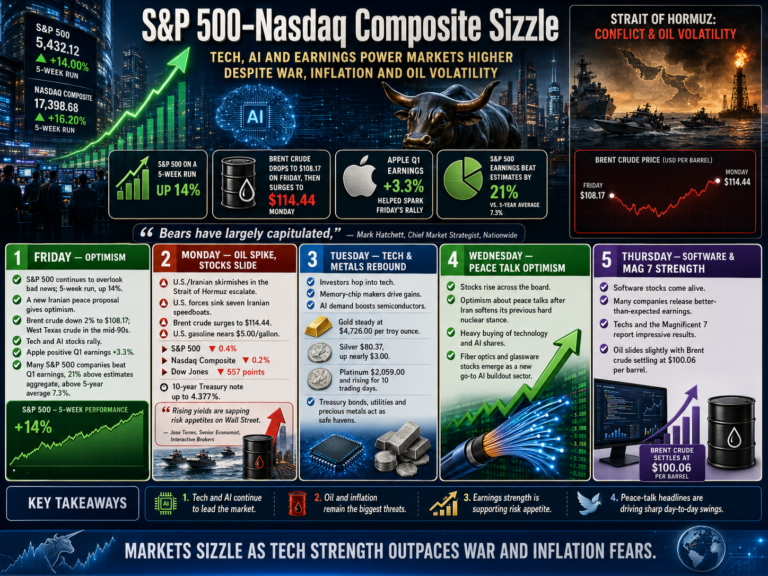
Slight tangent, but it matters: Brent crude and WTI both posted weekly losses exceeding 6% on the May 5–9 week despite Thursday’s fire exchange, driven by optimism around the peace proposal. If Hormuz reopens even partially, inflation expectations may recede faster than current positioning assumes — which could restore the rate-cut narrative and provide gold a second independent catalyst entirely separate from safe-haven demand. The two pathways to higher gold from here are not mutually exclusive. War continuation is one. Peace and subsequent Fed pivot is the other. That’s an unusual setup.
The Miners Are Telling a Different Story
The VanEck Gold Miners ETF (GDX) is trading near $94.59 — up over 3% on the May 9 session alone and carrying a 52-week range of $45.10 to $117.18. That spread tells the whole story of the past several months. GDX was up 81.9% over the prior trailing year. Asian physical gold bar demand hit an all-time quarterly record in Q1 2026. And yet the miners currently sit roughly 20% off their highs, offering a higher-beta expression of the gold thesis for traders willing to absorb that additional variance.
What’s interesting here is the divergence. When gold spot was making its January highs above $5,500, GDX was outperforming. Since the war-driven pullback, miners have lagged the recovery in spot — meaning if gold reclaims $5,000+, the miners could provide amplified upside. If the ceasefire fully collapses, the miners may overshoot to the downside. That beta cuts both ways, and the IV environment in GDX reflects it.
He Made $95 Million in the 2008 Crash. Now He’s Focused on Gold.
Barron’s ranked his fund in the top 1% worldwide. He went 20 years without a losing year.
Now he’s applying his strategy to the wildest gold market in decades – and sharing a three-step method that could pay you over $5,000 the next time gold drops.
Options Framework — GLD
For traders positioning around gold’s next move, a few structural observations that are worth sitting with:
- IV Environment: Implied volatility in GLD is elevated relative to historical norms, reflecting the geopolitical binary — full ceasefire or renewed escalation. The 90-day IV on GLD calls was running near 23% as of late April, well above pre-war norms. That cuts both ways. Premium sellers face binary event risk; premium buyers face elevated entry costs that require meaningful directional moves to justify.
- Bull Case Structure: For traders who believe gold recovers toward $5,000+ into Q3, a defined-risk call spread targeting GLD’s $460–$490 range captures the move with capped downside. The expected move in GLD across a 60-day window, at current IV levels, implies roughly 8–10% potential displacement — consistent with a recovery toward $5,100+ in spot gold.
- Bear Case / Neutral Structure: If the Iran ceasefire materializes fully and oil prices normalize toward pre-war levels, gold could retest the $4,220–$4,375 support zone. A put spread or iron condor with the short strike near current GLD levels and a defined lower boundary captures the range trade while collecting elevated premium in a still-elevated IV environment.
- GDX as a Leveraged Expression: For traders comfortable with higher beta, GDX options provide a more volatile but potentially more rewarding vehicle. The miners tend to move 1.5–2x spot gold in either direction on major geopolitical events. Defined-risk structures in GDX at current IV levels carry higher premium but also higher potential reward in a breakout scenario.
- Key Risk: Any sudden escalation — an Iranian strike on UAE oil infrastructure, a breakdown in the peace proposal, or a Fed chair transition signaling dovishness — becomes an immediate upside catalyst that invalidates short-vol positioning entirely. The risk is not symmetric. The tail risk is to the upside.
The Macro Calendar Risk Cluster
The next two weeks carry meaningful event risk for gold specifically. April CPI releases on May 12. April PPI drops May 13. Initial jobless claims follow on May 14. Manufacturing and Services PMI for May prints on May 21. Each one of those data points has the potential to shift rate-cut probability and, by extension, recalibrate gold’s opportunity cost narrative in either direction. A hotter-than-expected CPI reading would validate the BofA “no cuts in 2026” thesis and add near-term headwind to gold. A softer-than-expected print reopens the June/July cut discussion and likely provides immediate support.
None of that changes the structural thesis. But it does affect the tactical entry window. The part people skip in this kind of environment is that volatility events often create better entries than they destroy. A CPI spike that sends gold to $4,550 on May 12 doesn’t break the $6,000 year-end thesis — it potentially improves the risk/reward for defined-risk structures entered after the reaction.
Forward Outlook
Gold at $4,715 is not cheap. But it’s also down roughly 15.6% from its all-time high of $5,589 — reached just over three months ago — with institutional demand structurally intact, a geopolitical floor under price, and Wall Street’s most aggressive desks targeting $6,000+ into year-end. J.P. Morgan’s February revision to $6,300 represents roughly 34% upside from current spot. Wells Fargo’s $6,100–$6,300 range is in the same ballpark. Even the more conservative UBS target of $5,900 implies 25% from here. The options market isn’t pricing euphoria — it’s pricing uncertainty with a directional lean toward upside continuation. That remains a tradeable setup, not a conclusion.
The structural case has also quietly deepened. For the first time in decades, the market value of gold held by foreign central banks has surpassed their holdings of US Treasuries — a shift that reframes gold not as a speculative commodity but as the primary neutral reserve asset. Central bank reserves are now valued near $4 trillion in gold. That demand floor doesn’t disappear when a ceasefire gets announced.
What resolves this story one way or the other in the near term is still the Strait of Hormuz. Watch oil before you watch gold. And watch the May 12 CPI print before you watch either.
Tactical Checklist
- Monitor: May 12 CPI and May 13 PPI — primary short-term catalysts for rate-cut repricing and gold’s opportunity cost narrative
- Watch: Iran’s response to the US one-page peace MOU (expected within days) — a yes/no binary that directly drives oil and gold
- Track: GLD call/put flow ratio — any sustained shift toward put dominance would signal institutional repositioning out of the bullish structure
- Reference: $4,220–$4,375 in spot gold as the key support zone; $5,000 as the near-term upside inflection that validates the bull case
- For defined-risk bulls: GLD $460/$490 call spread or GDX equivalent — captures upside recovery with capped premium risk
- For range traders: Iron condor around current GLD levels in elevated IV captures premium decay if the binary delays resolution
- Risk management: Any overnight escalation in Hormuz creates gap risk. Size accordingly. Position for defined risk, not max conviction.
About the Author