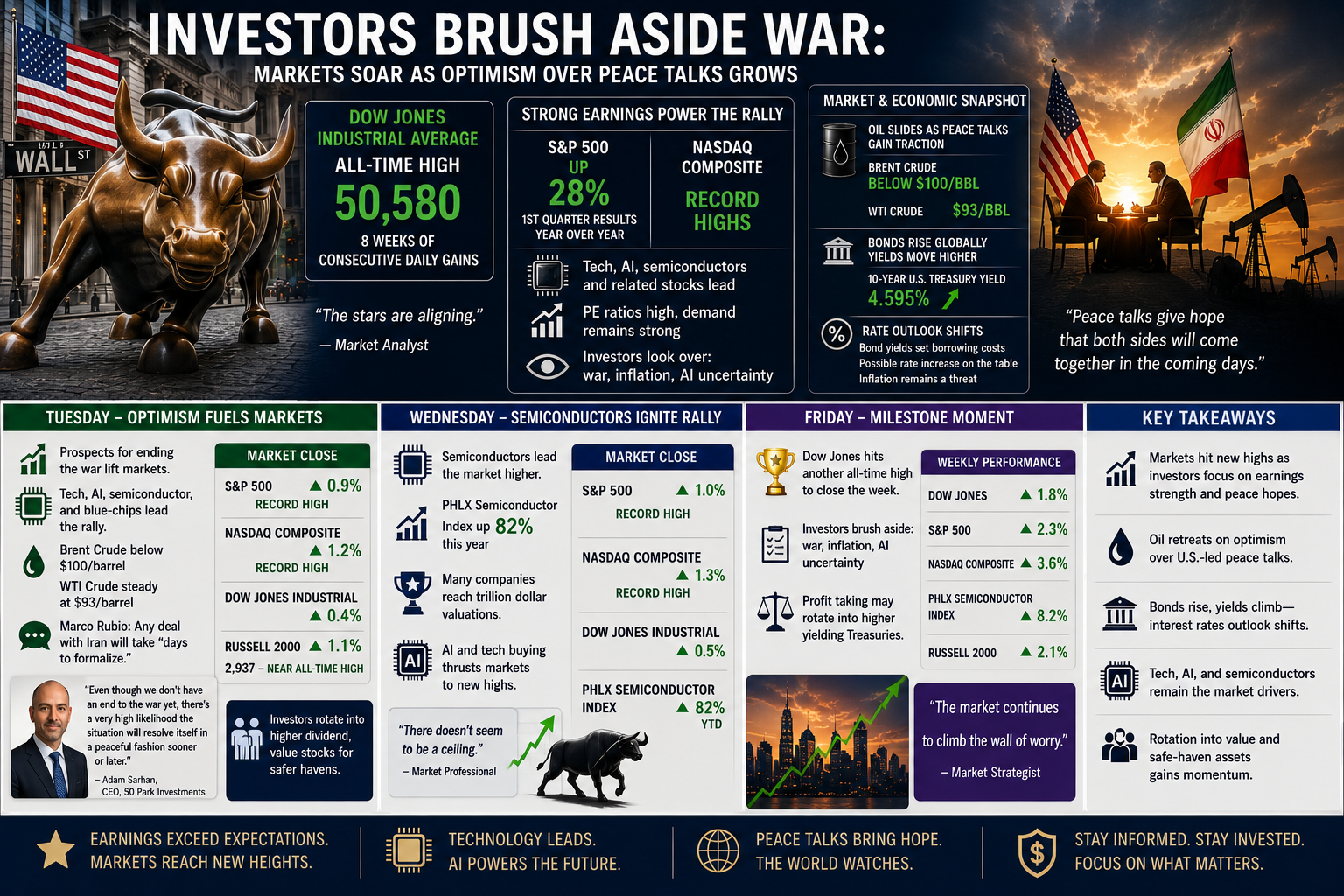
The Dow Jones Industrial Average hit yet another milestone Friday, closing at an all-time high 50580, boosted by a steady 8 weeks of consecutive daily gains. The “stars are aligning” as the S&P 500’s accent has been epic. Most companies in the index “have reported a jump in 1st quarter results of 28%”, year over year, according to FactSet. Earnings numbers have been extraordinary in an economy beset with major pitfalls. Investors and traders have contended with a Middle East War affecting oil significantly, along with creeping inflation, and the uncertain future of massive Artificial Intelligence build-outs. They have been able to ‘look-over’ all obstacles and drive markets higher with aggressive buying of technology, AI, semiconductor and related stocks. Indexes have soared, with stock prices at levels consistently in demand, and PE’s out of sight. Oil, up over 70% since the war’s start, has slowly begun to slide downward, evidenced on Friday as peace talks initiated by the U.S. have taken a more conciliatory mood, giving hope that both sides will come together in the coming days. Bonds have risen dramatically in the past several weeks in the U.S. and in worldwide markets, a strong indication interest rates are heading upward. Thoughts of a rate cut have given way to a possible rate increase as “bond yields set borrowing costs,” and threaten inflation. As yields continue to rise, investors are more likely to pivot from ‘hot stocks’ after profit taking into safer higher interest paying government Treasuries.
The shortened Memorial Day week opened Tuesday with market optimism high, as prospects for ending the war began to formulate, sending stocks higher. Technology, artificial intelligence, semiconductor, and blue-chips led to a strong market that led the S&P 500 and Nasdaq Composite indexes higher and to record highs. Brent Crude traded below $100 a barrel while West Texas Crude was steady at $93 a barrel. Secretary of State Marco Rubio cautioned that any deal with the Iranian Political Consortium would take “days to formalize, as it is difficult to gather 100% agreement amongst the hierarchy.” Adam Sarhan, chief executive of 50 Park Investments said: “Even though we don’t have an end to the war yet, there’s a very high likelihood the situation will resolve itself in a peaceful fashion sooner or later.” As Tuesday’s market closed, both the Nasdaq Composite and S&P 500 showed good gains as investors and traders were heavy buyers into techs and AI stocks, with semiconductor issues picking up steam. The Russell 2000 also was active as the smaller value-company index is 2937, near an all-time high. The index, in recent weeks, has been the go-to index for many investors looking to rotate capital into safer-haven higher dividend paying stocks.
Semiconductor stocks led the market Wednesday, driving the “red-hot” sector to unimaginable stock prices. The Philadelphia Semiconductor index (PHLX) is now up 82% this year, climbing every market day. A host of financial brokerages have recommended the hot sector, resulting in blazing movements upward. Many such companies are reaching the trillion dollar mark. All three indexes reached record highs again Wednesday, leaching off the buying pressure for semiconductor, artificial intelligence and technology stocks, as buyers’ enthusiasm continues to thrust the general markets to untold heights. As one market pro concluded: “There doesn’t seem to be a ceiling.”
RUMBLINGS ON THE STREET
David Bahnsen, chief investment officer of the Bahnsen Group, WSJ – “All the ingredients of the rally have held in there.”
Don Calcagni, chief investment officer at Mercer Advisors, WSJ – “There is a little bit of a disconnect between the bond market and the equity market. This is telling us that inflation fears are growing, and valuations are stretched.”
Jeff Blazek, multiasset co-chief investment officer at Neuberger, WSJ – “Stocks aren’t cheap, but they’re not horribly expensive. We like bonds, but we also like stocks.”
Jeff Bushbinder, chief equity strategist at LPL Financial, WSJ – “If we’re still looking at $100 oil in late summer, then the formula changes. Lower rates, more earnings–if we don’t get both these things then this stock market look expensive.