
May 31, 2026
Streaming’s Second Act: Ads Are Now the Score
Netflix, Disney, and Roku are chasing the same ad dollar. The gap is larger than it looks.
Streaming wasn’t supposed to become TV again. And yet here we are.
The first act was subscriber count and international expansion. The second act is advertising yield, ad load discipline, and who can turn viewing hours into high quality inventory without breaking the product. Markets don’t need a service to be loved. They only need the unit economics to hold together quarter after quarter.
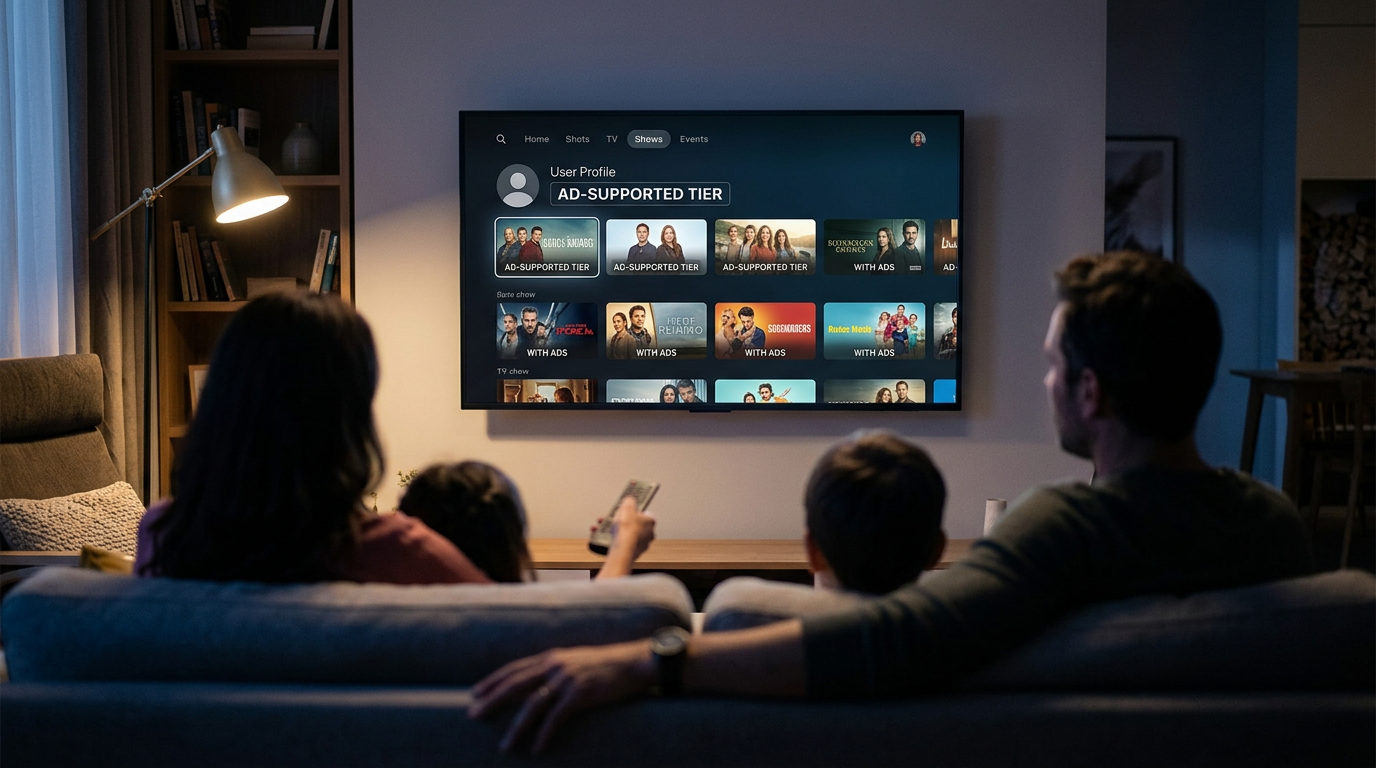
Slight tangent, but it matters: a lot of investors still talk about streaming like it is SaaS. It isn’t. It is closer to a hybrid of cable, digital video, and consumer subscription. That mix is exactly why the ad supported tier has become the cleanest lens for who is improving profitability and who is simply shifting revenue lines around.
The real reason Musk, Huang, Cook, and Fink just flew to Beijing
Last week, the CEOs of Nvidia, Apple, SpaceX, BlackRock, Goldman Sachs, Visa, Boeing, and more boarded Air Force One with President Trump to visit China. A U.S.-China trade deal would ignite a Melt Up in U.S. stocks, sending the market into a frenzy.
Learn the exact moves one Florida millionaire says to make today – before this window closes
The numbers that matter right now
Netflix (NFLX): In May 2024, Netflix said its ad supported plan drove over 40% of sign ups in countries where available, and the tier reached 40 million global monthly active users. That is the clearest public benchmark for adoption mix, and it is still the most widely cited figure in the market because Netflix later stopped providing regular subscriber counts. ([about.netflix.com](https://about.netflix.com/en/news/netflix-upfront-2024-the-year-of-growth-and-momentum?utm_source=openai))
Separately, third party measurement has suggested ad tier penetration rose meaningfully through 2025 in certain markets, with one report showing 40% of active accounts on Netflix’s ad tier in a sample of countries by Q3 2025. Third party data is not the same thing as company reporting, but it does reinforce directionally what the industry has felt: ad tiers are not a side project anymore. ([tvtechnology.com](https://www.tvtechnology.com/business/netflix-drives-global-growth-in-ad-supported-streaming?utm_source=openai))
Disney (DIS): Disney’s streaming segment (Disney+, Hulu, ESPN+) reported an operating loss of $18 million for fiscal Q2 2024 (three months ended March 30, 2024), narrowing sharply versus a $659 million loss in the prior year period. That is not victory, but it is a real shift in direction. ([latimes.com](https://www.latimes.com/entertainment-arts/business/story/2024-05-07/disneys-streaming-business-sans-espn-turns-a-quarterly-profit?utm_source=openai))
Roku (ROKU): Roku’s own disclosures show platform gross margin has typically sat in the low 50% range. For fiscal year 2025, platform gross margin was reported around 52.8% (with quarterly variation). This matters because Roku is still a margin story more than a pure growth story, and platform gross profit is where the model either works or doesn’t. ([last10k.com](https://last10k.com/sec-filings/roku?utm_source=openai))
Options trading has exploded in popularity.
But between expiration dates, premium decay, and volatility, it can quickly become more complicated than most people expect.
That’s why some traders are looking for ways to pursue options-style opportunities without trading options directly.
One trader claims he identified major market turning points in both 2022 and 2025 and has built a strategy around tracking institutional money flows through ETFs.
The approach has produced several notable winners along the way.
Now he’s sharing how the process works and what he’s watching next.
If you’d like that, take a look here now.
What the market is missing
A common mistake is treating ad supported streaming as “discount subscribers.” That framing is stale.
This is not about whether a user pays less. It is about whether the company can earn more per hour watched, and do it consistently. Subscription revenue is stable, but it is capped by price elasticity and churn. Advertising is cyclical, but it can scale with engagement, targeting, and measurement. Put those together and you get a different kind of compounding if the product stays sticky.
On pricing power: industry benchmarks for Netflix ad inventory often land in a premium band. Some industry summaries cite Netflix CPMs around the high $30s, with a broader premium streaming range often discussed as roughly $30 to $40 plus depending on targeting and placement. Treat those as market estimates, not audited figures, but the directional point is simple: the tier is not being sold like bargain basement remnant inventory. ([adwave.com](https://adwave.com/resources/tv-advertising-cpm-by-platform?utm_source=openai))
And here is where it gets interesting: if Netflix can keep ad load light while maintaining premium pricing, it is effectively selling scarcity. Scarcity is what protects yield when the ad cycle softens.
Macro to sector: why 2026 is a different ad year
CTV keeps taking budget. That is the steady backdrop.
One recent EMARKETER note highlighted a specific behavioral shift: 2026 US CTV upfront spend is expected to exceed primetime linear upfront spend (CTV $17.73B vs primetime linear $16.98B in that snapshot). That does not mean linear disappears. It does mean ad buyers are getting more comfortable committing dollars earlier to streaming inventory. ([emarketer.com](https://www.emarketer.com/content/digital-video-forecast-trends-q2-2026/?utm_source=openai))
If you are trying to understand who wins inside streaming, this is the constraint: ad buyers will pay up for reach plus measurement, but they will not tolerate fragmentation forever. Scale still matters, but so does the ability to prove incremental outcomes.
Company lens: three very different ways to win
Netflix is trying to win by controlling the full stack: global audience, content engagement, and more internal ad technology over time. The bet is that a unified product plus consistent viewing leads to repeatable ad performance. The adoption mix from the ad tier sign up data is the proof point that this is not a niche tier anymore. ([campaignasia.com](https://www.campaignasia.com/article/netflix-announces-ad-tier-milestone-and-adtech-platform/3xnqh29eokhs9dju1597qv6doi?utm_source=openai))
Disney is trying to win by bundling and by improving streaming economics while carrying legacy linear pressure. The streaming loss narrowing to $18M in fiscal Q2 2024 was meaningful largely because it showed the content cost and pricing actions were flowing through. But the whole enterprise still has to absorb linear declines, and that is why the equity often trades like a tug of war. ([latimes.com](https://www.latimes.com/entertainment-arts/business/story/2024-05-07/disneys-streaming-business-sans-espn-turns-a-quarterly-profit?utm_source=openai))
Roku is a different animal. It is not paying for premium global originals at Netflix scale. It is monetizing a platform layer: home screen, distribution economics, and advertising tools. That is why platform gross margin staying around the low 50s has been the anchor statistic. When platform gross margin holds, operating leverage has room to show up. When it slips, the “platform model” starts to look less inevitable. ([last10k.com](https://last10k.com/sec-filings/roku?utm_source=openai))
The real reason Musk, Huang, Cook, and Fink just flew to Beijing
Last week, the CEOs of Nvidia, Apple, SpaceX, BlackRock, Goldman Sachs, Visa, Boeing, and more boarded Air Force One with President Trump to visit China. A U.S.-China trade deal would ignite a Melt Up in U.S. stocks, sending the market into a frenzy.
Learn the exact moves one Florida millionaire says to make today – before this window closes
Options view: what volatility tends to do around this theme
I’m going to be careful here: without a live option chain in front of us, any exact implied volatility, IV percentile, or expected move numbers would be guesswork. And that is not worth doing.
What you can rely on structurally:
- NFLX tends to price options around earnings with a meaningful implied move, but the stock’s post earnings direction is often more about guidance and margin trajectory than subscriber headlines now that Netflix reduced subscriber detail.
- DIS frequently sees options pricing reflect both streaming progress and theme park plus linear uncertainty, which can make reactions feel “messy” even when streaming improves.
- ROKU has historically carried higher volatility characteristics than mega cap media names, and the market can react quickly to platform revenue growth and ad demand commentary.
If you want a clean way to think about defined risk structures around earnings windows, here are neutral templates that map to the economics without pretending to forecast direction:
- Directional but defined risk: debit spreads (call spread for upside, put spread for downside) sized so the max loss is known.
- Range bound expectation: iron condor style structures when you believe implied movement is rich relative to likely realized movement, with risk capped on both sides.
- Event driven hedge: a small long premium position (call or put) used to hedge an underlying exposure when the event risk matters more than the carry cost.
Risk, stated plainly
Advertising is cyclical. Even the best platform can’t fully escape a downturn in budgets, especially if measurement standards tighten or if brands shift money to retail media and social.
For Netflix specifically, the risk is less “can it sell ads” and more “can it maintain premium pricing without increasing ad load.” For Disney, the risk is that linear erosion offsets streaming progress for longer than expected. For Roku, the risk is that platform margin and growth do not travel together, forcing tradeoffs.
What I’m watching next
Not subscriber adds. Not press releases about “engagement.” The real tells are boring, and that’s why they work.
- Any disclosed mix shift toward ad supported plans, especially in higher ARPU regions.
- Disney streaming operating income trend by quarter, because the delta matters more than the level after such a large swing. ([latimes.com](https://www.latimes.com/entertainment-arts/business/story/2024-05-07/disneys-streaming-business-sans-espn-turns-a-quarterly-profit?utm_source=openai))
- Roku platform gross margin stability and platform gross profit growth, because that’s where the platform model is either strengthening or not. ([last10k.com](https://last10k.com/sec-filings/roku?utm_source=openai))
- Any credible commentary on CTV upfront commitments and measurement progress, since EMARKETER expects CTV upfront spend to exceed primetime linear in 2026. ([emarketer.com](https://www.emarketer.com/content/digital-video-forecast-trends-q2-2026/?utm_source=openai))
Wall Street: “Let Me Buy Your Algorithm”
This 20-year trading veteran once created a stock algorithm so powerful, Wall Street tried to buy it from him. Now, he’s built a BRAND-NEW market-crushing algo… and it’s flashing a HUGE opportunity that’s set to move THIS MONDAY.
Tactical checklist
- Write down the single metric you care about for each name before earnings (ad adoption mix, streaming operating income, platform margin).
- Compare the quarter over quarter change, not just the year over year headline.
- For options, keep risk defined first, and keep position size small enough that the earnings reaction is a data point, not a portfolio event.
- Revisit the thesis only after the conference call details, not after the first move.
Worth a look: pull the last two earnings decks for all three and track only two lines per company. You’ll see the whole story in about ten minutes, and you’ll also see what the market is likely to argue about next.