June 11, 2026
The Heat Problem Big Tech Can’t Ignore
Oracle’s spending shock points straight to Vertiv Holdings (VRT)
First a note from The Oxford Club
Most people trade earnings backward.
They try to guess what will happen before the announcement, which means even when a company beats Wall Street’s expectations, the stock can still turn around and fall hard.
I call that “Beat and Bleed,” and it’s exactly why I don’t like placing those kinds of bets.
My “Fast Cash” strategy is different because I wait until after earnings. I want the stock to show its hand first, then I look for post-earnings momentum backed by my 3 technical confirmations.
That is how top Profit Surge Trader examples could have turned a $5,000 start into:
$10,550 from RTX in 1 day…
$8,250 from FSLY in 1 day…
$11,640 from META in 18 minutes…
Again, these are top examples, not promises. Trading carries risk, no system wins every time, and you should never trade with money you can’t afford to lose.
But if you’re tired of waiting around for Slow Cash while the market keeps moving without you, I want you to see America’s Project: “Fast Cash” today.
Yours in smart speculation,
Nate Bear
Lead Technical Tactician, Monument Traders Alliance
Oracle reported after the close on June 10, and the stock got hit. Hard. Shares fell over 8% in after-hours trade and were down roughly 9% to 13% intraday on June 11 – not because the quarter was bad, but because the spending behind it was staggering. Capital expenditures for the fiscal quarter ending May 31 came in at $15.9 billion, pushing full-year capex to $55.7 billion – well past the company’s own $50 billion forecast. And the guidance for fiscal 2027 was even more alarming to Wall Street: the company flagged a capex ceiling of $95 billion and plans to raise approximately $40 billion in fresh debt and equity to fund it.
The revenue was actually fine. Total Q4 revenue hit a record $19.2 billion, up 21% year-over-year, slightly above the $19.1 billion consensus. Cloud infrastructure revenue – its IaaS business – grew 93% to $5.8 billion. Non-GAAP EPS came in at $2.11, beating estimates of $1.97. Oracle’s AI sales backlog stands at $130 billion, and GPU consumption for AI training grew 244% in the last twelve months alone. The demand side of this story is not in question.
What rattled investors was the denominator. Free cash flow for fiscal 2026 came in at negative $23.7 billion as Oracle poured capital into cloud infrastructure. The market is not questioning the growth – it is questioning who pays for it and how long before the returns show up.
Why This Matters Beyond Oracle
Here is what the Oracle selloff is actually telling you. It is not a referendum on cloud demand. It is a signal about the physical cost of AI at scale – and more specifically, about thermal physics.
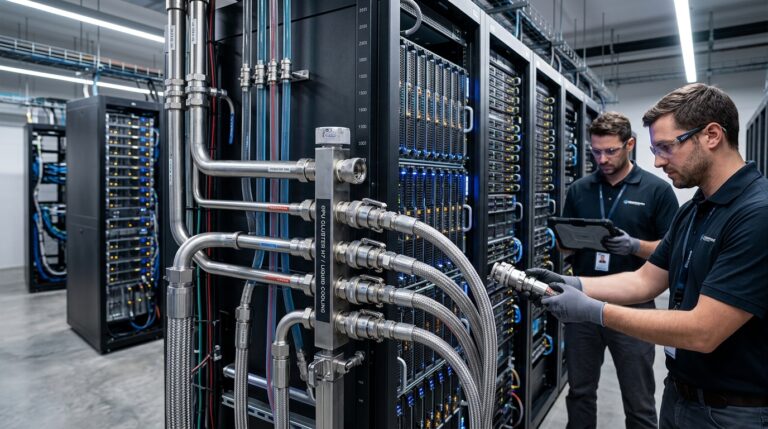
Traditional air cooling worked when server racks drew 10 to 15 kilowatts. AI training clusters running NVIDIA Blackwell and Rubin GPUs now push 120 to 150 kilowatts per rack. Air cannot remove that heat fast enough. The engineering math is blunt: as AI chip density compounds, the infrastructure holding those chips requires a complete thermal overhaul. Liquid cooling – cold plates, direct-to-chip systems, and full immersion – pulls heat directly from the processor and dramatically outperforms air in efficiency and density.
This is not a future problem. Liquid cooling is already the default specification for new hyperscaler facility designs. NVIDIA’s reference architectures for Blackwell and Rubin GPUs specify liquid cooling explicitly. Any data center built for serious AI workloads in 2027 or beyond will be built around liquid thermal infrastructure from the ground up.
Slight tangent, but worth noting: sovereign AI is becoming a parallel driver here. Nations are now building their own domestic AI infrastructure to protect data privacy, which means the addressable market for advanced thermal management is no longer confined to three or four American hyperscalers. It is global and expanding.
Vertiv Holdings Co. (NYSE: VRT) – The Data
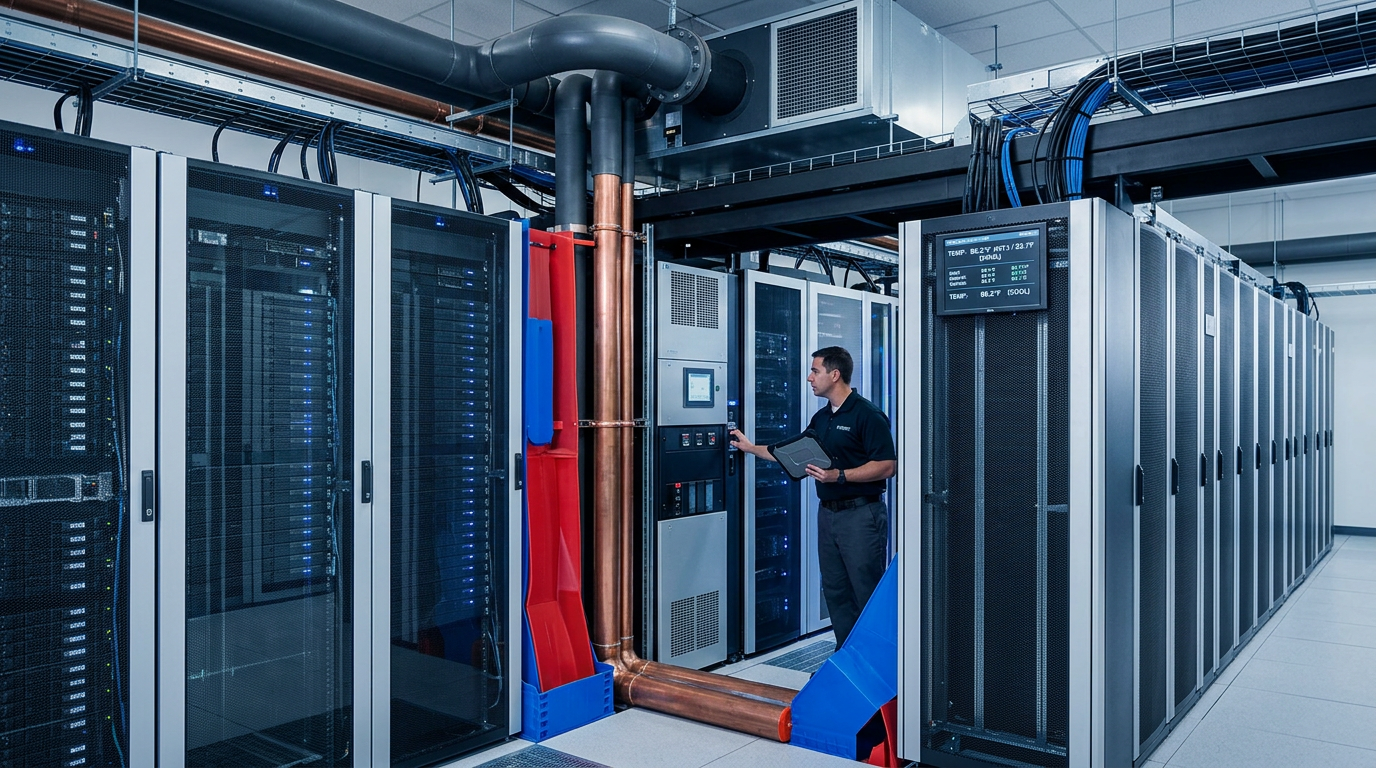
Vertiv is the company that builds the thermal management, power distribution, and critical infrastructure systems inside these data centers. It is not a chip company. It sits between the utility grid and the server racks – and right now, that positioning is worth more than almost anyone expected two years ago.
Full-year 2025 revenue came in at $10.23 billion, up approximately 28% from $8.01 billion in 2024. Q1 2026 net income reached $390 million on revenue of $2.65 billion, with adjusted diluted EPS growing 83% year-over-year and operating margin expanding 430 basis points to 20.8%. The company raised its full-year 2026 guidance at its May investor conference, now targeting net sales of $13.5 billion to $14.0 billion, adjusted EPS of $6.30 to $6.40, and adjusted operating margins of 23.3%.
The backlog number is the one that keeps standing out. As of Q4 2025, Vertiv’s backlog exceeded $15 billion – up 109% year-over-year. Q4 2025 organic orders grew approximately 252% year-over-year. Q1 2026 reports place the backlog still above $12 billion after record conversion. The pipeline is not slowing. Adjusted free cash flow in Q1 2026 reached approximately $653 million, up 147% from the prior year, with net leverage sitting at near-zero 0.2x.
Vertiv has been moving aggressively on acquisitions to lock in end-to-end thermal chain dominance. In April 2026, the company closed BMarko Structures to add structural fabrication capacity for converged infrastructure deployments. Later that month, it acquired Strategic Thermal Labs, enhancing engineering capability at the interface between server-side liquid cooling and supporting infrastructure. And in March 2026, Vertiv announced its intent to acquire ThermoKey, a leading provider of heat rejection and heat-exchange technologies, to extend its heat rejection portfolio for AI-ready data centers. The buildout is deliberate. This is a company assembling the entire thermal chain from the inside out.
Vertiv also deepened its NVIDIA partnership in 2026, co-developing an 800-volt DC power architecture aligned with the NVIDIA Rubin Ultra platform and launching a production-grade digital twin for AI factories integrated with NVIDIA Omniverse DSX Blueprint. It joined the S&P 500 in March 2026. The company announced roughly $50 million in investment to expand manufacturing in Ironton, Ohio, projects expected to increase liquid cooling and chilled water system capacity by approximately 45% through 2029.
The Structural Moat
There is a short list of suppliers with the scale, certifications, and engineering depth to bid on hyperscaler liquid cooling projects today. Vertiv is on that list. Most are not. That is the moat.
The stickiness goes deeper than brand recognition. Vertiv sells prefabricated modular solutions – essentially data centers in a box – that can be deployed rapidly to meet the aggressive build timelines of AI clusters. Once a hyperscaler integrates Vertiv’s thermal architecture into a live facility, mid-buildout substitution is operationally untenable. The proprietary systems, service contracts, and lifecycle management obligations bind customers to the platform across multi-year commitments. On June 9, 2026, Bernstein initiated coverage with an Outperform rating, citing robust earnings power as the core thesis. Citi raised its price target to $414. JP Morgan lifted its target to $350. The Street-wide mean target across 26 analysts currently sits near $377, with the high at $500.
What is interesting is how the analyst community has rarely been this aligned. Of 26 analysts currently covering VRT, 22 carry a buy or outperform rating, 3 hold neutral positions, and 1 carries an underperform. Oppenheimer raised its target to $353. Roth Capital lifted to $355. Evercore ISI maintains a Buy. TD Cowen remains a Buy. The consensus rating as of June 9, 2026 is Strong Buy.
This 4-Letter Ticker Unlocks Pre-IPO Access to America’s Most Secretive Tech Company
This company already has $26 BILLION in contracts with the Pentagon…
But it’s still private. So it’s off limits for most investors…
However, there’s a little-known ticker symbol that could get you in before the IPO boom – starting with just $20.
Options Market Analysis
VRT’s implied volatility rank is currently sitting in the mid-50s – elevated relative to its post-S&P 500 inclusion baseline, but not at the kind of panic-level readings that would suggest the market is pricing in a genuine breakdown. Options are not cheap, but they are not pricing in a binary event either. That mid-range IV environment is a workable one for traders with a directional view.
Put/call skew on VRT has been leaning modestly toward puts in recent weeks – consistent with broader market hedging rather than stock-specific bearish flow. The 30-day expected move on VRT is approximately 8 to 10% in either direction, reflecting both the stock’s beta to AI sentiment and its sensitivity to macro capex signals. Days like June 11 – where Oracle’s spending shock cascades into sympathy moves across infrastructure names – are exactly the kind of catalyst that can shift that range in a single session.
The part people skip: VRT has shown it can absorb AI sentiment volatility and still convert its backlog. The options market is pricing headline risk. The earnings trajectory is pricing something else entirely.
Structured Trade Framework
This is not financial advice. The following are defined-risk structural templates for analysis purposes only. All decisions carry risk of loss and should be evaluated against individual risk tolerance.
Bull Case – Bull Call Spread: For traders expecting continued guidance raises and backlog conversion through fiscal 2026. A defined-risk call spread 30 to 45 days out captures directional upside while limiting premium exposure in a mid-IV environment. The long leg absorbs directional movement; the short leg offsets cost. Max loss is the debit paid. If you believe the $13.75 billion revenue midpoint and $6.35 adjusted EPS guide hold or get raised again, the bull structure aligns with that conviction.
Bear Case – Put Debit Spread: If EMEA weakness deepens beyond management’s H2 2026 recovery guidance, tariff exposure re-accelerates margin compression, or a major hyperscaler announces a significant capex reduction, a put spread with 45 to 60 days to expiration defines the risk while positioning for a corrective move. VRT trades at roughly 46x forward earnings – peak growth and peak valuation multiples together carry real compression risk if execution misses even modestly.
Neutral Case – Short Iron Condor: For traders who believe the fundamental story is intact but the stock is range-bound near current levels while the broader market absorbs the Oracle capex shock and AI infrastructure sentiment recalibrates. Selling an iron condor collects premium from both sides with defined max loss on the wings. In a mid-50s IV rank environment, premium levels are sufficient to make this structure viable with appropriate strike selection.
Risk Analysis
The risks here are real and deserve honest framing. Hyperscaler concentration is the most obvious one – Vertiv’s revenue is tightly linked to a small number of massive customers whose capex decisions can swing violently, as Oracle just demonstrated. Categorical shifts in customer technology spending are listed prominently in Vertiv’s own SEC filings as a material risk factor. That is not boilerplate; it is the actual business risk.
EMEA headwinds remain unresolved. Management has guided for an H2 2026 recovery in the region, but that recovery has not yet materialized in reported numbers. Americas organic growth at 44% is carrying the overall company right now. If EMEA does not recover on schedule, the full-year revenue guide becomes harder to hit without Americas continuing to accelerate.
Valuation is the second-order risk. VRT stock has crossed 46x forward earnings – levels unseen in the company’s recent history. That multiple leaves no margin for error on execution. A single guidance hold rather than a guide raise could be enough to compress the stock 15 to 20% given where multiples currently sit. The bear case does not require a business deterioration. It only requires a deceleration.
Tariff exposure is still live. Vertiv cited tariff impacts and associated mitigation countermeasures in its Q1 2026 filing. The company has managed through the current tariff environment, but an escalation scenario reintroduces margin pressure that the current guide may not fully absorb.
Forward Outlook
The next catalyst is Q2 2026 earnings. Vertiv guided for Q2 net sales of $3.25 billion to $3.45 billion, GAAP net income of $477.2 million, and diluted EPS of $1.22. Adjusted EBITDA consensus for the June quarter is growing approximately 47% year-over-year. If the company hits the high end of that range and raises full-year guidance for the third consecutive quarter, the bull case strengthens materially.
The longer arc is worth sitting with. Oracle just told the market it is spending $95 billion on AI infrastructure through fiscal 2027. Microsoft, Google, Amazon, and Meta have collectively committed hundreds of billions more. Every one of those dollars requires somewhere to go physically – power systems, thermal management, modular deployment solutions. Vertiv does not need to win all of that spend. It only needs to hold its share of a market that is compounding at extraordinary rates.
Management has also outlined an M&A pipeline of $750 million to $1 billion focused on AI infrastructure – so the acquisition cadence of 2026 is not likely to slow. The ThermoKey heat rejection acquisition, the Strategic Thermal Labs cold-plate expertise, and the BMarko structural fabrication capacity all point to a company that is not waiting for customers to come to it. It is building the only end-to-end thermal chain at hyperscale capable of absorbing what the next three years of AI buildout actually requires.
The question worth leaving open: at what point does the market stop treating infrastructure spend as a cost problem and start treating it as a structural earnings machine for the suppliers who can deliver at scale? That answer is still being worked out. Vertiv’s backlog suggests the answer is already closer than the Oracle selloff implies.
Action Checklist
- Monitor Q2 2026 earnings date – guidance range is $3.25B to $3.45B in net sales and $1.22 diluted EPS; a beat and raise would be the third consecutive quarter of upward revisions
- Watch EMEA segment performance – management guided for H2 2026 recovery; confirm whether that materializes in Q2 results
- Track options flow into earnings – IV rank in the mid-50s makes defined-risk structures viable; avoid naked directional exposure given 46x forward earnings multiple
- Monitor hyperscaler capex announcements – Oracle, Microsoft, Google, Amazon, and Meta capex commentary directly impacts VRT order flow and sentiment
- Watch acquisition integration – BMarko Structures (April 2026), Strategic Thermal Labs (April 2026), and ThermoKey (pending close) need to contribute to margin, not just revenue
- Track backlog conversion – Q1 2026 backlog above $12B after record conversion; the rate of conversion into recognized revenue is the key earnings quality metric
- Analyst price target range: Street mean $377, high target $500, low target $260 – understand where current price sits relative to that distribution before sizing any position
- All trade structures carry defined risk – size accordingly, use spreads where appropriate, and treat this analysis as a framework, not a directive
– The Editorial Desk