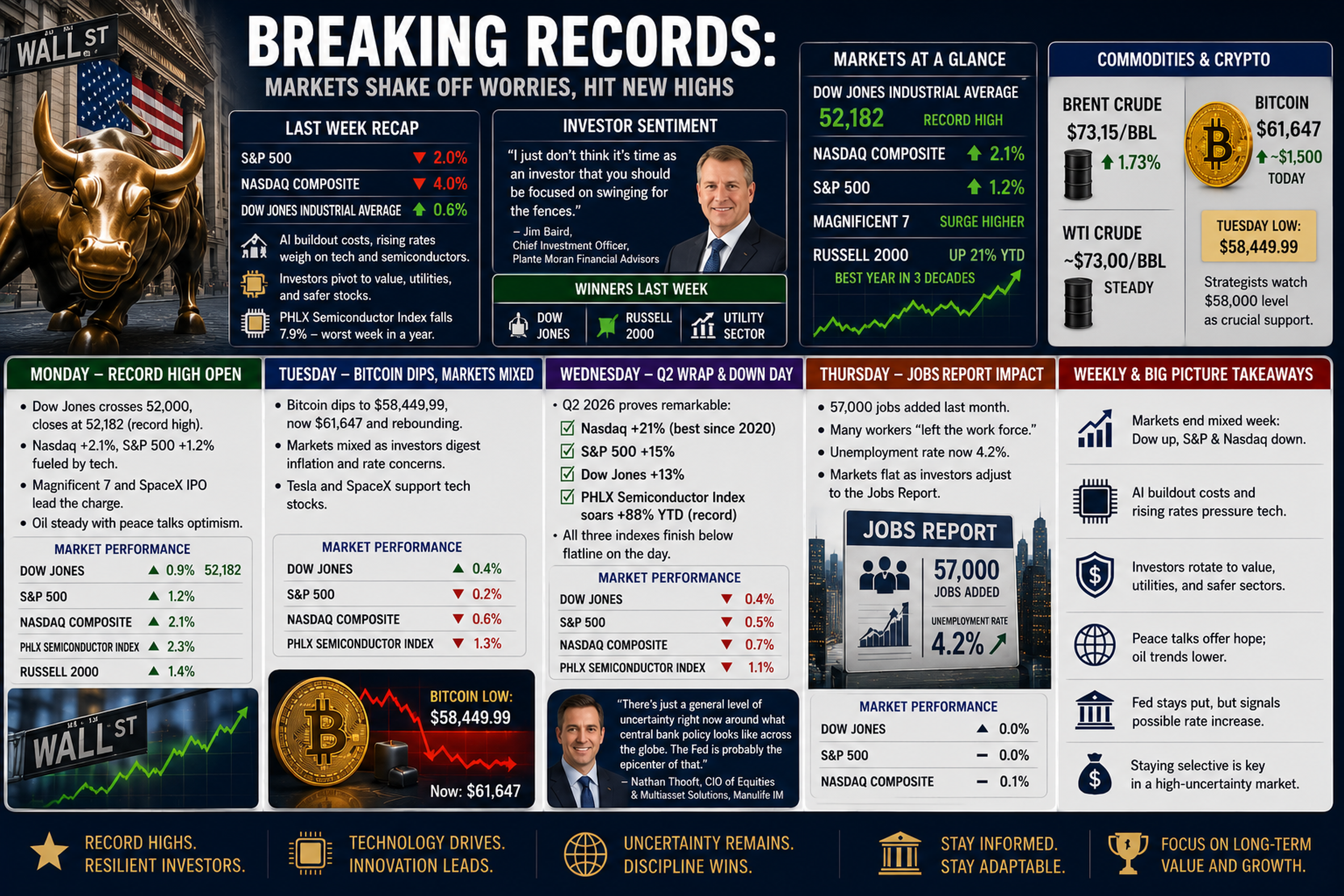
The market wobbled all last week with the S&P 500 and Nasdaq Composite losing 2% and 4% respectively. The formidable Dow Jones Industrial Average finished up 0.6% for the week. Persistent worries and concerns of the massive cost of the artificial intelligence buildout continue to weigh heavily on investors. Rising interest rates have added to the complicated situation. Heavy development financial costs, not yet justified by future earnings, have caused much skepticism, as debt load increases with climbing interest rates. “I just don’t think it’s time as an investor that you should be focused on swinging for the fences,” said Jim Baird, chief investment officer at Plante Moran Financial Advisors. The PHLX SEmiconductor Index fell 7.9%, “the worst week in a year.” Basic ‘bread and butter’ value stocks in the Dow Jones and Russell 2000 flourished as investors and traders pivoted away from technology and AI and semiconductors issues to safer ground. The quiet utility sector ‘picked up steam’ for several reasons; solid dividend histories, steady growth and peace-of-mind.
The Dow Jones Industrial Average crossed over 52000 level as the ‘blue chip’ index hit a record high Monday, closing at 52182. The technology sector fueled the indexes as the Nasdaq and S&P 500 climbed 2.1% and 1.2% respectively. The Magnificent 7 awoke, gaining on the heels of Musk’s Tesla and new IPO SPACE X stocks. The quiet, smaller company value stock index, Russell 2000 has had a substantial gain of 21% for the year according to the Wall Street Journal, with this year’s performance “the best in three decades.” Oil was shaky as the “resumption of peace talks” gave some optimism that retracting barrel prices would continue. Brent Crude added 1.73% to $73.15 a barrel with West Texas Crude steady near $73.00 a barrel. Bitcoin strategists have issued concern that the $58,000 level is a crucial stage that could be the start of severe declines in valuation. In trading Tuesday Bitcoin dipped to $58,449.99. Presently at $61,647 a coin and up near $1,500 today, the concern has somewhat diminished.
The second quarter of 2026 proved remarkable for the indexes. The technology–loaded Nasdaq Composite soared 21%, best gain since 2020. The S&P 500 climbed 15%, while the blue chip Dow Jones Industrial Average posted a 13% gain. The stubborn U.S. Israeli/Iranian War, rising interest costs and creeping inflation have not deterred investors and traders in their quest to invest heavily in the ‘hot markets’ of techs, Ai and semiconductors. The PHLX (semiconductor index) has soared up a record 88% this year. Even the tremendous build–out of artificial intelligence has not throttled investors’ enthusiasm. “There’s just a general level of uncertainty right now around what central bank policy looks like across the globe. The Fed is probably the epicenter of that,” said Nathan Thooft, chief investment officer of equities and multiasset solutions at Manulife Investment Management. New Fed Chief Kevin Warsh, has shown more concern about inflation than many expected as noted by The Wall Street Journal quote: As the inflation gauge is floating near 4.1%, much higher than the Fed’s target of 2%. Stocks were weaker Wednesday as all three indexes struggled, finishing below flatline. Techs and AI stocks were lethargic Thursday as the addition of 57,000 added hires last month indicated many workers “left the work force.” The unemployment rate now stands at 4.2%. Markets were flat all day as investors and traders adjusted to the Jobs Report.
RUMBLINGS ON THE STREET
Joe Mazzola, head trading and derivatives strategist at Charkles Schab, Barron’s – “The market’s breadth–the number of advancing stocks versus declining ones–has still been positive, even on days when tech is a mess. ‘This suggests investors are rotating their money into sectors beyond reach, a potentially healthy development.’”
Mark Hamkett, chief market strategist for Nationwide investment management group, WSJ – “I’m fearful that we’re building unintended leverage that isn;t fully understood. You’ve got people with a lottery mentality using margins to buy options on levered ETFs. That’s three or four layers.”
Dave Nadig, an industry veteran and director of research of ETF.com, WSJ – “Anytime you have any known in–advance, price–indiscriminate buyers and sellers, you have a problem.”