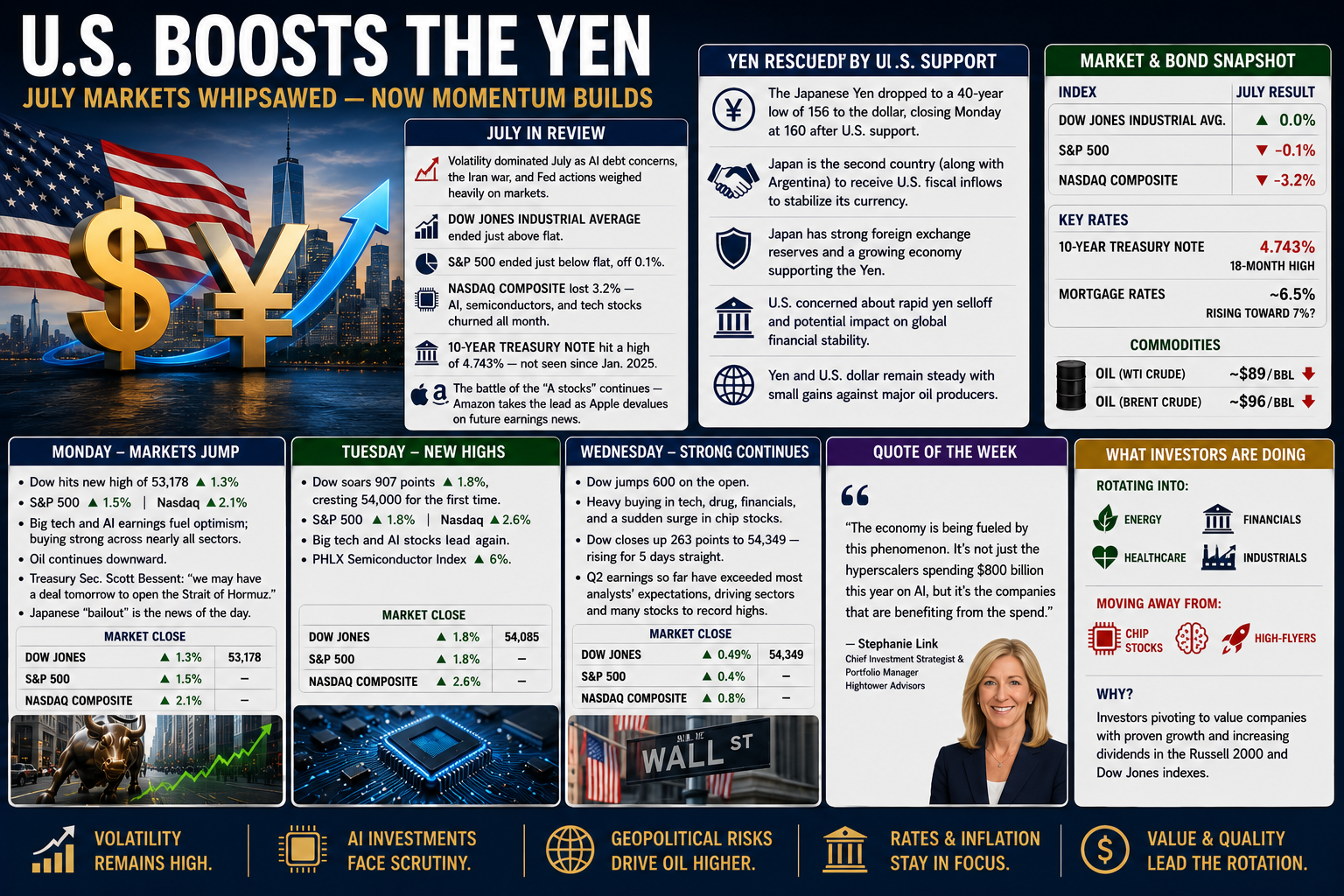
July was a topsy–turvey month for the markets as volatility undermined investors and traders. Artificial intelligence woes: the build–out of massive debt, the stubborn war with Iran and the Federal Reserve actions have handcuffed investors. Steve Sosnick, chief strategist at Interactive Brokers wrote, “It’s like being on a whale–watching trip. Everybody rushes to the side of the boat where there’s a whale, then rushes back to the other side when the whale swims under the boat.” July’s indexes were heavily influenced by a multitude of negative news struggling all month. The blue–chip Dow Jones Industrial Average finished the month just above flatline. The S&P 500 ended just below flatline, off 0.1%, while the heavy – technology Nasdaq Composite took the ‘biggest hit,’ losing 3.2%, as AI, semiconductors, and related tech stocks churned much of the month. Not surprising, the bond market was active as yields hit new highs. The 10–year Treasury note reached a high of 4.743% “not seen since January 2025.” The battle of the “A stocks” (Apple and Amazon) continues, as valuations fluctuate, with Amazon taking the title as Apple devalued on future earnings news.
The struggling, falling Japanese Yen was ‘rescued’ by President Trump, after dropping to a 40 year low of 156 to the dollar, closing Monday at 160. Japan is the second country to receive U.S. fiscal inflows from the U.S. along with Argentina. Both were stabilized as “under valuation” threatened both countries’ currencies. The Yen and Argentina’s Peso had both been drifting lower as inflation has increased significantly in both countries the past year. The difference between the 2 countries is that Japan has a “strong foreign exchange reserve and a growing economy” to support the Yen whereas Argentina lacks the basics of fiscal policy. President Trump considers Japan a “true friend and was happy to bolster their fiscal condition.” According to Paul Cavey, who runs ‘East Asia Econ,’ a consulting firm providing data for the region said: “The U.S. could be concerned about a rapid selloff in the yen that undermined global financial stability.” Japan has major investments in U.S. Treasuries that could be sold, putting bond yields in question. The U.S. dollar has stayed steady with the yen with small gains against major oil producing countries, backed by a U.S. economy that is sizzling.
Stocks on Monday jumped as the Dow Jones Industrial Average hit another new high of 53178, up 1.3%, while both the S&P 500 and Nasdaq were up 1.5% and 2.1%. Big tech and AI earnings gave investors and traders optimism as buying was heavy in nearly every sector. Oil continued downward as Treasury Secretary Scott Bessent told CNBC “we may have a deal tomorrow to open the Strait of Hornuz.” The Japanese ‘bailout’ was the ‘news-of-the-day’ as economists and analysts debated the fall–out. The Dow Jones hit yet another high on Tuesday, soaring 907 points, up 1.8%, cresting 54000 for the first time. The tech–heavy Nasdaq surged 2.6% while the S&P 500 gained 1.8%. Again big tech and artificial intelligence stocks drove the market. The PHLX Semiconductor Index was active, rising 6%. Wednesday opened positive as the Dow Jones jumped 600 on opening with heavy buying of technology, drug and financial stocks and… a sudden surge of buying of chip stocks. The Dow Jones finished up 263 points, to 54349, rising for 5 days straight. Quarterly earnings released so far have exceeded most analysts and strategists, driving every sector of the market and to many record highs. Stephanie Link, chief investment strategist and portfolio manager at Hightower Advisors said it best: “The economy is being fueled by this phenomenon. It’s not just the hyperscalers spending $800 billion this year on AI, but it’s the companies that are benefiting from the spend.”
RUMBLINGS ON THE STREET
Christian Hoffman, head of fixed income at Thornburg Investment Management, WSJ – “Warsh suggested policymakers should follow the bond market rather than lead it, and the bond market’s response was to punch him in the face.”
Rupal Bhansali, CEO, CFO, Double Duty Money Management, Barron’s – “Investors need to be vigilant about falling for the ‘hype’ trap–pricing cyclical earnings as though they were structural, and inflating the earnings and multiples.”
Mark Luschini, chief investment strategist at Janny, WSJ “This sort of malaise that we’ve seen is going to need to be shaken by some positive catalyst. Investors are perhaps a little bit exhausted with that AI narrative story.”