Editor’s Note: For nearly two decades, Whitney Tilson managed money for wealthy investors – growing a hedge fund launched from his spare bedroom into a firm running more than $200 million. Today, at least five billionaires follow his daily research notes. Now, he’s revealing what he believes is Warren Buffett’s final “hidden” legacy move – and three ways to get in early before a newly-IPO’d power company lights the blue touchpaper. See below for the details…
Dear Reader,
I think we can all agree Warren Buffett is one of the greatest investors who ever lived.
He compounded his money at around 20% a year for six decades…
By turning a dying textile mill into the most famous holding company on Earth – one valued at $1 trillion today.
But hardly anyone is paying attention to what I believe is his final – and least understood – bet in the market.
The details are all laid bare in a story ex $200M hedge fund firm manager Whitney Tilson calls “Project Vulcan”… and what it says about Buffett’s last bet is truly astonishing.
For years, Berkshire has been quietly building a dominant position in a niche type of energy production to fuel the AI build-out…
A fuel source The Economist says is “better than nuclear.”
And one the International Energy Authority predicts could be flooded with over $2.5 trillion of investment in the next decade.
It’s been overlooked by mainstream investors for years.
But an imminent power station switch-on – slated for this October – could be about to light the blue touchpaper in this sector.
And now Whitney is sharing all the details on this story… including three ways you could potentially profit before the big money piles in.
Get the full details on Whitney’s 3 “Project Vulcan” plays now.

Sincerely,
Matt Weinshenck
Publisher and Director of Research, Stansberry Research
P.S. The clock started ticking on this opportunity the moment Buffett handed the keys to his empire over to his hand-picked CEO. Watch my presentation now so you don’t get left behind.
Boeing’s Engineers Vote by Oct. 2. A Strike Could Hit 777X Certification.
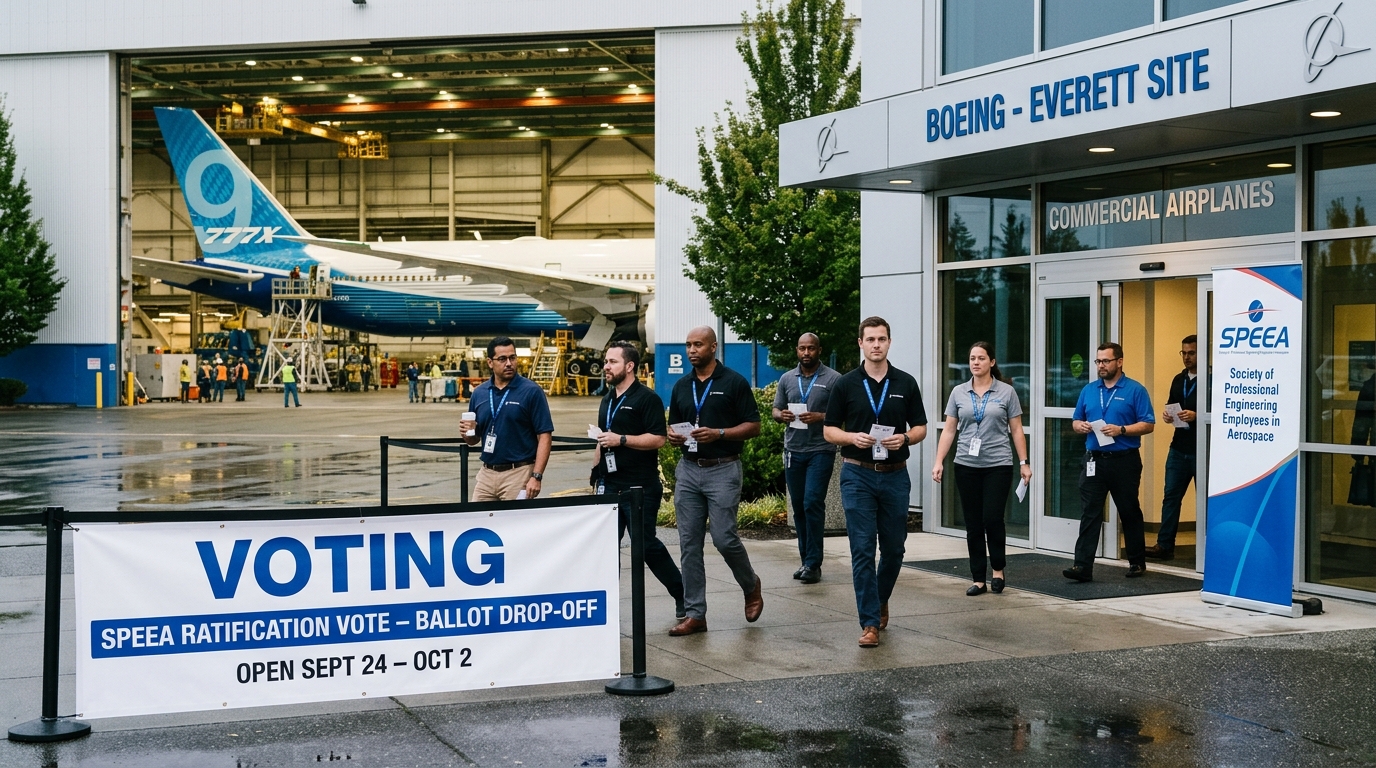
Boeing released the full terms of its revised SPEEA offer on the evening of September 17. The complete contract document is now in members’ hands ahead of an electronic ratification vote running from September 24 through October 2. The current contracts expire October 6. There is no ambiguity about the timeline. The outcome arrives before the deadline, or Boeing enters uncharted territory with its white-collar workforce for the first time in a generation.
This is not a wages story. It is a certification story wearing a wages story as a disguise.
What Is Actually on the Table
Boeing’s offer includes 34% in total wage funds over the life of the contract, with 26% of that fully guaranteed for every represented employee. A 10% guaranteed wage increase would take effect October 2 if the deal is ratified, followed by annual wage pools of 4%, 6%, 6%, and 6%, each with a guaranteed minimum of 4%. The union’s bargaining teams are recommending a yes vote.
The same bargaining teams recommended yes on the July 30 package. Members rejected that offer anyway, with 64.25% of professional unit ballots voting against. The Technical unit was more emphatic, rejecting by 71.87%. What changed structurally: the first offer had included retroactive pay to February 20, 2026, an amount equal to 40% of each member’s 2026 incentive bonus, and 40 restricted stock units worth more than $9,000. Boeing confirmed after the August rejection that the retroactive pay and higher 2026 incentive plan target were no longer available. The second offer has a higher guaranteed wage floor. It does not restore what was withdrawn.
The Operational Stakes
CEO Kelly Ortberg told investors at the Morgan Stanley Laguna Conference that a SPEEA strike would mean the 777X certification program shuts down until the engineers return. Boeing says it has a strike contingency plan aimed at maintaining some level of 737 production, but the company has also warned that a strike would have ripple effects into production.
Boeing holds 652 orders for the 777X family, including 270 from Emirates and 124 from Qatar Airways. Every week of delay in certification is a week of revenue that a company carrying $45.9 billion in debt cannot book. The 737 MAX 10 is also in the crosshairs: Ortberg said the model represents roughly 30% of Boeing’s backlog, and its certification process is highly sensitive to engineering availability.
The stock has already absorbed some of this. BA closed at $198.20 on September 18, after trading between $195.46 and $199.63. BofA identified a potential SPEEA strike as the key near-term concern ahead of the October 6 contract expiry while maintaining its Buy rating and $270 target. As of the September 18 close, BA is at $198.20.
Options Market Analysis
BA’s 30-day implied volatility is at 33, against a 52-week range of 25 to 46, placing IV rank near the middle of its annual band, not elevated enough to favor premium selling outright, but not cheap enough to buy volatility without a defined catalyst. The catalyst is dated and public: votes close October 2, contracts expire October 6. The October 9 expiration straddles the event cleanly.
Recent flow shows put volume at 45,620 against call volume of 90,080, a Put/Call ratio of 0.51, calls are running nearly 2-to-1 over puts, consistent with positioning that prices in resolution rather than escalation. That ratio can reverse fast if the vote fails. Unusual options activity has already been flagged in BA as of September 18.
Structured Trade Framework
Bull case (ratification): If the yes vote carries by October 2, the SPEEA risk premium deflates immediately. For traders expecting resolution, a defined-risk structure would be a bull call spread in the October 16 expiry, buying the 200 strike and selling the 210 strike. Maximum loss is the debit paid; the position profits if BA recovers toward analyst targets as the labor overhang clears.
Bear case (rejection and strike): A second rejection would be structurally worse than August’s, because retroactive pay is already gone and Boeing has fewer concessions remaining. For traders expecting a no vote, a bear put spread buying the 195 strike and selling the 185 strike in the October 9 expiry frames the downside with defined risk. Technical support sits at $197.12, with downside risk toward $189.35 if that level fails.
Neutral case: With IV rank near 40 and a hard resolution date, a short strangle, selling the October 9 200 call and 190 put, collects premium if BA stays range-bound through the vote. Risk is undefined to the upside; adjust position size accordingly.
Risk Analysis
The two units vote separately under separate contracts. The Professional unit covers roughly 13,000 members and the Technical unit roughly 4,000, and the units split in 2020. A partial ratification, professionals approve, technicals reject, creates a more complex outcome than either clean scenario and may not resolve the options overhang before October 6.
Ratification would cost Boeing roughly $240 million a year in base salary, which is immaterial against 2026 free cash flow guidance of $1 to $3 billion. The financial cost of settling is manageable. The financial cost of a prolonged engineering walkout, measured in 777X certification months and MAX rate slippage, is not.
Action Checklist
- Monitor the September 24 ballot opening for any early SPEEA commentary on member sentiment.
- Results announced by SPEEA on or before October 2. Position expiry selection should account for that date, not October 6.
- Watch the Technical unit result separately. A split vote is the ambiguous outcome the market is least priced for.
- IV rank near 40 does not strongly favor buying or selling premium; defined-risk spreads on either side are the appropriate structure.
- BofA’s $270 target and Tigress Financial’s $305 target represent the consensus bull case on resolution; those levels frame the upside of any call spread.