
September 6, 2026
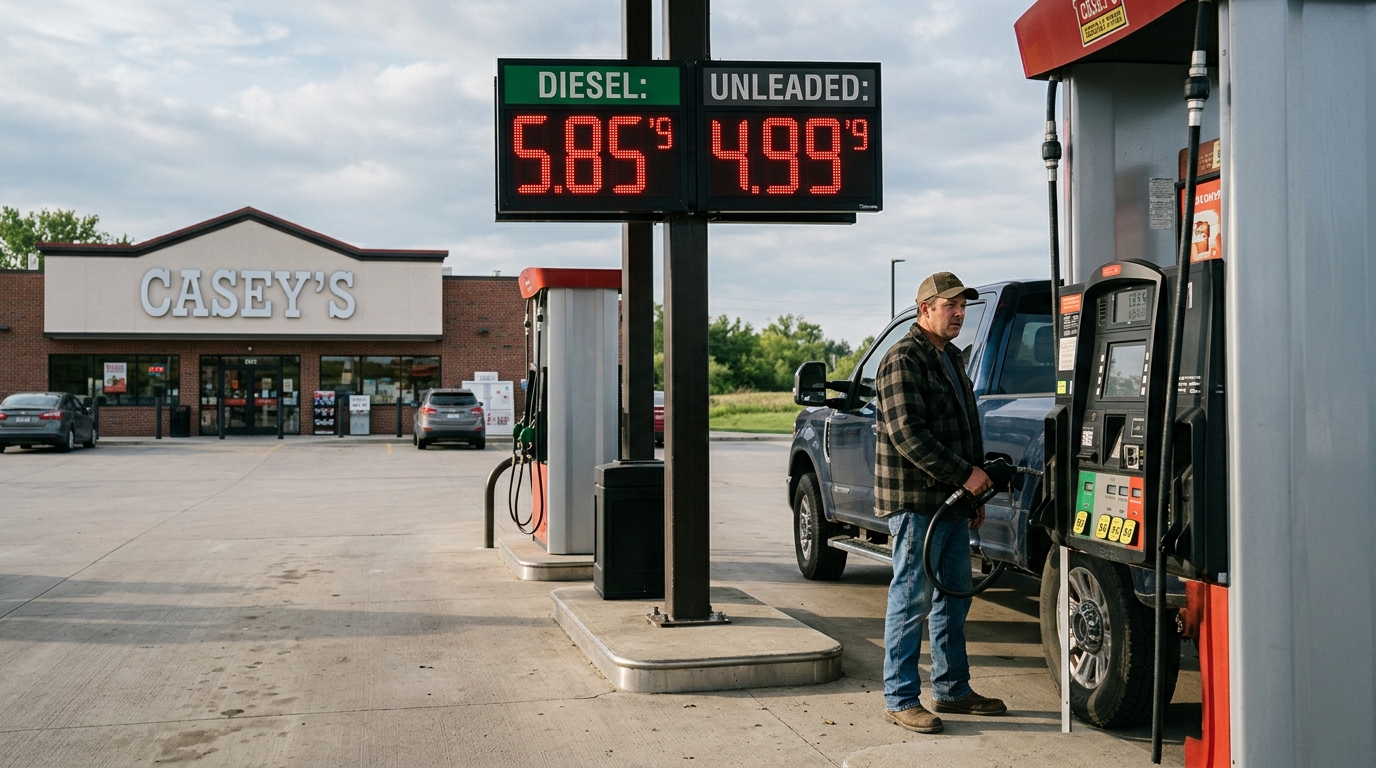
Diesel just hit $5.85, and Tuesday’s report tests the fuel-margin model.
Pump economics work differently for the operator than for the driver. When gasoline and diesel prices spike, consumers wince. Convenience store retailers with disciplined wholesale fuel procurement can widen their cents-per-gallon margins precisely because retail prices lag spot moves on the way up. Casey’s General Stores (CASY) heads into Tuesday’s fiscal Q1 2027 report carrying the tailwind of exceptionally high fuel prices, but also the risk that record wholesale costs finally caught up with the spread.
Gold Majors Are Running Out of Gold
Here’s a “secret” the largest gold miners don’t advertise… They’re running out of gold. The second-biggest miner on earth is watching its production collapse from 2 million ounces a quarter down to 719,000 – and another major just paid $15 billion for a rival in the biggest gold deal in history, only to see its output stay flat. They can’t drill their way out fast enough, so they have to buy their way out. Which means gold just entered its acquisition phase – where the best small miners get bought out at whatever premium it takes. Already, my readers have enjoyed overnight buyout premiums of 40%… 67%… 79%… and the acquisition phase has barely begun.
Go here to see details on my current top three buyout picks.
The macro context is unambiguous. Gasoline reached about $4.15 a gallon ahead of Labor Day, while diesel hit a record $5.85 per gallon, eclipsing the prior June 2022 mark near $5.82. Higher prices reflect constrained global fuel supplies tied to the Iran conflict and the Russia-Ukraine war. For Casey’s, the quarter that closed July 31 covered almost the full run of this surge.
What the Street Expects
Analysts expect Casey’s to report a profit of $6.58 per share on a diluted basis, up 14% from $5.77 per share in the year-ago quarter. Revenue consensus sits near $5.56 billion. For the full year, analysts project EPS of $21.14, up 10.3% from $19.16 in fiscal 2026, with further growth to $23.49 expected in fiscal 2028.
The bar matters in context. In the most recent quarter reported, Casey’s beat the consensus EPS estimate of $3.31 by $1.06, delivering $4.37. Fuel margin hit 46.9 cents per gallon that quarter, a company record. The question for Q1 FY2027: did they repeat it in an even more extreme fuel environment?
The Margin Equation
For full fiscal 2026, fuel gross profit was up 21%, with total fuel gallons sold up 10% and fuel margin averaging $0.426 per gallon, as management credited the capabilities of the fuel team developed over prior years to excel during volatility. That averaging disguises the quarterly peaks; the Q4 print of 46.9 cents shows what is achievable when crude runs fast and retail pricing is disciplined.
5 Little-Known Stocks Behind Today’s Defense Tech Shift
Behind the headlines, a major transformation is underway.
Modern warfare is being driven by AI, autonomous systems, and next generation technology. A handful of lesser known companies are helping power this shift.
This report uncovers five stocks quietly playing a critical role in the future of defense.
The inside-store dynamic is the counterweight. Management guided fiscal 2027 for inside same-store sales growth of 2% to 5% with inside margin above 42%. High pump prices can depress the basket: consumers who stop only to fuel up spend less on prepared food, beverages, and snacks. Casey’s pizza and foodservice operation is large enough, ranking the company as the fifth-largest pizza chain in the nation, that any traffic softness registers immediately in same-store comps.
Stock Context and Analyst Positioning
CASY has outperformed the S&P 500’s 16% gain over the past 52 weeks, with shares up 61.8%, and considerably outperformed the Consumer Discretionary SPDR’s 1.4% decline over the same period. That run carried shares to a 52-week high of $927.85. As of September 4, the stock traded in a range of $747.28 to $767.00, sitting roughly 18% below that peak. Deutsche Bank recently lowered its price target to $927 from $1,000 while maintaining a Buy rating, signaling valuation compression rather than fundamental concern.
Options Market Analysis
Options data compiled by Bloomberg implies a 6.9% move when Casey’s reports earnings September 8 after the market close. On a stock trading near $758, that translates to a roughly $52 expected swing in either direction. History suggests the realized move frequently exceeds the implied. On June 9, 2026, options implied 7.0% while the actual price change was 22.8%. On March 9, the implied was 5.8% versus an actual 0.6% move. On December 9, options indicated 6.1% against an actual decline of 6.3%. On September 8, 2025, the implied was 6.2% versus an actual gain of 9.5%. The distribution is wide and asymmetric. CASY has beaten to the upside more violently than it has missed. Current Put/Call flow sits near 0.56, suggesting call positioning outweighs put protection ahead of the event.
Structured Trade Framework
Bull case: If you believe fuel margins held above 44 cents per gallon and inside same-store sales met or exceeded guidance, a defined-risk long structure makes sense. A bull call spread with the long strike near $760 and the short strike near $820 caps upside but limits premium at risk to the net debit paid, with the position profitable if CASY breaks above the lower strike plus the debit by expiration.
5 Little-Known Stocks Behind Today’s Defense Tech Shift
Behind the headlines, a major transformation is underway.
Modern warfare is being driven by AI, autonomous systems, and next generation technology. A handful of lesser known companies are helping power this shift.
This report uncovers five stocks quietly playing a critical role in the future of defense.
Bear case: For traders expecting fuel margin compression or inside-store traffic erosion from high pump prices, a defined-risk put spread anchored near current levels with a short strike near $700 isolates the downside without unlimited exposure. The risk is capped at the net debit.
Neutral case: Given the 6.9% implied move and CASY’s history of realized moves that overshoot in both directions, selling premium via an iron condor centered on $760 collects the volatility crush post-earnings. Short strikes placed at approximately $810 and $710 leave room for the implied move while keeping defined maximum loss on both wings. This structure benefits most if the stock settles within the expected range.
Risk Factors
Three risks are worth quantifying before Tuesday’s close. First, wholesale cost spikes can erode margin even with disciplined retail pricing if the timing mismatch is severe enough. Second, the stock’s 39x trailing P/E offers little cushion against a guidance cut. Management guided for 8% to 10% EBITDA growth in fiscal 2027 and at least 120 new store openings. Any downward revision to those figures carries multiple compression risk at current valuations. Third, inside-store basket deterioration in a high-fuel environment is a lagged signal; the worst traffic impact may not yet be visible in Q1 data.
Forward Outlook
The EIA expects Brent crude oil prices to average $85 per barrel in Q3 2026, before dropping to $69 per barrel in 2027 as inventories rebuild and production increases. A structural easing of fuel prices would compress Casey’s fuel margin windfall but potentially restore inside-store traffic. The longer-term thesis, Casey’s executing a classic consolidation story in a fragmented gas and convenience market, using a strong balance sheet and steady cash flow to fund acquisitions and expand territory, does not change on a single quarter. What changes is the margin mix underpinning it.
Action Checklist
- Watch fuel cents-per-gallon margin: above 44 cents is bullish signal, below 40 cents introduces downside risk to full-year EPS estimates.
- Monitor inside same-store sales growth: the 2% to 5% guidance band is the fulcrum between an inline and a miss scenario.
- Options: 6.9% implied move translates to roughly $52 either direction from $758. Use defined-risk structures only.
- Watch management commentary on wholesale fuel cost trends through August, given diesel hit $5.85/gallon as recently as September 4.
- Peer read-across: Murphy USA (MUSA) and Sunoco (SUN) fuel margin commentary will provide real-time calibration on sector-wide CPG dynamics heading into this print.