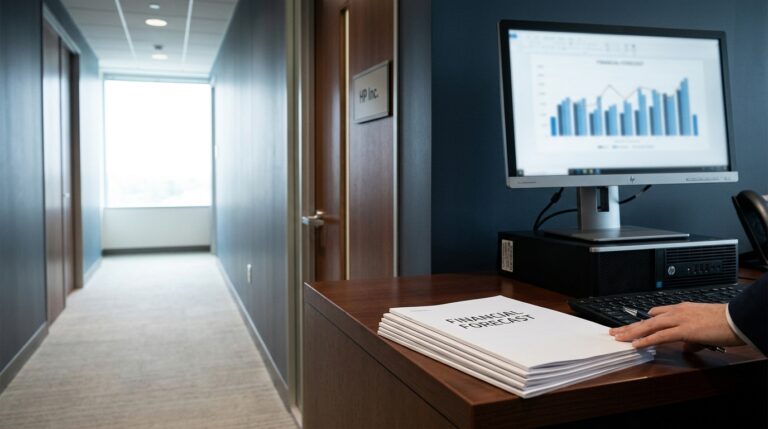
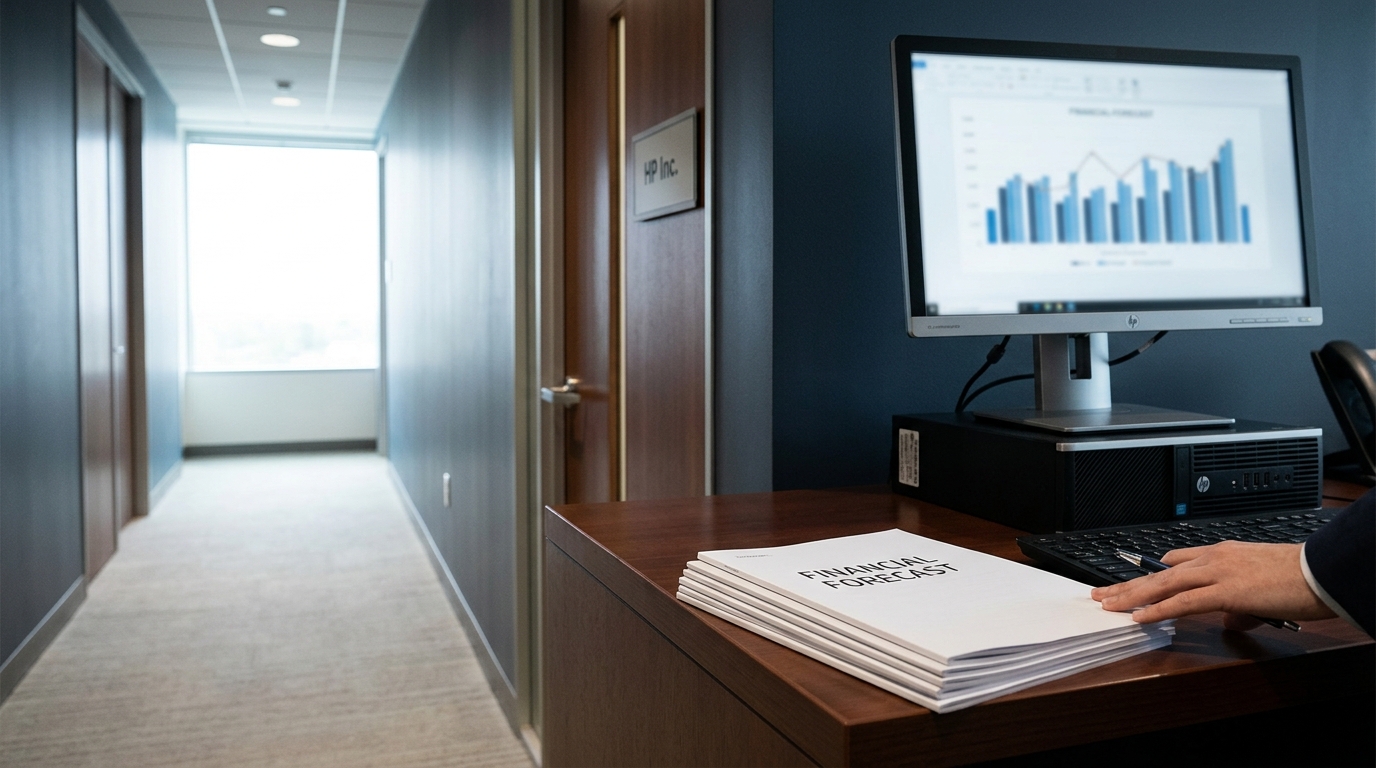
HP Inc. pays $1.20 per share annually in dividends and carries a yield near 3.5% as of mid-September 2026. That income stream has survived ten consecutive years of increases since the company’s separation in 2015. What it has not faced before is a memory cost shock of this magnitude arriving at the same time the company is warning the SEC that the PC market will shrink again in 2027.
In a fresh SEC filing, HP cautioned that it expects global PC unit volumes to shrink by mid-single digits in calendar 2027 compared to 2026. The company stressed that the projection is a market assumption rather than formal financial guidance for fiscal 2027, noting it remains in its planning period for fiscal 2027 and is not providing financial guidance at this time, the same position it held around its August 26, 2026 earnings release and conference call. That silence is doing real work. Investors cannot model a dividend coverage ratio they cannot see.
The memory situation is the reason HP is reluctant to commit. HP has said memory costs increased roughly 100% sequentially from fiscal Q1 to fiscal Q2 of 2026, with expectations for further increases through the year, pressuring margins. In the most recent quarter, Personal Systems operating margin came in at 4.6%, below the long-term range due to higher commodity costs. Management has said it expects Personal Systems margins to bottom in fiscal Q4 2026, then improve in fiscal 2027 as mitigation actions ramp.
The supply side of this problem is structural, not seasonal. Reports have said the memory industry’s tightness is being driven by AI demand and long-term agreements, with HBM capacity booked out and conventional DRAM tightening behind it. HBM also consumes materially more wafer capacity than commodity DRAM, leaving fewer resources for the chips that go into PCs, smartphones, and cars. According to TrendForce, conventional DRAM contract prices jumped about 90-95% in the first quarter of 2026 and another 58-63% in the second quarter. That is the cost pressure HP has been working through in Personal Systems.
Now for the dividend math. HP’s payout ratio has recently been in the low-to-mid 40% range, which looks manageable on earnings. The real question is free cash flow. On its fiscal Q3 2026 call, HP said year-to-date free cash flow was more than $2.5 billion and it raised full-year free cash flow guidance to $3.0 to $3.2 billion. Annual dividends at $1.20 per share across about 902 million shares outstanding run roughly $1.1 billion. At the guided free cash flow midpoint, dividend coverage remains about 2.9 times. The payout is not in immediate danger.
But fiscal 2027 is the unknown. Higher component costs are pressuring PC units and Personal Systems margins, and HP has told the market nothing about how far those pressures extend into next year. The company noted its planning assumption depends on market performance in the second half of calendar 2026, which it described as remaining fluid and subject to change. If the memory squeeze keeps Personal Systems margins at or below 4% for three more quarters, earnings estimates will fall, and the payout ratio will climb toward the top of its historical range.
The bull case rests on HP’s demonstrated ability to pass cost through pricing. In fiscal Q3 2026, revenue was $15.7 billion, up 12.5% year-over-year, with Personal Systems revenue of $11.8 billion rising 18%. Higher average selling prices are doing the job that unit volume cannot. Commercial Personal Systems revenue grew 22% in the quarter, and commercial represented about 73% of Personal Systems revenue, a mix that can support margin recovery once input costs stabilize.
The bear case is simpler: memory costs stay elevated through all of 2027, unit volumes fall as HP projected, and pricing power erodes as Dell and Lenovo fight for shrinking share. In that world, fiscal Q4 2026 becomes a low-water mark that does not recover as cleanly as management expects. Management has said it expects to discuss its commodity mitigation and the path forward as it reports fiscal Q4 results. That is the number to watch. If the cost roadmap for 2027 looks credible at the Q4 call, the dividend is a real return. If it does not, the stock has further to fall.