May 13, 2026
The Most Important Tech Trip of 2026
Trump. Xi. Huang. And a $50B chip market hanging in the balance.
What You Need to Know
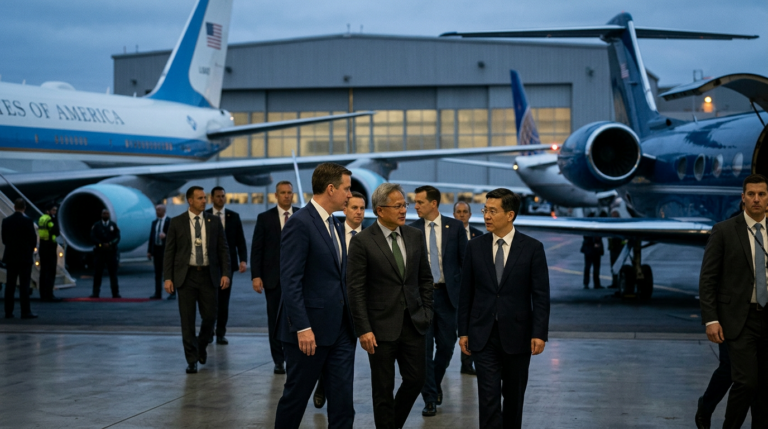
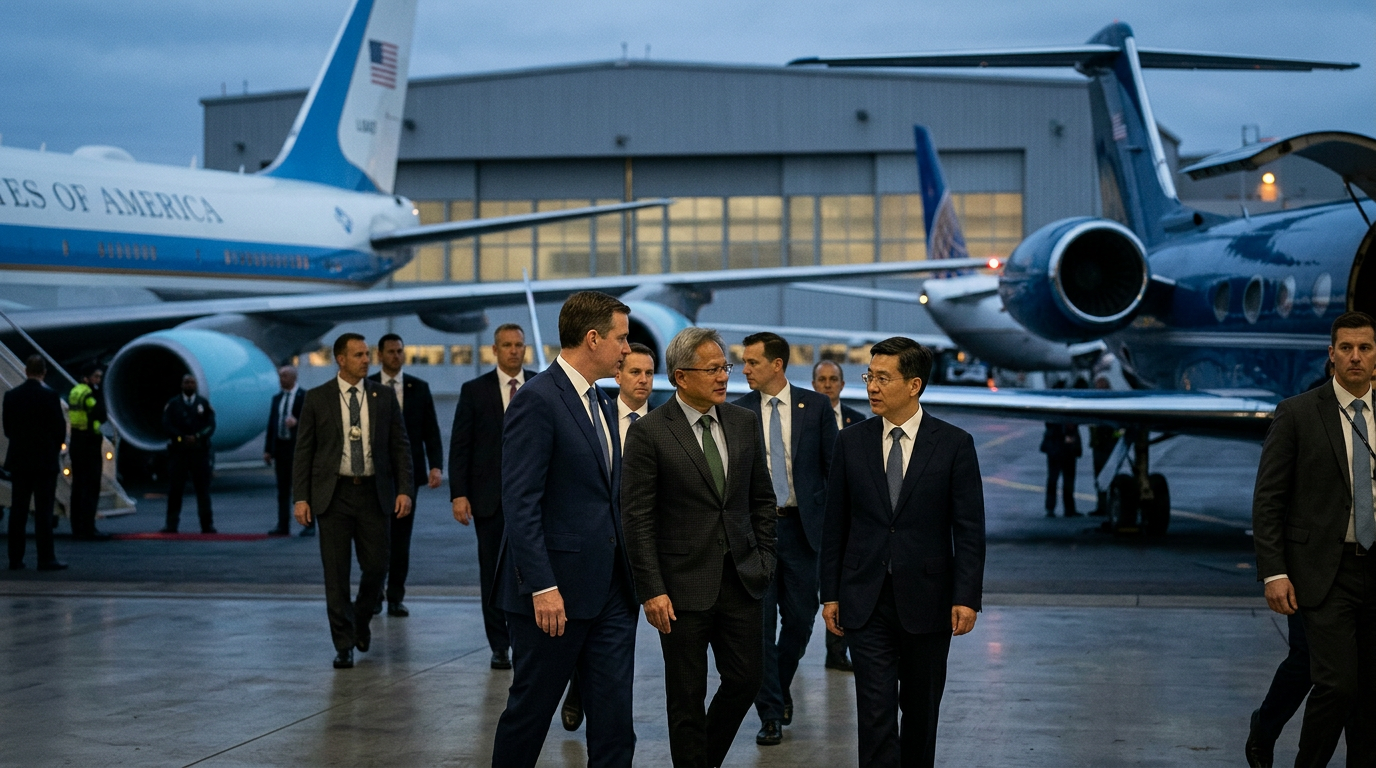
- Jensen Huang was not on the original delegation. Trump called him last-minute. Huang flew to Anchorage and boarded Air Force One mid-route to Beijing.
- Nvidia’s China revenue has fallen to effectively zero since H20 export restrictions in April 2025 – representing a $50B addressable market now sitting idle.
- A bilateral tariff truce struck May 12 cut U.S. tariffs on Chinese goods from 145% to 30%. The truce has a 90-day clock ending mid-August.
- China’s SAMR paused antitrust investigations into Nvidia, Qualcomm, and Intel ahead of the summit as a goodwill gesture.
- Beijing holds meaningful leverage via Iran crude purchases and rare earth export controls – China refines ~87% of the world’s rare earth supply.
- NVDA trades ~25x forward earnings with zero China data center revenue in guidance. Any policy shift makes that guidance conservative fast.
He wasn’t on the list. Then Trump called him. Then Jensen Huang flew to Anchorage, Alaska, to board Air Force One mid-route.
That sequence tells you almost everything you need to know about where U.S.-China tech policy stands right now – and why the next 72 hours in Beijing might matter more to semiconductor investors than any earnings call this year.
What Actually Happened
President Trump landed in Beijing today – May 13 – for a state visit with Chinese President Xi Jinping. It’s the first time a sitting U.S. president has been to China since Trump’s own trip in November 2017. On the agenda: trade, Taiwan, AI infrastructure, and the ongoing Iran conflict, which has closed the Strait of Hormuz and pushed U.S. gasoline costs up more than 28% from a year ago.
The business delegation is substantial – Elon Musk, Tim Cook, Larry Fink, David Solomon, Sanjay Mehrotra of Micron, Cristiano Amon of Qualcomm. A serious group. Jensen Huang was not on that list Monday. Congressional China hawks noticed immediately. House Foreign Affairs Chair Brian Mast put it bluntly: “The joke here is, Jensen wants us to trust the CCP.”
Then Trump saw the coverage. He called Huang. Huang flew to Alaska and boarded Air Force One at the Anchorage refueling stop. Trump posted on Truth Social that Huang had “always” been on the plane. An Nvidia spokesperson later confirmed: “Jensen is attending the summit at the invitation of President Trump to support America and the administration’s goals.”
This is not a routine diplomatic footnote. It’s a last-minute, president-initiated inclusion of the CEO whose company sits at the center of the most consequential bilateral tech dispute in the world.
The Opportunity Often Comes Before the Listing
Med-X is preparing for a potential Nasdaq listing under the reserved ticker MXRX, giving early investors an opportunity to invest before broader public market exposure.
The company has already generated millions in sales, operates across 41 markets, carries zero long-term debt, is backed by Maxim Group Investment Bank, and has retail distribution through Amazon, Walmart, and Kroger.
As demand continues to grow for safer, plant-based pest control solutions, Med-X is positioning itself within the rapidly expanding $17.6B biopesticide market.
Explore Med-X and become a shareholder at $4/share ahead of its planned Nasdaq listing
Disclosures: This is a paid advertisement for Med-X’s Regulation A+ Offering. Please read the offering circular at invest.medx-rx.com.
The Numbers Behind the Tension
China accounted for 13% of Nvidia’s fiscal year 2025 revenue. That market has since gone to effectively zero. Export restrictions imposed in April 2025 halted H20 chip sales – the downgraded GPU Nvidia engineered specifically to comply with prior control thresholds. Nvidia took a $4.5 billion inventory charge, then absorbed an estimated $8 billion in lost H20 revenue. The company guided Q1 fiscal 2027 at $78 billion – well above the $72.6 billion Wall Street expected – but explicitly excluded any China data center revenue from that figure.
Full fiscal year 2026 revenue came in at $215.9 billion, up 65% year over year. Q4 alone posted $68.1 billion with data center revenue of $62.3 billion driven by Blackwell chip demand. The company is not hurting. But Huang has publicly valued the addressable China AI chip market at roughly $50 billion – and that number is sitting at zero right now.
In December 2025, Trump gave Nvidia conditional approval to sell H200 chips to approved Chinese customers. As of early May, those sales had not materialized. Commerce Secretary Howard Lutnick told lawmakers: “We have not sold them any chips as of yet.” That statement conflicted with remarks Huang made in March and prompted a formal congressional inquiry. Nvidia’s China AI chip market share has since fallen to approximately 5% – down sharply from 2024 levels.
Why Beijing Holds Leverage
U.S. tariffs on Chinese goods peaked at 145% before a bilateral truce on May 12 brought them down to 30%. Chinese tariffs on U.S. goods dropped from 125% to 10%. That truce came after preparatory talks on semiconductors, rare earths, and the suspension of Chinese antitrust investigations into Nvidia, Qualcomm, and Intel – paused by China’s SAMR as a goodwill gesture ahead of the summit.
The Iran conflict has closed the Strait of Hormuz – through which roughly 20% of the world’s oil previously transited. China has managed that disruption well, leaning on strategic reserves and overland pipeline infrastructure. Beijing purchases more than 80% of Iran’s exported crude. Xi has leverage here that Trump needs. That’s not a minor detail – it shapes everything about the negotiating dynamic in the room.
China’s asks are straightforward: ease semiconductor export restrictions, stabilize tariff policy, and hold the line on Taiwan. Taipei is watching closely, specifically concerned about the $11 billion arms sale package and any softening of U.S. defense language.
Elon Musk And The Most Valuable Rock In The World
This rock looks ordinary. But inside this rare-earth metal lies the power to move every Tesla, SpaceX rocket, and Optimus robot on Earth. The problem? China controls 90% of it. Musk may have just discovered a way out of this stranglehold – igniting a $3 trillion boom.
Watch this shocking briefing before Musk goes live with an announcement any day now.
Two Ways to Read Huang’s Seat on Air Force One
The optimistic read: his inclusion signals the administration wants flexibility on H200 export licensing as a negotiating tool. Nvidia has asked TSMC to scale toward two million H200 units for 2026. At roughly $32,000 per processor, even an initial tranche of 40,000 to 80,000 units represents $1.3 to $2.6 billion in potential revenue. If the China market reopens in any meaningful way, that zero in the guidance becomes something else fast.
The skeptical read: former Commerce Secretary Carlos Gutierrez said he “still believed the U.S. remained far from reaching any agreement with China on AI chip export controls.” Congressional hawks haven’t softened. A House committee has advanced legislation giving lawmakers 30 days to review and block key chip sales. The political ceiling on what Trump can actually offer may be lower than the optics suggest.
Worth noting: Chinese domestic AI chip shipments now account for roughly 41% of that market, with Huawei’s Ascend series leading. TrendForce projects that share could reach 50% by end of 2026. The export restrictions didn’t stop China from building AI capability – they accelerated investment in domestic alternatives. Huang’s argument has always been that the U.S. isn’t preventing Chinese AI development, it’s subsidizing Chinese competitors while costing American companies billions. That argument is harder to dismiss now than it was two years ago.
What to Watch
- NVDA: Consolidating $188–$202, up ~6% YTD. Trades ~25x forward earnings. Any H200 licensing movement makes the $78B Q1 guide look conservative. China is pure optionality the market has stopped pricing in.
- SMH broadly: Rare earth controls on gallium, germanium, and antimony matter as much as chip licensing. China controls ~87% of global rare earth refinery output – a rollback reduces input cost pressure across the domestic buildout.
- Energy and defense: Watch Strait of Hormuz language. Whether Xi offers measurable pressure on Iran moves energy prices and risk sentiment directly.
- Taiwan: Any softening of U.S. defense commitments or arms sale language is a negative catalyst – full stop.
The 90-day tariff truce has a clock. No durable agreement by mid-August means tariffs revert, probes resume, and decoupling accelerates. That deadline is the real pressure point – not the photo opportunities.
Both sides want stability more than resolution. Xi is comfortable. Trump needs something to show for the trip. Whether Huang’s last-minute seat on Air Force One was signal or theater – that starts becoming clear Thursday morning Beijing time.
Watch the language on chips. Watch the language on Taiwan. And watch what doesn’t get said.
If you still haven’t downloaded my free “Simple Options Trading For Beginners” guide…
…please take a few seconds and download it right now before your new temporary download link expires.
I eventually plan to charge money for this training, so do yourself a favor and download it now…
That way, no matter what it costs in the future, you’ll have a free copy on your computer.
Make sense?
This editorial is for informational purposes only. Nothing here constitutes financial advice or a recommendation to buy or sell any security. All analysis is presented as educational context for understanding market dynamics.
– The Editorial Desk
About the Author