July 2, 2026
AMD Reports Aug 4. The CPU Story Is the Bigger One.
Featured: AMD Reports Aug 4. The CPU Story Is the Bigger One.
Dear Reader,
Did the SpaceX IPO just trigger the end of the bull market?
It’s already being called “the biggest insider cashout in market history”, as insiders will begin selling $1.6 trillion in paper wealth.
And it marks the final and most dangerous phase of the bull market.
It’s happened before, of course…
In 1999, as the dot-com bubble roared toward its final, explosive peak, three mega-IPOs hit the market in rapid succession: UPS, Goldman Sachs, and AT&T Wireless.
Together, they helped fuel the final, furious surge that sent markets parabolic, before they crashed back down to earth.
Now, history appears to be repeating itself.
Back in 1999, many individual stocks soared 500% or more.
I expect this time around to be no different.
But given the wild volatility we’ve seen throughout the SpaceX IPO, it’s critical that you position your money today.
Here’s exactly where to move your money, before this bull market reaches its dramatic conclusion.
Regards,
Brett Eversole
Senior Editor & Analyst, Stansberry Research
P.S. Most investors don’t realize the real money – the potentially once-in-a-generation profits – WON’T come from SpaceX.
The Melt Up is already sending stocks soaring in recent months, like Micron, up 986%… SanDisk, up 4,498%… and Bloom Energy, Lumentum, and Planet Labs… ALL UP more than 1,100% in recent months.
But you haven’t missed it yet. I believe the biggest gains are right around the corner. And when the Melt Up spreads to the rest of the market, stocks will take off FAST. I explain everything you need to know right here.
FEATURED
AMD Reports Aug 4. The CPU Story Is the Bigger One.
AMD closed June at $580.91, hit a fresh 52-week high of $584.73, and the market cap is approaching $950 billion. Those numbers are extraordinary. And yet the options market is pricing this like a coin flip ahead of the August 4 earnings date.
Here’s what’s interesting. Everyone keeps talking about the GPU story.
The CPU story is bigger. At least right now, in the options market, in the forward estimates, and in what the next six months of execution will actually prove or disprove.
Start with what’s already confirmed. AMD’s Q1 2026 results, released May 5, showed $10.25 billion in revenue, up roughly 38% year over year, with non-GAAP EPS of $1.37 — beating the consensus estimate of $1.29. Data Center revenue alone reached $5.8 billion, up 57%. Management then guided Q2 to roughly $11.2 billion (plus or minus $300 million) at a 56% non-GAAP gross margin, implying roughly 46% year-over-year growth. The Street’s current Q2 consensus sits close to $11.3 billion, fractionally above the guidance midpoint.
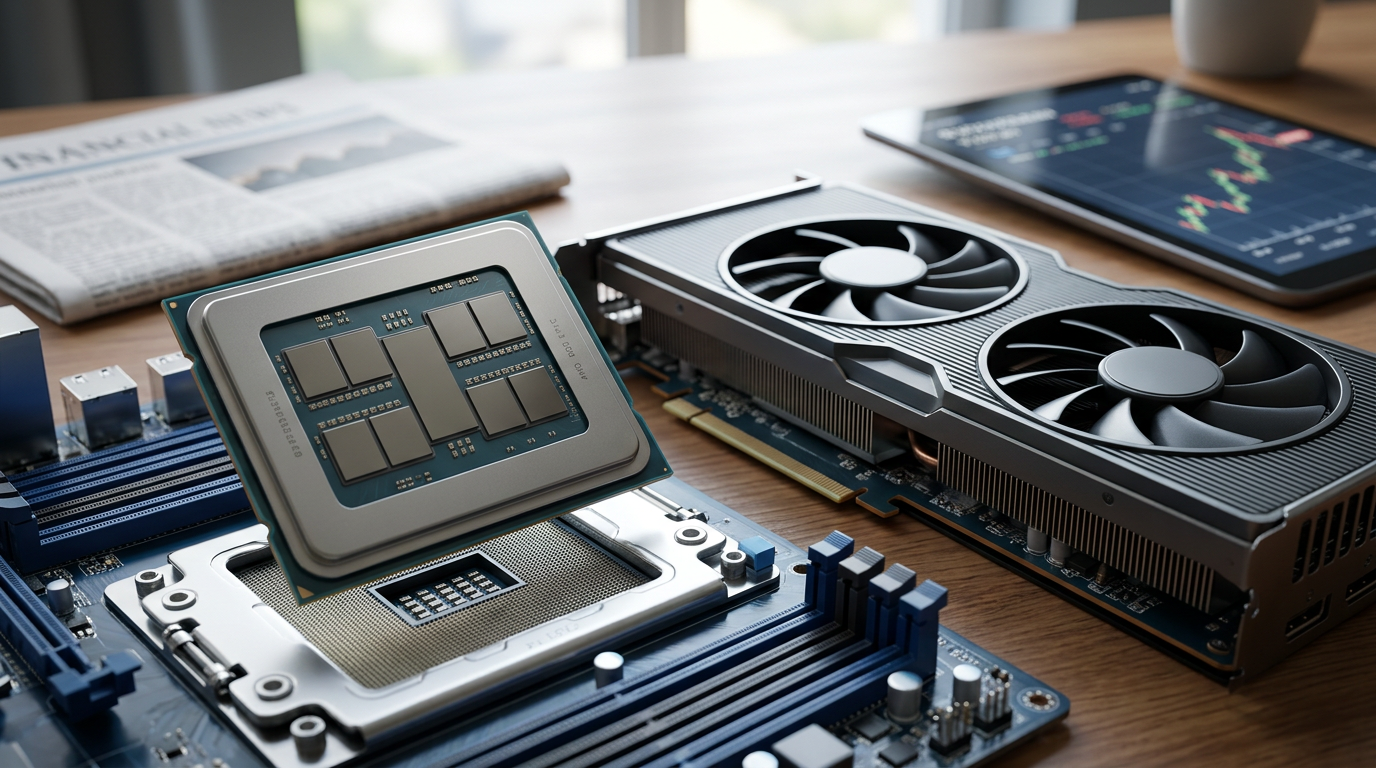
What’s behind those numbers isn’t just MI450 GPU traction. On the Q1 call, CEO Lisa Su told investors the server CPU market is expected to grow at greater than 35% annually, reaching over $120 billion by 2030, driven by AI workloads that require both CPUs and accelerators in parallel. AMD’s 6th Generation EPYC “Venice” server CPUs, built on TSMC’s 2nm process, entered production ramp in May, with AMD noting it has more customers validating and ramping Venice than any prior EPYC generation.
On the Q1 call, Su also said: “Customer engagement around MI450 Series and Helios is strengthening, with leading customer forecasts exceeding our initial expectations.” Separately, Meta has committed to deploying up to 6 gigawatts of AMD Instinct GPUs across multiple generations, with shipments supporting the first 1-gigawatt deployment expected to begin in the second half of 2026 powered by a custom Instinct GPU based on AMD’s MI450 architecture. AWS, Google Cloud, Microsoft Azure, and Tencent have all expanded EPYC-powered cloud instances as well.
The 7 Things I Wish I’d Known Sooner
I’ve been trading for over 50 years. In that time, I’ve made every mistake an options trader can make – and watched plenty of other people make them too.
Here’s what I learned: the losses you regret most almost never come from a lack of knowledge. They come from skipping a step you already knew to take.
So, I wrote down the 7 steps that matter most. On one page. Run it before any options trade.
It’s called the Smart Trade Options Checklist. Normally $29.97. Free today.
What the Options Market Is Seeing
AMD reports August 4. That’s confirmed, after market close. Ahead of that date, call volume has been notably heavy, with traders piling into out-of-the-money calls as the stock broke to new highs at the end of June.
Slight tangent, but it matters here: the implied move going into August 4 will almost certainly price in less than the biggest recent post-earnings swings. AMD jumped roughly 15% in after-hours following the Q1 report in May. The options market learns, sometimes too cautiously.
The bull case has structure. Cantor Fitzgerald lifted its AMD target to $700 on June 29 and UBS moved to $670 on June 24, both citing server CPU share gains. UBS analyst Timothy Arcuri specifically pointed to “accelerating traction in standalone CPU racks” as a key driver, arguing AMD could be one of the primary beneficiaries of that shift. If MI450 ramps cleanly and Data Center AI revenue scales toward the multi-billion trajectory Su outlined for 2027, a path toward $700 isn’t aggressive from here.
The bear case is real. AMD’s trailing P/E sits around 172x depending on the source, leaving almost no room for execution slippage. China remains a wildcard — FY2025 absorbed approximately $440 million in net MI308 inventory and related charges tied to U.S. export controls. NVIDIA still dominates AI training. And insider activity over the past 90 days is skewed net-selling, though most of that appears to be scheduled 10b5-1 plan activity after a massive one-year rally.
Trade Framework
Bull case: For traders expecting MI450 ramp confirmation and continued Data Center beats in Q2, a defined-risk structure targeting the $600-$620 range through September expiry gives directional exposure while capping downside. A debit call spread — buying the $590 call and selling the $620 call — limits dollar risk to the net premium paid if AMD reverses.
Bear case: If you believe forward EPS estimates are peaking, a put spread structures better than naked puts given the elevated implied volatility environment approaching the August 4 date. A $550/$520 put spread defines the risk on both sides and benefits from any move below $550 without the full bleed of a long put into volatility crush after earnings.
Neutral case: An iron condor — selling the $620 call and $520 put while buying the $650 call and $490 put — harvests premium if AMD stays in a range through the August 4 event. The breakeven range needs to hold between roughly $520 and $620 for the full credit to be collected.
The July 22-23 “Advancing AI 2026” event at San Francisco’s Moscone Center is the pre-earnings catalyst that hasn’t been fully factored in yet. AMD confirmed the main keynote is July 23, with Lisa Su presenting alongside AI ecosystem partners and customers. Industry coverage suggests the event could include unveilings around MI450 accelerators and Venice CPU details — either of which could shift implied volatility going into the August 4 report.
The August 4 earnings date is the settlement event. But July 23 is where the momentum either builds or stalls before the report arrives. Worth watching both.