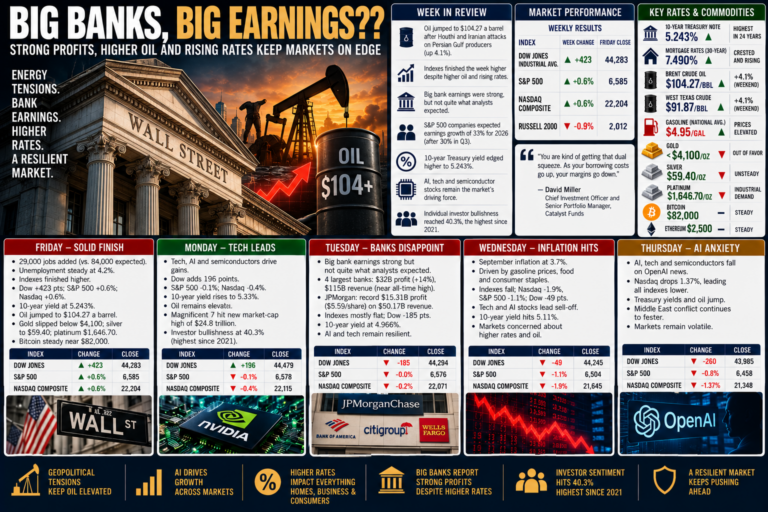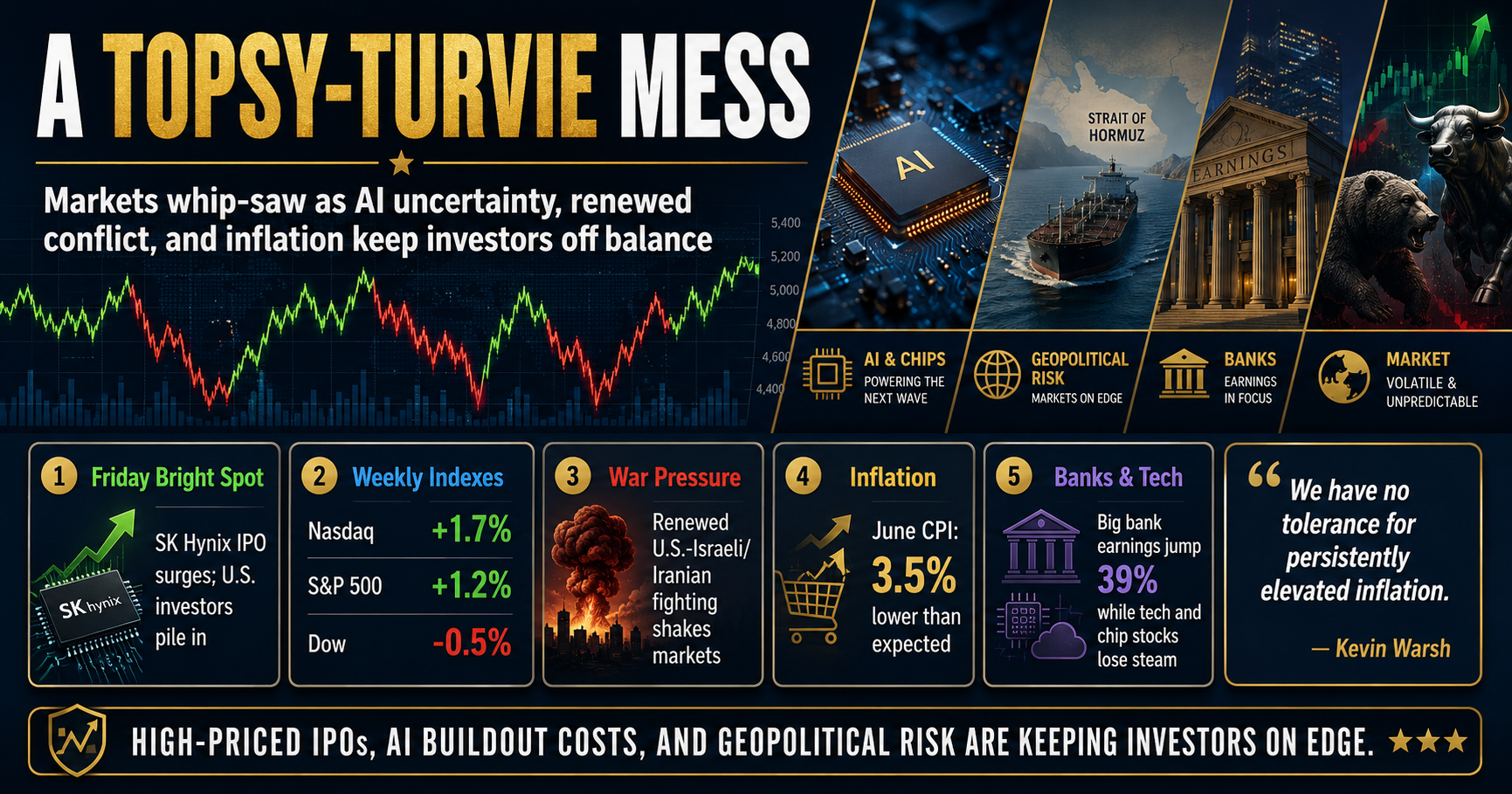
Stocks whip–sawed all week with investors and traders unable to stabilize a foothold in the unpredictable artificial intelligence future and the massive expected buildout. The renewed fighting in the U.S. Israeli/Iranian war, and growing concerns of creeping inflation has given pause to aggressive technology stock buying. ‘Friday’s bright spot’: South Korea’s SK Hynix IPO supercharged the market, and was overwhelmingly received by U.S. investors. “The $26.5 billion U.S. share sale, was the largest by a foreign country ever.” As trading ended Friday the IPO market value “exceeded $1.2 trillion, larger than several domestic chip makers.” The insatiable demand for ‘chips’ by leading U.S. artificial intelligence companies has positioned the two South Korean chip makers in an enviable demand level as SK Hynix and Samsung “account for the world’s major production.” Struggling Indexes, most of the week, came alive Friday after the South Korean IPO release, gaining back early losses. The heavy–tech Nasdaq Composite finished up 0.3% amidst big trading volumes, while the Dow Jones Industrial Average added 150 points. For the week the Nasdaq and S&P 500 were up 1.7% and 1.2%, while the ‘bread and butter’ Dow Jones fell 0.5%, overshadowed by AI and teck stocks.
All markets slid Monday as the U.S. Israeli/Iranian conflict festered to critical levels. President Trump ordered ‘heavy bombardment’ of new military targets in Iran and several staging islands in the Strait of Hormuz, frustrated with “no action” by Iran in negotiations to settle the Strait‘s shipping shutdown. He has proclaimed that the U.S. will control the Strait of Hormuz and that “it will remain open and under U.S. protection.” Iran countered: “We will under no circumstance allow the United States to interfere in the management of the Strait of Hormuz.” According to Secretary of State Marco Rubio, “It is an internal waterway. No country is allowed to charge tolls or fees on an international waterway. That’s existing international law.” Gold led the slide Tuesday, falling 2.6% to a new recent low of $3,997 a troy ounce as all precious metals continued weaker. Gold peaked in January at a high of $5,318 a troy ounce, now down 25%. Silver has followed with heavier losses, down near 50% at $56.88 a troy ounce after a high of $115 a troy ounce earlier this year. Oil jumped quickly, with Brent Crude, the international benchmark trading at $79.87 a barrel.
June’s inflation came in at 3.5%, down from May’s 4.2%, as analysts had predicted 3.8%. Lower oil prices dropped pump prices significantly after President Trump’s ‘cease–fire’ agreement with Iran. Now the tables have turned, with renewed attacks on both sides with the Strait of Hormuz in U.S. control. “I wouldn’t bet on these more modest inflation readings continuing for the remainder of the year,” said Mike Reed, head of U.S. economics at RBC Capital Markets. Fed chief Kevin Warsh stood firm, proclaiming; “We have no tolerance for persistently elevated inflation.” Bright spots in rising inflation are lower with used and new automobile costs, domestic travel costs, and wireless data costs. Big banks were big beneficiaries, as announced earnings were reported Tuesday. Massive IPOs, and huge equities trading boosted quarterly earnings to a composite of up 39%, besting nearly every previous quarterly report for many years. Jamie Dimon, CEO of JPMorgan Chase said: We just don’t know how long it’s going to last.” Adding, “banking business is getting close to as good as it gets.” The market, both Wednesday and Thursday struggled, as technology and chip stocks lost steam, driving the indexes down. Investors are dealing with many aspects of the general market making consistent buying decisions tougher and shorter in duration. High priced IPOs and richly priced tech and AI and semiconductor stocks are beginning to frazzle the investors’ buying moods.
RUMBLINGS ON THE STREET
Northwestern Mutual Investment Team, Barron’s, – “First there is still a meaningful uncertainty around how sustainable this AI earnings growth will be,” they said. “In many cases current growth is being supported by heavy capital spending to build out AI infrastructure, and those investments are still out pricing the actual revenue being generated.”
Askash Doshi, head of gold strategy at State Street Investment Management, WSJ – “A temporary break of ceasefire does not mean that the market is going to think we’re reverting to March, April conflict levels. It’s just day-to-day noise.”
Henry Susanto, a portfolio manager at Gambelli Funds, WSJ – “There are still many questions about longevity and cyclicality of memory sectors. Overall, I’m bullish on the road map for 2026 and 2027, and we are feeling growing confidence among major players about 2028.”