July 28, 2026
FOMC IV Is the Trade Today
Featured: FOMC IV Is the Trade Today
Editor’s Note: Larry Benedict has spent more than 40 years as a professional trader. He went 20 years without a losing year and made over $274 million for his clients. Now he’s revealing a ticker he calls one of the best-kept secrets in the market. Click here to see the details.
Dear Reader,
Something huge is going on in Washington.
It’s a plan taking shape inside the White House – an ambition so vast, the most powerful people in America have been working on it for a decade.
It’s known as “The American Energy Endgame”…
And now, we’re potentially just days away from it triggering billions of dollars to flood into one specific corner of the market.
Larry Benedict has a habit of tracking moves coming out of the capital… and getting ahead of them.
It’s how he went 13 for 13 in Q1 2025.
And while the S&P 500 returned around 15% that year, Larry made a 279% return on cash.
That’s an 18x difference in percentage terms.
So when Larry says what’s coming as soon as August 15 is something you do not want to miss – that means something.
That’s why he just recorded a special presentation revealing the one ticker at the very heart of this opportunity.
Lauren Wingfield
Managing Editor, The Opportunistic Trader
P.S. When a move like this hits, it happens before most people understand what’s going on. If you are reading this, you’re early. Take advantage of that and click here to watch the presentation, free.
FOMC IV Is the Trade Today
Tuesday, July 28, 2026
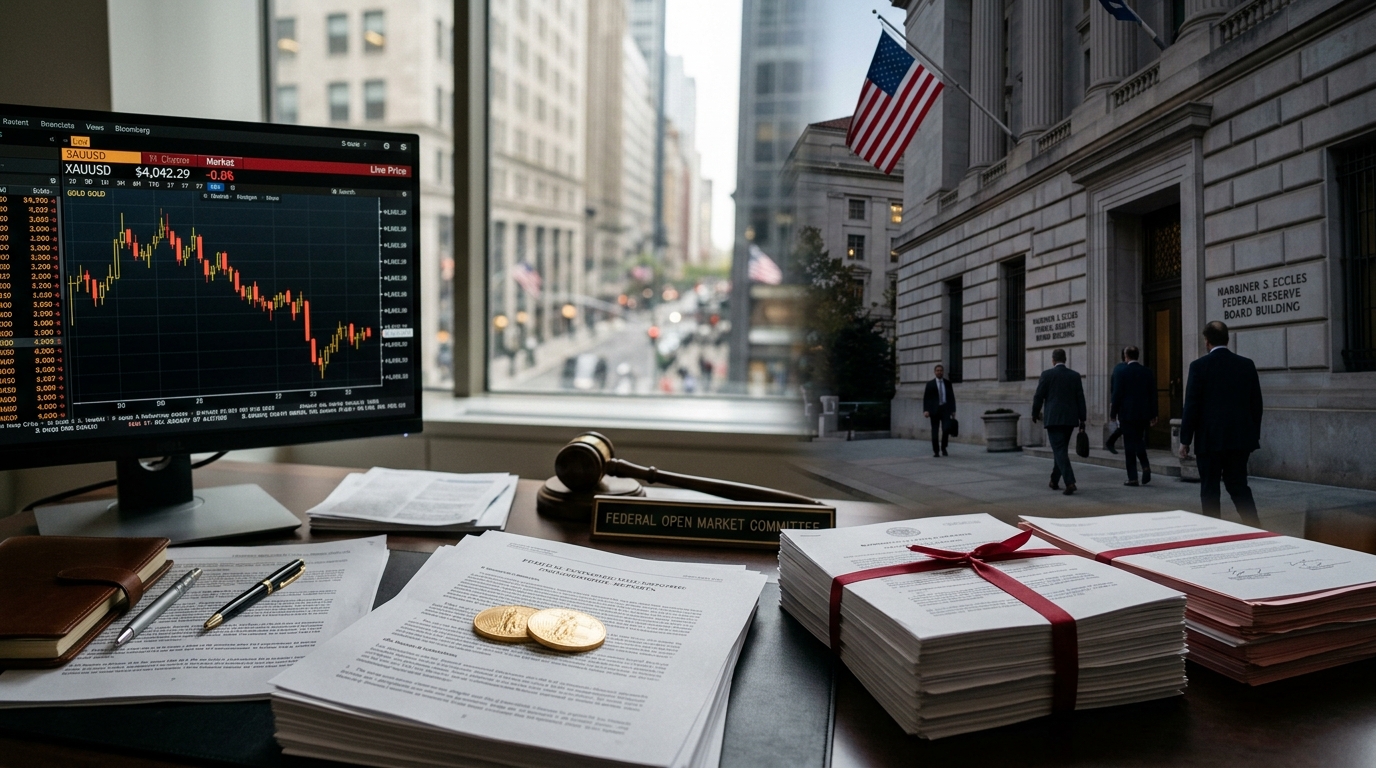
The loudest signal today is not in gold itself. It is in how traders are paying for protection and leverage into a single timestamp: Wednesday, July 29 at 2:00 p.m. ET.
If you want to know where the market thinks the surprise risk lives, you follow implied volatility into the event. Not the headlines.
The Signal
The options market is treating tomorrow’s Fed decision like an event-volatility release, even though the base case is still a hold.
One clean way to see it is via rate expectations that feed directly into dollar strength, real yields, and then gold. As of this week, market-implied odds for the July 29, 2026 meeting are not lopsided. Investing.com’s Fed Rate Monitor, based on CME Fed Funds futures, showed a 62.4% probability for the most likely outcome at the July 29 meeting. ([investing.com](https://www.investing.com/central-banks/fed-rate-monitor?%3Butm_campaign=official_account&%3Butm_medium=social&utm_source=openai))
That is the important nuance. When odds compress, the distribution widens. And when the distribution widens, near-dated options tend to carry a premium because nobody wants to be short gamma into the announcement.
Why It Matters
Gold is sitting in the crosswinds of two competing forces.
First, the short-term driver: Fed policy expectations that swing the dollar and real yields around event windows.
Second, the slow-burn driver: central banks and reserve managers acting on multi-year horizons. Those buyers do not care about a 2:00 p.m. press conference. But options traders do, because their risk is marked every minute.
So you get this odd mix: the spot market can look calm or range-bound, while options markets can get edgy and expensive into the catalyst. That is where asymmetric opportunities can show up, especially if implied movement gets too aggressive versus what the underlying usually does.
The Company Behind the Signal
I am watching the gold complex through two lenses: the broad proxy (GLD and related ETFs) and the operating leverage names (the large miners).
On fundamentals, the miners are not guessing. They are generating cash at today’s gold prices.
Agnico Eagle (AEM) reported Q1 2026 results with higher realized gold prices of $4,861/oz and free cash flow of $732 million (company-defined), alongside record quarterly operating margins and adjusted net income. ([sec.gov](https://www.sec.gov/Archives/edgar/data/2809/000110465926054134/tm2612722d3_ex99-1.htm?utm_source=openai))
Newmont (NEM) reported a quarterly free cash flow record of $3.1 billion in Q1 2026. ([sec.gov](https://www.sec.gov/Archives/edgar/data/1164727/000116472726000017/newmontq12026earningsrelea.htm?utm_source=openai))
That matters for options because it anchors the “fundamentals floor.” If gold chops around post-Fed, these businesses are still throwing off cash. The implied volatility risk is about timing and the path, not whether the sector is viable.
Market Expectations
Here is how I translate the options message into plain English:
1) The market expects an abrupt move around 2:00 p.m. ET tomorrow. The compressed probability distribution around hold versus hike is the kind of ingredient that inflates near-dated premiums. ([investing.com](https://www.investing.com/central-banks/fed-rate-monitor?%3Butm_campaign=official_account&%3Butm_medium=social&utm_source=openai))
2) The market is paying up for downside convexity. Into macro catalysts, put skew often steepens because hedgers want quick protection if rates surprise higher and the dollar jumps.
3) The market is uncertain about the second-order outcome. Even a hold can be hawkish, and a hike can be framed as “one and done.” Options price uncertainty, not just direction.
One practical note: if you are looking at a one- or two-day horizon, what you are really trading is implied versus realized movement. If realized movement comes in smaller than implied, long premium can disappoint fast. If realized movement is larger than implied, premium can pay.
Strategic Considerations
I am not interested in pretending we can predict the Fed. I am interested in structuring exposure so the outcome matters less than the size and direction of the move.
So the question becomes: do you want to own volatility into the event, or sell it?
If you believe implied volatility is too cheap for the event risk, defined-risk long premium structures (like a debit spread in GLD or AEM) can express that view while capping capital at risk. The trade-off is time decay and the possibility the market simply does not move enough.
If you believe implied volatility is too expensive, defined-risk short premium structures (like a credit spread) can express the view that the post-decision move will be smaller than what options imply. The trade-off is that gap risk is real around 2:00 p.m. ET, so defined risk is not optional here.
On miners specifically, there is a second lever: company fundamentals can dampen downside versus a pure macro proxy, but they also bring equity-beta and operational sensitivity that can magnify moves when the whole sector de-risks.
What to Watch
Over the next 24 to 72 hours, I am watching:
- Front-end rate expectations: Do July 29 odds swing sharply again, or stabilize around the current most likely outcome? ([investing.com](https://www.investing.com/central-banks/fed-rate-monitor?%3Butm_campaign=official_account&%3Butm_medium=social&utm_source=openai))
- Dollar reaction: If the dollar strengthens on the decision, gold often feels it first, then miners second.
- Skew behavior post-event: Does put skew relax (fear leaving) or stay elevated (hedging demand remains)?
- Miners versus gold ratio: If gold is flat but miners catch a bid, that is often a sign the market is looking past the meeting.
One last thought, a little messy but true: markets do not need the Fed to be right. They only need the Fed to be clear. If tomorrow delivers clarity, implied volatility can come in even if spot barely moves. If it delivers ambiguity, you can see a second wave of hedging after the first move.
That is the real options signal going into July 29.
Wall Street is calling it the “Warsh Shock.” Here’s how to profit from it…
Nearly half of the world’s biggest money allocators are scrambling to reposition for what they expect to be the most volatile market in years.
Larry Benedict isn’t scrambling. He’s seen this before.
He says the Warsh Shock is setting up the most predictable wealth-building window he’s seen in 20 years… and there’s one ticker right at the center of it.