August 13, 2026
TeraFab Wants Hundreds of EUV Machines. ASML Ships 65.
Everyone is debating the building. The real investment question sits in Veldhoven.
First a note from The Oxford Club
Dear Reader,
In a market where it’s almost impossible to find great stocks at cheap prices… This is the most wildly profitable and insanely cheap stock I’ve ever seen.
A Texas energy company “making too much money…”
It has signed a multi-million-dollar partnership agreement with Palantir…
It pays a dividend 300% BIGGER than the average S&P stock…
And right now you can get in for under $10 a share.
President Trump is publicly backing this stock.
The bad news is, I’m strictly reserving the details on this stock for my members.
The good news for you is, right now, you have the chance try my research risk-free for a year.
Fair warning: Wall Street is starting to load up.
Get the full details now.
Yours in smart speculation,
Karim Rahemtulla, Head Fundamental Tactician
Monument Traders Alliance
TeraFab Wants Hundreds of EUV Machines. ASML Ships 65.
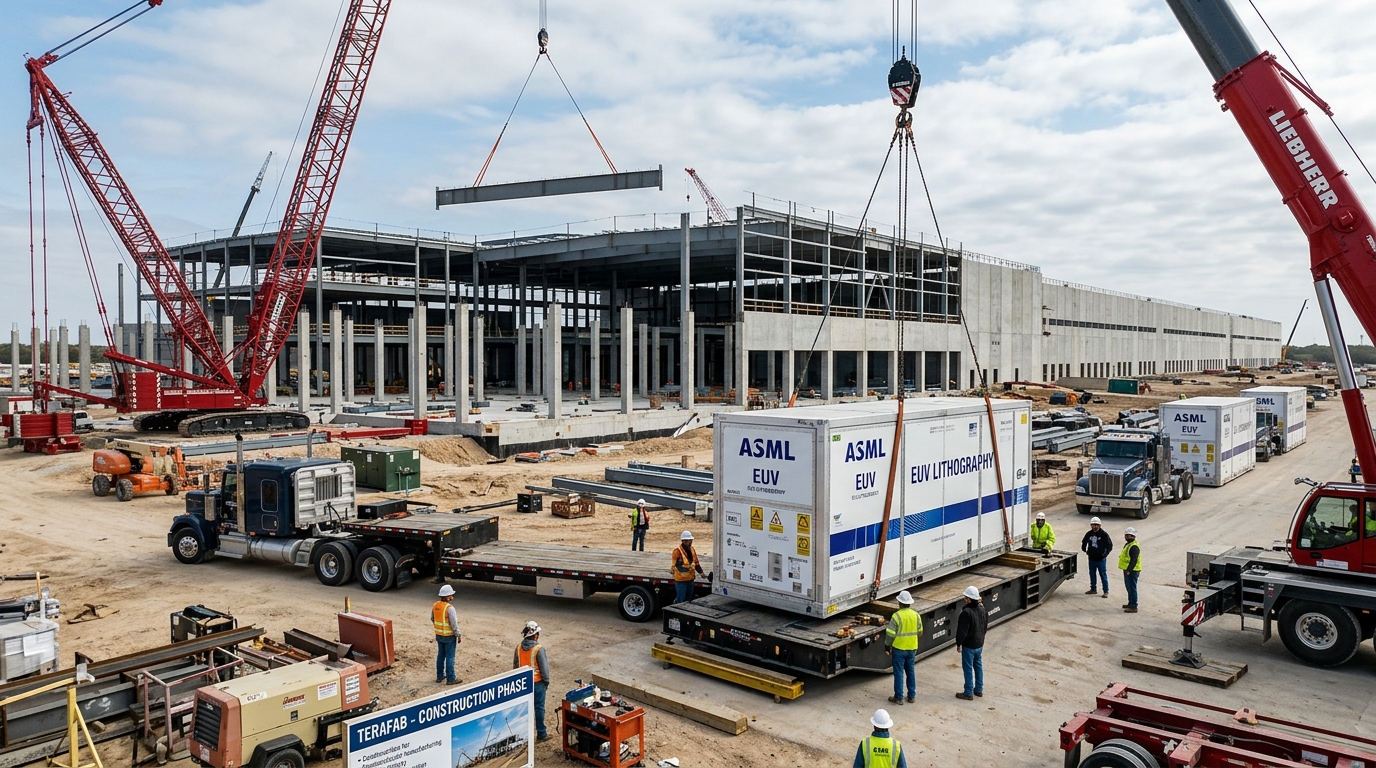
Here is the number that puts TeraFab in perspective: ASML, the only company on earth that manufactures extreme ultraviolet lithography machines, shipped 48 of them in all of 2025. The target for 2026 is approximately 65. Elon Musk’s joint Tesla and SpaceX semiconductor facility, announced August 6 for Grimes County, Texas, is being described as exceeding 100 million square feet and representing an initial investment of $16.8 billion. The square footage gets the headlines. The machine count is where the investment question lives.
Why This Stock Matters Now
On July 15, ASML reported Q2 2026 results that beat guidance on both the top line and margins. Net sales came in at €9.3 billion against a guided midpoint of roughly €8.7 billion. Gross margin reached 54%, above the prior 51% to 53% full-year range. More consequentially, management raised its 2026 net sales outlook for the second time in the year, lifting the range from €36 to €40 billion to €43 to €45 billion. Q3 guidance is €11 to €12 billion, implying further acceleration through the back half.
The guidance revision reflects something beyond a single strong quarter. Customers are pulling forward capacity expansion at a pace ASML’s own CEO described as unusual. What TeraFab adds to that picture is a new and very large source of demand pointed at the same allocation queue that TSMC, Samsung, and SK Hynix are already contesting. That is not a trade on a news cycle. It is a structural argument about a company whose leverage only increases as the ambition of the AI buildout grows.
The Investment Thesis
ASML is the mandatory tollbooth for advanced chipmaking. No other company produces EUV lithography systems. Nikon and Canon exited EUV development years ago and compete only in older tool categories. A fab targeting leading-edge nodes cannot run without ASML equipment, which means every serious dollar committed to advanced semiconductor capacity flows through Veldhoven before it reaches silicon.
The thesis in one sentence: ASML is a supply-constrained monopoly with demand accelerating faster than its own production ramp, and TeraFab just put a very large new customer in the queue.
That supply constraint is not a temporary bottleneck. The 30% capacity increase ASML is planning for 2027 is itself a multi-year engineering effort. Management has said 2027 orders are already substantially committed. A new customer of TeraFab’s stated scale, placing an order today, would be competing for allocation years out.
The Business Behind the Stock
ASML designs and manufactures photolithography machines that transfer circuit patterns onto silicon wafers. Its EUV systems use light at a wavelength of 13.5 nanometers, generated by firing a laser at tin droplets, to print features at leading-edge nodes. No competitor has replicated this at production scale. A standard Low-NA EUV system costs approximately €180 million. The newer High-NA EUV machines, of which ASML plans to ship 10 in 2026, carry price tags of roughly €380 to €400 million each.
The Q2 2026 results show three distinct and growing revenue streams. New system sales drove headline growth. The installed base business, software upgrades and productivity enhancements for machines already on customer floors, came in €300 million above management’s own expectations as customers pushed to extract more output from existing tools. Metrology and inspection demand also accelerated. That combination, hardware growth plus a high-margin recurring service layer, is what makes ASML’s financial profile unusually durable relative to most capital equipment businesses.
Memory is a second major growth engine, separate from the AI logic story most investors focus on. ASML’s CFO Roger Dassen noted that memory revenue is expected to grow 75% in 2026, driven by HBM demand from AI data centers and a broader tightening of DRAM supply. South Korea represented approximately 43% of Q2 system sales by region, reflecting Samsung and SK Hynix expansion programs that are running concurrently with logic fab buildouts in Taiwan and the United States.
What is “The Presidio Initiative”?
A single $20 million check delivered to a former military base may have launched the biggest megaproject in American history.
Intel’s role is worth tracking separately. ASML confirmed Intel as the first customer to use its next-generation High-NA EUV EXE:5200B for mass production, tied to the 14A node. In collaboration with ASML, Intel completed acceptance testing for the 14A node to enhance wafer output. As of Intel’s Q2 2026 earnings, CEO Lip-Bu Tan pulled the 14A risk production timeline forward by a full year, now targeting the second half of 2027 for internal products and high-volume manufacturing in 2028. That acceleration means ASML’s High-NA tools are entering production deployment sooner than the prior schedule implied.
What’s Changing
Three catalysts converged in a compressed window. First, on August 6, Texas Governor Greg Abbott, Tesla, and SpaceX jointly announced Grimes County as the site for TeraFab, with a first-phase investment of $16.8 billion and a planned workforce of at least 3,000. The facility is described as a vertically integrated plant bringing logic, memory, packaging, and testing under one roof. Musk framed it bluntly: both Tesla and SpaceX will need more chips than current and future global production can supply.
Second, Intel has acknowledged a role in the project, though it has offered no details on the scope of that involvement. Intel’s 14A node, which entered trial production with ASML’s High-NA tools, is the most plausible manufacturing process for any advanced TeraFab output. Intel now targets 14A risk production in the second half of 2027 and high-volume manufacturing in 2028. Every month that timeline holds means ASML’s order window for TeraFab-linked equipment stays open.
Third, ASML itself is expanding capacity at a pace it has not attempted before. The company targets approximately 65 Low-NA EUV systems in 2026, up from 48 in 2025. It is planning a 30% increase in both EUV and DUV immersion capacity for 2027, and is studying a further 30% increase for 2028. Critically, the model shift matters too: newer E and F model EUV systems offer higher throughput, meaning effective wafer output capacity is expected to rise roughly 45% even as unit shipments grow 30%. That productivity gain expands total addressable manufacturing output without requiring proportional increases in unit deliveries.
The Risks
The most immediate structural risk is China. ASML’s China revenue fell from 36% of net system sales in Q4 2025 to approximately 19% in Q1 2026 and roughly 14% in Q2 2026. That compression is already underway. The larger threat is the proposed MATCH Act, bipartisan legislation introduced in Congress in April 2026 and cleared by the House Foreign Affairs Committee on April 22. The bill would extend export controls beyond EUV to include DUV immersion tools, and critically, would restrict post-sale servicing of approximately 1,400 ASML machines already inside Chinese fabs. Bank of America has estimated that a full DUV and servicing ban would cut ASML revenue by 14 to 15% and operating profit by 16 to 17%. The bill still requires passage through both chambers and a presidential signature, but the legislative momentum is real and the timeline carries a 150-day multilateral alignment deadline for the Netherlands.
The TeraFab-specific risk is that the order does not materialize. SpaceX’s May 2026 S-1 described TeraFab as a general framework with no binding commitments, no finalized capital expenditure plan, and an explicit acknowledgment that definitive agreements may never be reached. Tesla’s near-term chip supply is already contracted elsewhere: Samsung is producing Tesla’s AI5 chip in Taylor, Texas, Tesla signed a $16.5 billion deal with Samsung for the AI6 chip, and TSMC handles the remainder. TeraFab is a longer-duration bet, and the gap between CEO conversations and purchase agreements is where execution risk lives.
Valuation is also a real consideration. ASML has gained significantly in 2026, now carrying a market capitalization above $700 billion and a backlog exceeding €45 billion. A stock priced for sustained outperformance has less room to absorb negative surprises, whether from a booking slowdown, a China restriction, or a guidance miss. The installed base business has become a meaningful earnings buffer, but it does not fully insulate ASML from a deceleration in new system orders.
Finally, neither Tesla nor SpaceX has ever built or operated a semiconductor fabrication facility. Chipmaking requires extreme contamination control, highly specialized supply chains, and a workforce with skills that take years to develop. The building is the easy part.
What Investors Should Watch Next
Four signals will tell you whether this thesis is playing out or unraveling.
- A confirmed ASML equipment order from TeraFab. ASML CEO Christophe Fouquet confirmed direct talks with Musk and called him “very serious,” but no purchase agreement has been signed. A binding order would be the clearest possible signal that the project has moved from framework to execution.
- ASML’s Q3 2026 results on October 14. With quarterly net bookings no longer disclosed separately, investors should watch the tone on shipment cadence, second-half revenue delivery, and any update on capacity commitments beyond the 2027 ramp. Management’s guidance trajectory has now been raised twice this year. A third raise would materially change long-term revenue models.
- Intel 14A PDK 0.9 availability in October. The process design kit release is the technical gate that allows external customers to commit to designing chips for the node. If that milestone slips, every downstream TeraFab-linked schedule shifts with it.
- MATCH Act progress through Congress. The bill’s trajectory matters for China revenue modeling. A stall or amendment reducing the servicing restriction would meaningfully change the bear case on ASML’s installed base margin.
Bottom Line
ASML raised its full-year 2026 revenue outlook twice in four months, lifting it from €34 to €39 billion at the start of the year to €43 to €45 billion after Q2. Gross margin hit 54% in the most recent quarter. The order book for 2027 is described as nearly full before Q3 has even begun. That is not a company benefiting from cyclical tailwinds. That is a monopolist operating at the center of the largest capital spending wave the semiconductor industry has ever seen.
TeraFab adds a new dimension to an already compelling situation. Even if the project executes at a fraction of its stated ambition, it represents an enormous new source of demand for a supplier that cannot simply be asked to double output. Acquiring even a few dozen EUV machines from a manufacturer running at 65 units per year, while competing with TSMC, Samsung, SK Hynix, and Intel for the same allocation, is a multi-year undertaking that begins with placing an order today.
The bear case is real: China export restrictions could compress 14 to 17% of revenue and margin, TeraFab could remain a framework rather than a purchase order, and a stock at these levels needs continued execution to justify its valuation. Those are legitimate risks, not hypothetical ones.
But the core structural argument is unchanged and, if anything, reinforced by the events of August. Every serious dollar committed to leading-edge chip production has exactly one place to go for the machines that make it possible. That chokepoint does not care whether TeraFab gets built on schedule or not. It simply collects a toll on every serious attempt to get there.