October 2, 2026
Claims just hit a 10-week low. Layoffs are at a 4-year low. A frozen labor market is not a soft one.
Markets don’t need a blockbuster payrolls number this morning. They only need one that refuses to crack. That distinction matters more than the headline figure the BLS releases at 8:30 a.m. ET today, because the surrounding data already tells a coherent story: companies are not firing people, they are simply not hiring aggressively. A plateau, not a collapse. And in the current policy environment, a plateau is enough to keep rate pressure alive through year-end.
Elon Musk Just Did Something He’s Never Done Before
This February, Elon spent millions to send a message to 125 million Americans. Most people ignored it. But Wall Street veteran Whitney Tilson couldn’t stop thinking about it, and says what Elon was really saying explains everything about what’s unfolding in America’s economy right now.
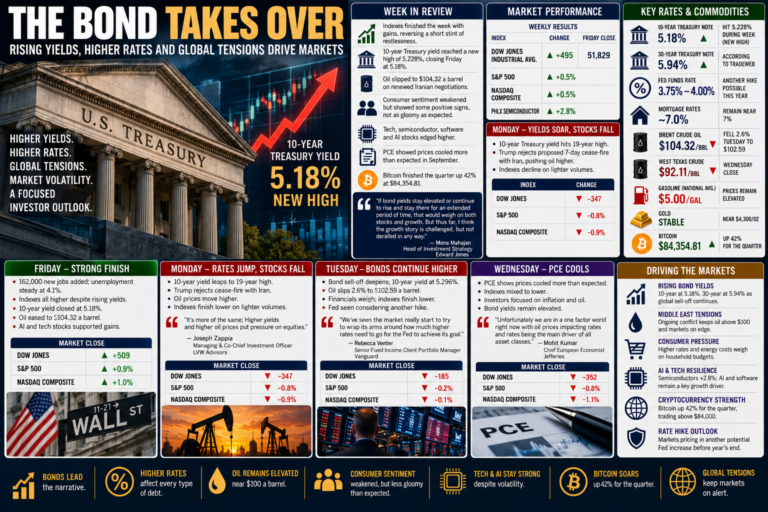
The consensus for September nonfarm payrolls sits near 90,000 to 98,000, down sharply from August’s 162,000 gain. But Bank of America is forecasting just 60,000, arguing that August was inflated by unusually favorable seasonal adjustments rather than genuine momentum. The revision risk matters: ADP printed exactly 90,000 private-sector jobs on Wednesday, beating a roughly 70,000 consensus and snapping a three-month slowdown. Education and health services drove 55,000 of that total. Financial activities shed 16,000. The rebound is real but narrow.
The Composition Argument
This is not about whether September beats 90,000. It’s about whether the internals argue for tightness or fatigue. Three data points from the past 48 hours make that case for tightness, uncomfortably clearly. Weekly initial jobless claims came in at 197,000, the lowest since mid-July, for the week ending September 26 and below the 207,000 level heading into the August survey window. Continuing claims also moved lower to 1.701 million from 1.712 million. And Challenger, Gray & Christmas reported Thursday that planned layoffs dropped 18% month-over-month and 20% year-over-year in September to 43,281, the lowest September total since 2022.
Hiring plans are a different story. Challenger noted that the usual seasonal surge in hiring that starts in September was weak, with hiring plans up 3% versus 2025 but still running lower than last year’s levels. As Andy Challenger put it, companies are in a wait-and-see period, facing high energy costs, geopolitical uncertainty tied to the Iran conflict, and the prospect of borrowing costs staying elevated. Low layoffs and low hiring in tandem is not a deteriorating labor market. It is a frozen one, and that combination can sustain wage pressure even as headline job creation cools.
Fed Officials Blink, But December Stays Firm
Fed Vice Chair Philip Jefferson delivered a pause signal on Thursday, saying policymakers may need more time before the next move. New York Fed President John Williams echoed the same logic earlier in the week, saying there is no need for urgency. Evercore ISI analysts called Jefferson’s remarks confirmation that the Fed does not plan a back-to-back hike at the October 27-28 FOMC meeting. Futures pricing also shifted this week, with traders taking down the probability of an October hike versus last week while keeping December more live.
Get “Backdoor Access” BEFORE the Next Big IPO
Peter Thiel’s biggest bet is now worth $61 BILLION – and its valuation has roughly doubled every year.
Most investors will be locked out until AFTER the big announcement.
But I’ve discovered a “backdoor” that lets you grab a pre-IPO stake right now.
The September hike, 25 basis points to 3.75%-4.00%, the Fed’s first rate increase in more than three years, was delivered under Chair Kevin Warsh in a unanimous 12-0 vote. The dot plot that accompanied it showed 16 of 19 FOMC participants expecting at least one additional hike before year-end. Today’s payrolls number either validates that path or muddies it further.
Options Market: Two Different Universes
TLT’s IV rank is elevated, reflecting one of the widest implied-volatility regimes of the past year as the bond ETF sells off to multi-year lows. The 10-year yield touched 5.306% intraday on September 30 before retreating to about 5.24% on Thursday. The term structure in TLT is inverted, signaling binary event risk around today’s release. SPY tells the opposite story: implied volatility remains muted versus its own one-year range, keeping equity vol in the low end of its 52-week distribution. The front-week SPX options carried meaningfully higher implied volatility than the weeks behind it as of Thursday, suggesting options traders are pricing a one-day event rather than sustained equity risk.
The asymmetry is the signal. Bond volatility is expensive; equity volatility is cheap. That divergence prices a world where rates move but stocks absorb it.
Structured Trade Framework
Bull case for SPY (payrolls miss, Fed stays on hold): If September prints below 70,000 with unemployment holding at 4.1%, October hike odds likely collapse further. With SPY implied volatility still subdued versus its one-year range, defined-risk structures such as a November call spread offer leverage without overpaying for volatility. For traders expecting this outcome, a call debit spread targeting the prior range high defines risk cleanly.
Miss These 10 Stocks… Miss the Rally
What are the “Double Engine” stocks for the rest of 2026? Instead of settling for income or growth, these are stocks that deliver both. Our Top 10 Best Stocks to Own in the Second Half of 2026 report includes companies that are the perfect combination of steady payouts and explosive capital appreciation potential – all in one portfolio-ready list. This is how you position ahead of a market tailwind.
Bear case for TLT (payrolls beat, December hike firms): A number above 120,000 with wages at 0.3% or higher would challenge the pause consensus and push the 10-year back toward 5.30%. With TLT implied volatility elevated, premium-selling structures can be more attractive than outright long-vol bets. A defined-risk put spread into November expiry captures elevated premium without naked short exposure.
Neutral case (payrolls 80-110k, no change to odds): If today’s number lands in-line, the October hold stays consensus and December remains priced but uncertain. An iron condor on TLT harvests the elevated implied volatility while containing tail risk on either side.
Risk and Forward Outlook
The principal risk is an August revision. If BLS cuts August’s 162,000 figure sharply, September’s headline could look stronger in relative terms even if the raw number disappoints. Seasonal adjustment distortions remain the swing factor. Beyond today, the next major data point is September CPI on October 14, which arrives inside the Oct. 17 to Oct. 29 Fed blackout window and could still reshape December pricing if inflation re-accelerates.
Action Checklist
- Watch the August revision alongside the September headline, directional changes in the revision matter as much as the new number
- Monitor average hourly earnings: consensus is 0.3% month-over-month; a print at 0.4% or above reopens October hike debate immediately
- Elevated implied volatility in TLT argues for premium-selling structures, not premium-buying; assess defined-risk put spreads pre-open
- Subdued implied volatility in SPY keeps defined-risk long structures relatively inexpensive; a payrolls miss below 60,000 would be the catalyst
- Track CME FedWatch December pricing in real-time after 8:30 a.m., that number, not October, is the policy anchor for Q4