Hey there, bargain hunter. Jensen Huang just signed a deal that makes Nvidia one of the most structurally unusual large companies in American finance.
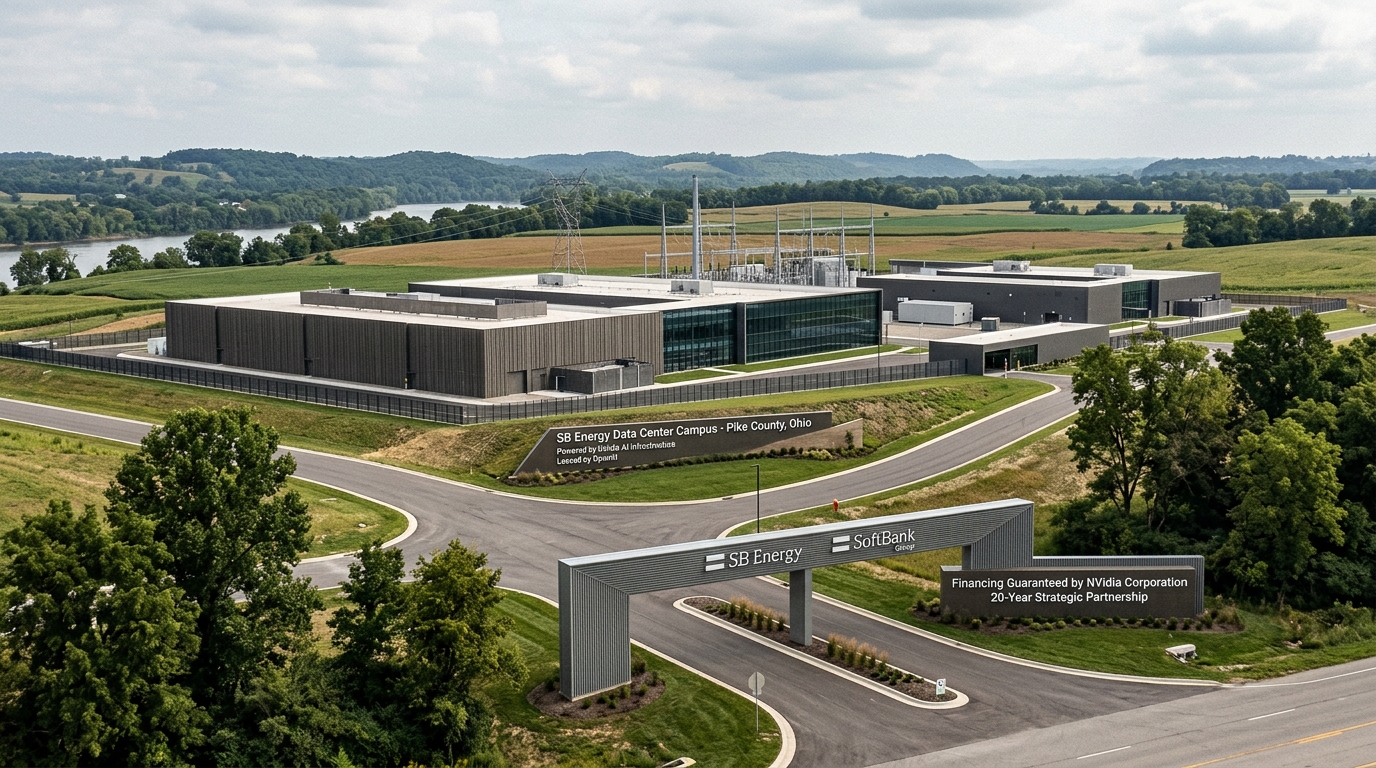
On Monday, August 17, 2026, OpenAI announced it will sign a 20-year lease for a sprawling data center campus in Pike County, Ohio, with financing partly guaranteed by Nvidia. The builder and owner is SB Energy, a SoftBank Group company. Nvidia, the company that sells the chips filling every rack, is now also backing the landlord’s income stream if the tenant ever defaults.
That is not a chip company. That is something new.
Scoreboard
Here is what is publicly described about the deal, stripped of the press release language:
- $105 billion: Nvidia’s stated cap on guarantees tied to the Ohio project’s lease and power-related payment obligations
- 20 years: the length of OpenAI’s lease
- 800 megawatts: initial phase targeted to be available starting in 2028
- Jobs: OpenAI said 35,000 construction roles and 2,500 permanent operating positions
Several widely circulated line items in the early chatter around this deal are not yet supported by primary public disclosures I can verify today, including precise gigawatt tranches (4.25 GW plus a 3.75 GW option), “chips per generation,” and specific per-generation Nvidia revenue estimates. Treat those as unconfirmed until they appear in an SEC filing, a company presentation, or direct quotes on the record.
NVDA shares were effectively flat on the day, down about 0.07%. That calm hides a very loud structural question.
The Real Reason This Deal Is Different
The Ohio campus sits on the former Portsmouth Gaseous Diffusion Plant, a Cold War uranium enrichment site that ceased operations in 2001 and has been under environmental remediation since 2011. The PORTS site is federal land, and the project has been positioned as a public-private effort involving the Department of Energy and Department of Commerce.
But the site is not the story. The financing structure is.
Nvidia is guaranteeing that if OpenAI defaults on its lease and related obligations, Nvidia will cover specified shortfalls owed to SB Energy. The payments only trigger on default or insolvency. That sounds like a backstop. It is, technically. But the economic reality is that Nvidia has now tied its own credit to OpenAI’s ability to generate revenue, at a scale that makes the arrangement hard to dismiss as immaterial.
Earlier reporting said Nvidia had discussed a backstop as high as $250 billion for this Ohio concept. What has now been announced is a $105 billion cap.
That scaling-back matters. So does the number that remains.
Deep Dive: What Nvidia Has Become
Nvidia’s business model was once legible: design chips, sell them to data center operators, collect margins that would embarrass a pharmaceutical company. Fiscal Q1 2027 revenue came in at $81.6 billion, up 85% year-over-year. Net income was $58.3 billion.
That model still exists. What has been added around it is stranger.
Over the past 18 months, Nvidia has played a growing role in the financing ecosystem around AI infrastructure, including supporting GPU-heavy buildouts and encouraging institutional capital to fund more data center capacity. Now it has guaranteed a nine-figure landlord’s income stream in exchange for getting one of the biggest AI tenants in the country into a campus that, if built to full scale, will be designed around Nvidia-class compute.
The Ohio deal is the clearest expression yet of a strategy Nvidia has been building: lock up the physical sites where its chips can operate for multiple generations, stabilize the economics so the sites get built, and then collect chip revenue from every hardware refresh over many years.
That is not a single sale. That is a captive customer relationship on a campus Nvidia helped make financeable.
Data Section
Nvidia financials (Fiscal Q1 2027, reported May 2026)
- Revenue: $81.6 billion (+85% YoY)
- Net income: $58.3 billion (+211% YoY)
- Additional buyback authorization: $80 billion
Ohio campus scope (publicly described)
- Site: PORTS Technology Campus at the former Portsmouth Gaseous Diffusion Plant, about 3,700 acres, Pike County, Ohio
- First phase: 800 MW targeted to be available starting in 2028
- Power buildout: project materials describe 9.2 GW of new gas-fired power ultimately envisioned for the Ohio effort
- Transmission: SB Energy materials describe $4.2 billion in high-voltage transmission investment via AEP Ohio
- Jobs: 35,000 construction roles and 2,500 permanent operating positions (per OpenAI)
The circular financing web (as of August 17, 2026)
- Claims about $3 trillion of off-balance-sheet AI obligations “across major hyperscalers,” record Nvidia CDS levels, and formal warnings by the BIS or IMF about this specific structure could not be verified in primary public documents today. Treat them as watchlist items, not settled facts.
Is It Cheap?
Nvidia’s stock is up roughly 11% in August alone, per Bloomberg data. The question for a bargain hunter is not whether NVDA is expensive by traditional metrics, it is. The question is whether the valuation reflects the right business.
If Nvidia is a chip company, the multiple looks stretched. If Nvidia is an infrastructure-finance-adjacent platform that can lock long-duration compute demand through guarantees and partnerships, the comparison set shifts toward industrial infrastructure franchises, not semiconductor cyclicals.
The real valuation tension is on the liability side. A guarantee like this is not the same thing as on-balance-sheet debt, but it is a real contingent obligation. If OpenAI’s revenue misses, that contingency can get expensive fast.
One more caution flag: prediction-market odds about an OpenAI IPO are not a financial statement. They are a mood ring. Useful as a sentiment signal, not as a solvency metric.
Bull, Base, and Bear
Bull
OpenAI never defaults. The campus comes online in phases starting 2028. Nvidia collects multi-cycle chip revenue at the site for years. The guarantee costs nothing. The backstop becomes an unusually profitable piece of risk underwriting.
Base
The campus opens in 2028 as planned. OpenAI services its lease through subscription revenue and ongoing fundraising. Nvidia collects one or two hardware cycles of chip sales at the site before the AI chip market fragments meaningfully. The guarantee remains untriggered. Nvidia earns a strong but not transformational return on the Ohio bet.
Bear
OpenAI’s revenue growth slows sharply before 2028 as enterprise AI adoption plateaus or open-source alternatives compress pricing. If SB Energy cannot quickly re-lease a massive block of specialized capacity at attractive economics, Nvidia could face a meaningful draw on the $105 billion cap. In that world, NVDA gets valued less like a pure semiconductor winner and more like a hybrid of manufacturer plus financial guarantor.
The Lucent and Nortel comparison that has circulated on credit desks is worth taking seriously as a pattern risk: when a supplier starts absorbing financing risk to keep customer demand accelerating, the unwind can get ugly. The counterargument, and it is a real one, is that this is not vendor financing in the classic “buy my gear on credit” form. It is a guarantee that helps a long-duration infrastructure asset get built, with a tenant that expects long-duration compute demand.
That distinction matters. Whether it is enough is the question markets will keep pricing.
Action Plan
If you already own NVDA: Hold. The Ohio deal is a long-duration bet on compute demand that has not yet been disproved. But size carefully. A position sized for a chip company needs revisiting if you are now effectively holding contingent, off-balance-sheet exposure that starts to look like a credit instrument.
If you are considering a new position: The August 26 earnings date remains the next hard catalyst. The Q2 data center revenue number and the Q3 guide will either validate or complicate the multi-year infrastructure math. Wait for that before adding at current prices. A scale-in approach, one-third before earnings, one-third on any post-earnings weakness, one-third if the 2028 capacity timeline holds in subsequent disclosures, limits exposure to contingent-liability risk crystallizing before the revenue does.
Adjacent trades worth tracking:
- CoreWeave (CRWV): The neocloud sector is a direct beneficiary of expanded GPU financing access. CoreWeave built its model around fleet-backed institutional capital.
- BlackRock (BLK) and Apollo (APO): If AI infrastructure financing volume accelerates, big asset managers and credit platforms can benefit from originating and underwriting.
- SoftBank (SFTBY): SB Energy is a SoftBank Group company. If the Ohio campus builds out at scale, SoftBank’s exposure to that platform grows more valuable with each confirmed tranche of capacity and power.
Cheap Investor Scorecard
Track these before making any move on NVDA or its ecosystem:
- Guarantee terms: When the actual guarantee agreement details show up in an SEC filing or a formal disclosure, read the triggers, caps, and mitigation language.
- Any disclosure of a draw: Any hint of a payment under the backstop changes the calculus immediately.
- OpenAI revenue visibility: Any credible, sourced datapoint on OpenAI revenue trajectory helps you judge whether 20 years of obligations are realistic.
- Phase 1 construction timeline: The first 800 megawatts are targeted for 2028. Slips signal permitting, power, or capital friction.
- Nvidia August 26 earnings: Q2 data center revenue and Q3 guidance. The Ohio math only works if the core chip revenue trajectory stays intact long enough for the campus to open.
- Transmission progress: The project has described $4.2 billion of transmission investment via AEP Ohio. Track approvals and milestones.
- Power permitting: The project’s cited 9.2 GW gas-power vision is huge. Any regulatory or financing delay pushes the timeline right.
- Vera Rubin ramp: Nvidia has said Vera Rubin is ramping into full production. Watch real shipment and capacity signals, because schedule risk becomes revenue timing risk.
Bottom Line
If OpenAI’s revenue holds and the Ohio campus opens on schedule, the $105 billion guarantee costs Nvidia nothing and NVDA benefits from long-duration, high-dollar compute demand tied to a campus built around modern AI infrastructure. That is the best outcome, and it may well be the base case.
If OpenAI’s revenue falters before the campus generates meaningful returns, Nvidia is not just a chip company with a bad quarter. It is a guarantor with a very large contingent obligation whose downside shows up in credit-style risk, not product-cycle risk.
The deal is bold. The upside is real. Size accordingly, and keep your eyes on the credit details, not the press release.