August 22, 2026
Black Sea Grain Corridors Under Siege
Featured: Black Sea Grain Corridors Under Siege
You won’t believe what I’ve been seeing almost every Monday at 9:30am.
For 20 years, I’ve been watching the markets.
Seen every pattern you can imagine.
But this one still blows my mind.
Almost every Monday morning… Right when the bell rings…
Certain stocks start doing things that shouldn’t be possible.
Little companies nobody’s heard of…
Have suddenly rocketed 100%… 200%… sometimes 500%.
All on the same day.
Past performance doesn’t indicate future results. And all trading carries risk, of course…
But after years of tracking this anomaly…
There are 4 specific things that happen before these Monday explosions.
And when I see all 4 together?
That’s my cue.
I’ve automated the whole process now.
My scanner watches thousands of stocks every Monday…
Hunting for those 4 signals.
When it finds them… you’ll know immediately.
Because Monday mornings could become your favorite time of the week.
See the Monday pattern that’s been hiding in plain sight
Tim Bohen
Black Sea Grain Corridors Under Siege
As wheat prices rise, not all importing countries will have the economic capacity to maintain their purchasing volumes, which could lead to a significant decline in domestic consumption. In the poorest countries, this will trigger famine.
While Black Sea ports account for only 3% of global dry bulk seaborne exports, the region plays a larger role in grain trade and accounts for roughly 14% of global seaborne grain volumes. That asymmetry is the crux. This is not a diversified disruption. It is a concentrated one in the most price-sensitive commodity category in global trade.
For agribusiness equities, the divergence is playing out as expected. Integrated global traders, grain merchandisers with diversified sourcing, and North American producers with export optionality are the clear beneficiaries. Food manufacturers and livestock producers in import-dependent markets are the transmission channel for margin compression.
Options Market Analysis
CBOT wheat futures (ZW) are currently trading the September 2026 contract near 680-683 cents per bushel, with the December contract at 650.50 cents and the March 2027 contract at 667.25 cents. CBOT wheat futures as of August 6 showed the September 2026 contract at 631.25, December 2026 at 650.50, March 2027 at 667.25, and the December 2027 contract at 698.25 cents per bushel. The forward curve through December 2027 is in a modest contango above current spot levels, reflecting market uncertainty about when, or whether, Black Sea logistics normalize.
Kansas City hard red winter (HRW) is carrying a meaningful premium to Chicago SRW, consistent with elevated bread wheat demand. The September 2026 Kansas City HRW front contract was trading near 754.50 cents per bushel, a premium of approximately 73 cents over Chicago SRW at the same delivery date. That spread reflects the quality premium baked into milling wheat as supply tightens in the protein-rich grades most affected by Black Sea disruption.
The CFTC’s Commitment of Traders report for the week of August 18 showed managed money cutting back 4,916 contracts from their CBOT wheat net short position to a net short of 26,485 contracts. In KC wheat, managed money added back 7,173 contracts to their net long to 34,835 contracts. The divergence is meaningful: institutional money is covering shorts in Chicago while actively building longs in Kansas City, signaling a quality-driven rotation rather than a blanket commodity bet.
Implied volatility across the wheat complex has expanded materially since early July. Options markets reflect heightened uncertainty in both directions: the upside case (sustained or escalating Black Sea disruption, North African demand surge, early 2027 planting reduction) and the downside case (ceasefire, reopened corridors, Northern Hemisphere harvest relief). The expected move priced into near-term options has widened, making single-direction outright positions more expensive and favoring defined-risk structures on both sides.
Russia’s Union of Grain Exporters and Producers projected that, if current conditions persist, the FOB price of wheat could rise to between $340 and $370 per ton, with the prospect of exceeding $400. At $370 per metric ton, that translates to roughly $10.07 per bushel on a CBOT-equivalent basis, a level that would represent the highest sustained price since the 2022 post-invasion spike. Options markets have not priced that as a base case, but open interest in out-of-the-money calls has increased noticeably in recent weeks.
The Best Time Of Day To Trade For A Better Retirement
This little known trading window is turning even novices into consistently profitable investors, and now, you can learn to take advantage of it for free!
With expert Dave Aquino’s latest free guide, “How To Master The Retirement Guide”, you’ll get step-by-step instructions to one of the most powerful market plays around today.
Structured Trade Framework
The following templates represent analytical frameworks for traders monitoring this situation. None of this constitutes financial advice. All positions carry risk of total premium loss. Consult a licensed advisor before taking any action.
Bull Case: Sustained Disruption, Corridor Remains Closed
Thesis: Black Sea corridor remains functionally closed through October. Ukraine’s storage deficit materializes. Egypt’s private sector procurement scrambles in Q4. Managed money net short in Chicago continues to unwind, adding fuel to a technically driven move.
Defined-risk structure: For traders expecting continued price appreciation, a long call vertical in December 2026 ZW, targeting the 700-750 cents range, limits downside to the net premium paid while capturing upside if the corridor stays closed into the Northern Hemisphere planting window.
Key catalyst to watch: Any ceasefire language covering maritime shipping. Even a rumored deal would compress IV sharply and move the market against the bull thesis within a single session.
Bear Case: Diplomatic Resolution, Alternative Routes Scale
Thesis: A ceasefire deal covers Black Sea civilian shipping. Ukraine redirects cargoes to its Danube ports as well as Romanian ports, reducing the acute supply pressure. Russia reroutes through Caspian and Baltic channels faster than expected. Prices correct sharply from current elevated levels as short-covering reverses.
Defined-risk structure: For traders expecting a diplomatic resolution and price normalization, a long put vertical in March 2027 ZW at current elevated strikes caps maximum loss at premium paid. A reversion toward the $5.50 to $5.80 range would represent a full unwind of the geopolitical premium currently embedded in the curve.
Key catalyst to watch: Formal ceasefire proposals covering civilian maritime traffic. A recent proposal by Ukraine to halt attacks on shipping in the Black Sea was rejected by Russia, reducing hopes for a near-term recovery in exports. That rejection is the bear case’s primary obstacle.
Neutral Case: Elevated Volatility, Range-Bound Uncertainty
Thesis: Neither a full resolution nor a further dramatic escalation materializes before year-end. The market chops between $6.20 and $7.20, grinding on daily headline risk. Implied volatility stays elevated. Time decay works against directional buyers.
Defined-risk structure: For traders expecting continued elevated volatility without directional resolution, a short iron condor on ZW options with strikes positioned outside the expected near-term range collects premium from elevated IV while remaining defined on both sides. This is a premium-selling strategy appropriate only in environments where IV rank is historically elevated, as it is now.
Key risk: A single major escalation (a strike on a NATO-adjacent port, a formal trade embargo by an importing nation, or a large sovereign default by a wheat-dependent government) would blow through the upper strike and create full maximum loss on the position.
Risk Analysis
The bear risks to the wheat bull thesis are real and should not be dismissed. Ukraine’s early 2026 grain harvest is off to an unusually strong start, easing immediate concerns over Black Sea wheat availability and putting mild downward pressure on regional prices. Rising Ukrainian yields contrast with weather stress in parts of Western Europe, leaving global wheat markets more balanced than feared at mid-summer. That supply buffer is the primary pressure relief valve for the market, and it is real for now.
The balance of supply and demand for wheat through H2 2026 leans moderately firm, and Black Sea export disruption from ongoing geopolitical risk maintains premium pressure on European and North African import costs. Record global wheat production from Russia and Australia built adequate stocks in key exporting nations earlier in the year, and competitive Russian export pricing maintained downward pressure on global benchmarks before the current disruption. In other words, the market entered this crisis with more buffer than it had in 2022. That buffer delays the acute food security inflection point but does not prevent it if the corridor remains closed.
The second major risk is contagion into other commodity markets. Fertilizer costs, which are also heavily sourced from the Black Sea region, have not yet moved in response to the shipping disruptions at the scale that grain prices have. If they do, the input cost shock feeds back into global agricultural production costs for the 2027 season, compounding the planting reduction risk already building in Russia and Ukraine.
Currency exposure for importing nations is the third risk layer. Countries sourcing wheat in dollars, with weakening local currencies, face a compounding affordability problem that global FOB price benchmarks do not fully capture. According to one economist, the blockade could cost Ukraine around 1 to 1.5% of its gross domestic product by end of year. For import-dependent economies in sub-Saharan Africa and Southeast Asia, the GDP cost translates directly into reduced food purchasing capacity at the sovereign level.
Your Download Link Will Expire
If you still haven’t downloaded my free “Safe Trade Options Formula” guide…
…please take a few seconds and download it right now before your new temporary download link expires.
I eventually plan to charge money for this training, so do yourself a favor and download it now…
That way, no matter what it costs in the future, you’ll have a free copy on your computer.
Make sense?
Forward Outlook
The three variables that will determine the price trajectory through year-end are: the status of the Black Sea corridor by mid-September, the pace of Ukrainian Danube rerouting, and the October planting decisions of Russian and Ukrainian farmers.
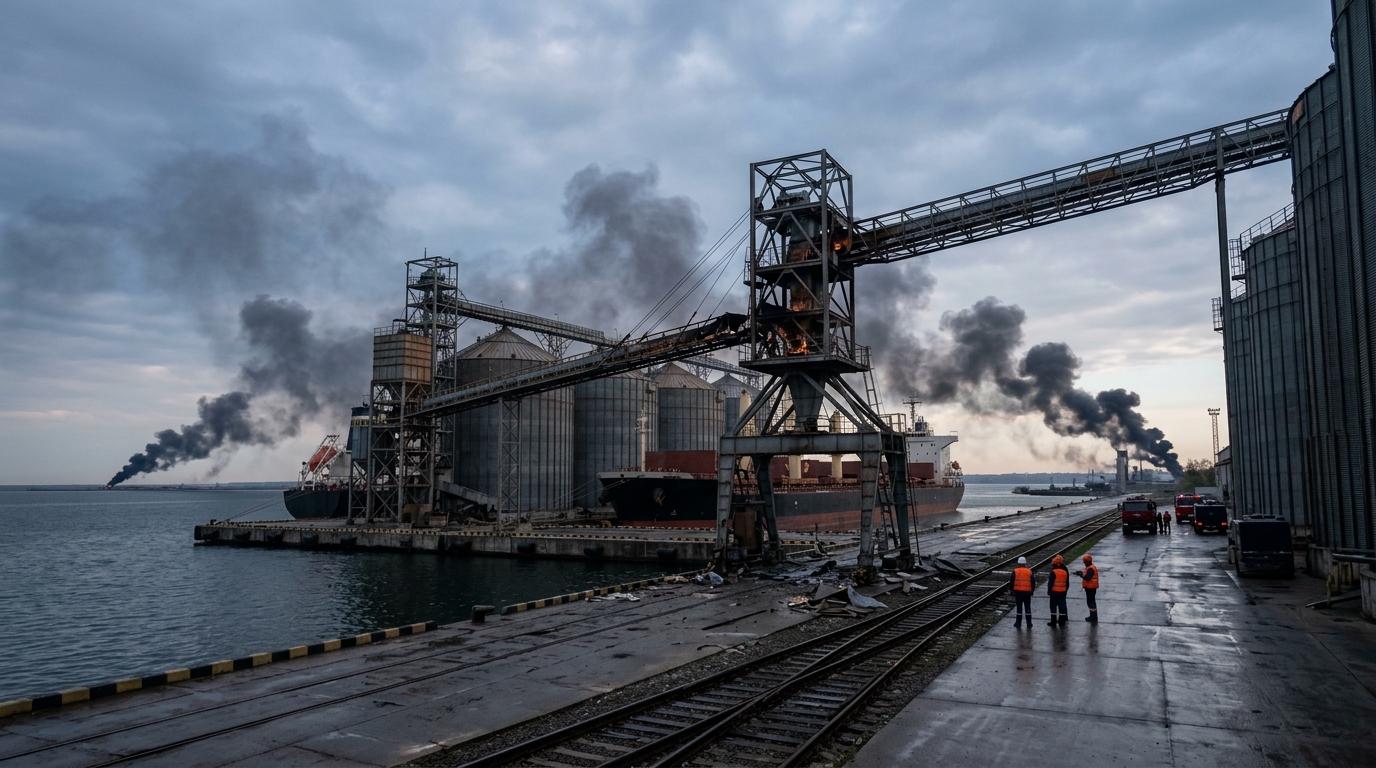
“There’s not enough capacity in other ports to relieve the supply that’s building at the ports that have been attacked,” said Tanner Ehmke, lead grains and oilseeds economist with the Knowledge Exchange research division of CoBank. That capacity ceiling is the structural ceiling on any short-term diplomatic fix. Even if a ceasefire covered maritime shipping tomorrow, the physical infrastructure damage at Novorossiysk alone would require months to repair. The IGC’s pre-crisis forecast put combined Russia-Ukraine exports at 95.4 million tonnes for 2026-27, with wheat accounting for 63.5 million tonnes of that total. The gap between that pre-war projection and current operational capacity is the number traders need to watch.
The global wheat price average is expected in the $0.302 to $0.334 per kilogram range for H2 2026, with continued firming as Black Sea logistics premiums persist and global stocks-to-use ratios remain at tighter-than-normal levels. Those consensus forecasts were set before the August escalation in Novorossiysk. They are likely too low.
The medium-term setup, looking at H1 2027, depends heavily on the planting season decisions that will be made in September and October 2026. If both Russian and Ukrainian farmers reduce planted area in response to the logistics paralysis, the supply shock does not resolve in one marketing year. It compounds across two. Markets are not pricing that scenario. Not yet.
Action Checklist
- Monitor CBOT ZW December 2026 at 650.50 cents and March 2027 at 667.25 cents as the primary forward pricing anchors for corridor disruption duration expectations.
- Track the KC/Chicago spread. A widening HRW premium above 70 cents signals quality-driven demand acceleration from import-sensitive buyers. A narrowing spread signals risk-off positioning or diplomatic progress.
- Watch managed money positioning via the weekly CFTC Commitment of Traders report. The current net short in Chicago SRW at 26,485 contracts represents potential fuel for a short-covering rally if bullish catalysts materialize.
- Evaluate IV rank on ZW options before initiating any directional position. Elevated implied volatility makes outright long options expensive. Defined-risk structures (verticals, condors) are more cost-efficient at current IV levels than naked directional bets.
- Track Novorossiysk terminal repair timelines. Even a partial reopening of one of the three major terminals (NKHP, NZT, KSK) would represent a bearish catalyst for near-term futures. Satellite imagery services covering the port are the most reliable real-time indicator.
- Watch Egypt’s sovereign procurement activity. Egypt sourcing 82% of wheat imports from Russia and Ukraine means any emergency buying program it announces will move international benchmarks. A formal Egyptian government tender at elevated prices would confirm the bull thesis.
- Monitor ceasefire dialogue covering maritime shipping. Ukraine’s proposal to halt attacks on Black Sea civilian shipping has already been rejected once by Russia. A second proposal or multilateral pressure could shift the corridor status within days.
- Track 2026 autumn planting reports from Russia and Ukraine starting in late September. Any documented reduction in planted wheat area below 2025 levels is a forward-looking supply signal the market will need to reprice materially.
Markets don’t need a war to move wheat prices. They only need uncertainty about who feeds the world next season. Right now, that uncertainty is not theoretical. It is being manufactured, one drone strike at a time, over the same waters that have supplied grain to the Mediterranean, North Africa, and the Middle East for a century. The price is already moving. The question is how much of the structural damage is still ahead of us.
The Editorial Desk