
August 24, 2026
Tesla’s Cybercab Has a Date. Price Hasn’t.
Featured: Tesla’s Cybercab Has a Date. Price Hasn’t.
If you sat down with a laptop and a cup of coffee 10 years ago as a regular person…
You’d probably be stuck trying to write a “Hello World” webpage.
But with today’s AI tools…
A regular person can develop a trading engine that’s able to flag one of the market’s most reliable bullish signals every single day.
That’s exactly what a Virginia dad did, and he went on to crush Wall Street’s finest hedge funds by the end of 2025.
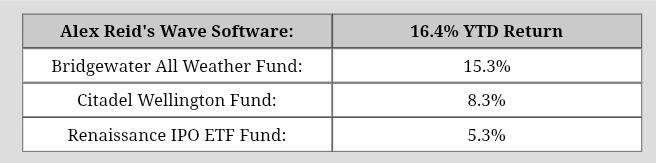
This Virginia dad is none other than me!
I recently went live to spill my guts on the inner workings of this AI breakthrough.
I can’t make guarantees on the market, of course, but if you’re yet to see exactly how this powerful tool works…
You should hurry over here now to get the full details.
To Better Trading,
Alex Reid.
Tesla’s Cybercab Has a Date. Price Hasn’t.

Analyst Targets
- Morningstar: Buy | Fair Value $450, calls Cybercab deployment a “positive step forward” and views current levels as a “good entry point for long-term investors”
- Deutsche Bank: Buy | Target $420 (lowered from $465)
- Jefferies: Hold | Target $350 (lowered from $400 on August 7), trimmed 2026 EBIT forecast 37% to $3.9 billion on weaker operating leverage
- ARK Invest (published model): 2029 price target $2,600 | Bear case $2,000 | Bull case $3,100, estimates robotaxis will account for nearly 90% of Tesla’s enterprise value by 2029
- Consensus (47 analysts): Buy | Average target $395.34
The Week That Changed the Debate
Three events arrived in rapid succession last week, and together they have moved the Tesla investment question from “can this work?” to “how fast, at what scale, and priced at how much?”
On August 20, the Nevada Transportation Authority unanimously approved Tesla Robotaxi, LLC’s Autonomous Vehicle Network Company permit, authorizing a fleet of up to 5,000 fully autonomous vehicles within Clark County during the first 12 months, subject to conditions that must be satisfied before service can begin. On August 22, Tesla confirmed a Cybercab launch event for September 3 in Austin. And running underneath both: a stock that gained more than 5% on Friday alone, recovering from a late-July low near $297 toward the $362.86 level seen as of the August 21 close.
The stock’s year-to-date performance remains a complicated story. TSLA has underperformed every other member of the Magnificent Seven in 2026, and a 14.5% single-session drop after Q2 earnings in July still sits in recent memory. But the regulatory approvals and the confirmed Cybercab date have investors asking the same question again: is this the inflection, or just another promise?
Company Profile
Tesla is no longer trying to be the world’s largest automaker. That pivot was explicit. In Q4 2025, CEO Elon Musk used the earnings call to announce the end of Model S and Model X production and reframe Tesla around four pillars: Robotaxi services, the Optimus humanoid robot, AI infrastructure, and energy storage.
The vehicle business still generates the bulk of revenue, and Q2 2026 record deliveries of 480,126 units proved demand can return when pricing and availability align. Energy storage reached 13.5 GWh deployed in Q2. The services segment generated $4.58 billion, up 50% year-over-year with record margins.
But none of those numbers justify the valuation. The valuation is a bet on autonomy at scale, which is precisely why the Cybercab and the Nevada permit matter so much to so many investors carrying a large position.
Missed Tesla? PayPal? SpaceX? You Might Regret Missing This One Too…
Many are calling him The Next Elon Musk…
His first company made investors 6,566% before the age of 25…
Now, he’s building one of the most-anticipated companies in the world… with $26 billion in government contracts already in place.
And one rare 4-letter ticker gives you early access – before the IPO.
The Q2 Numbers
Tesla’s second-quarter 2026 results delivered a split verdict that drove the stock down sharply the day after the report.
- Revenue: $28.24 billion vs. $26.36 billion expected, beat of approximately 7.1%, up 26% year-over-year
- Non-GAAP EPS: $0.33 vs. $0.54 expected, miss of approximately 38%, down year-over-year
- Operating income: $398 million, down 57%, operating margin of 1.4%
- Automotive gross margin (ex-regulatory credits): 16.3%
- Regulatory credit revenue: $146 million, down from $439 million a year earlier
- Vehicle deliveries: 480,126, a Q2 record
- Energy storage deployments: 13.5 GWh, up more than 40% year-over-year
- Free cash flow: Negative $1.09 billion, capital expenditures surged to $5.79 billion
- Operating expenses: Up 47% to $4.35 billion, driven by AI infrastructure and R&D
- Full-year capex guidance: In excess of $25 billion
The market’s verdict was fast and severe. TSLA fell 14.5% in the session following the report. The revenue beat was real, but the profit collapse was not easily explained away. Operating income fell 57% to $398 million, and a company trading at well over 300 times trailing earnings needed something more than “we are investing for the future.”
Why the Stock Is Moving Now
The rebound from the July low to the $360 range is not a function of the fundamentals improving. It is a function of the Cybercab calendar crystallizing.
Three catalysts in one week compressed what could have been a months-long wait into a single, tangible date. The Nevada Transportation Authority’s August 20 vote was the most consequential regulatory approval Tesla has received for its ride-hail ambitions. The approval authorizes a fleet of up to 5,000 fully autonomous vehicles within Clark County during the first 12 months following permit issuance, but it remains subject to compliance requirements before vehicles can be placed into service. This replaced an earlier Nevada order that had capped Tesla at 10 vehicles with additional restrictions, including a 45 mph speed ceiling and confinement to a Strip corridor geofence.
Then came the September 3 event confirmation. Tesla officially announced a Cybercab launch event in Austin, with access limited to invited guests. Tesla has said it began Cybercab production at Gigafactory Texas and employee test rides started in July 2026, with the vehicles widely spotted around Austin. The launch is expected to begin with limited rides before broader availability.
The Cybercab itself is a two-seat vehicle with no steering wheel and no pedals, priced below $30,000 for private buyers and designed from the outset as a commercial robotaxi rather than a retrofitted consumer car. It is a fundamentally different product than the Model Y vehicles currently comprising Tesla’s Austin fleet.
Meanwhile, Tesla disclosed during the Q2 earnings call that its Robotaxi program had accumulated more than 380,000 unsupervised miles across six cities in two states with zero notable incidents, and cumulative paid Robotaxi miles had reached approximately 2.5 million since the service opened in Austin in June 2025. Those numbers matter because they represent real-world data collection that feeds FSD training, which in turn is the underlying engine of the entire thesis.
Macro and Industry Context
The autonomous vehicle market in 2026 is no longer a proving ground. It is a commercial battleground, and Tesla is entering it from behind on one critical dimension: fleet density.
Waymo, backed by Alphabet, operates across 11 U.S. cities as a fully driverless commercial service and uses a sensor-heavy approach combining cameras, lidar, and radar across its fleet. Its share of the U.S. robotaxi market by monthly active users stood at approximately 69% in June 2026, down from 79% at the start of the year, as Amazon-backed Zoox grew its own share from 15% to 25% over the same period.
Tesla is competing on a fundamentally different architecture. Its vision-only, end-to-end neural network approach requires no lidar and is designed to use the real-world miles driven by Tesla vehicles in FSD mode as its primary training advantage. The scale of that data is unmatched. The question is whether the data advantage translates into the kind of consistent, scalable unsupervised performance that regulators require before they allow unrestricted fleet deployment.
The regulatory picture is clarifying, but not uniformly in Tesla’s favor. In Nevada, the company asked for 5,000 permits and initially received 10, with a speed cap, a geofence, and no airport pickups. The August 20 approval authorizing up to 5,000 vehicles for Clark County is a significant jump, but vehicles still cannot be placed into service until the company meets the Authority’s pre-service requirements, including inspections, insurance, and rate filings. At the August 20 session, a Tesla representative said the company would be “extremely happy” to reach roughly 2,500 vehicles in Nevada by 2027.
That gap between permitted capacity and operational reality is the central tension in the investment case right now.
Forward Scenarios
Bull Case
The Cybercab enters service in Austin before the end of September. FSD v15 ships in late 2026 or early 2027, enabling meaningful scale across multiple states simultaneously. Tesla’s unit economics advantage, with the Cybercab targeting a cost per mile materially below Waymo’s current model, allows aggressive pricing that drives rapid rider acquisition. Morningstar’s bull case assigns more than 30% of Tesla’s valuation to robotaxis alone at a $450 fair value. ARK’s model, which attributes nearly 90% of future enterprise value to autonomy, implies far higher numbers if fleet deployment reaches the millions by 2029. TSLA back above $500.
Base Case
The Cybercab launches September 3 in Austin, begins initial rides, and folds into broader public service over the following weeks. Nevada commercial rides begin with a small initial fleet after Tesla clears the Authority’s pre-service requirements, scaling through 2027. Automotive margins stabilize in the high teens as pricing pressures ease. The stock holds in the $350-$420 range, roughly in line with the consensus analyst target of $395, as investors wait for Q3 earnings to confirm whether the capex cycle is producing operating leverage.
Bear Case
The September 3 launch is a media event, not a commercial inflection. Fleet deployment remains in the dozens, not thousands, through year-end. FSD v15 slips into 2027 or beyond. Automotive gross margin continues declining as regulatory credit revenue, which fell from $439 million to $146 million year-over-year, disappears entirely. Free cash flow stays negative while the company spends more than $25 billion in capex. At a high-multiple valuation, the stock has no floor that fundamental analysis can reliably identify. The $125 low-end analyst target is not theoretical at that valuation.
Technical Overlay
TSLA rebounded from a late-July low near $297 to close at $362.86 on August 21, its best week in over a month. The recovery has developed through a sequence of higher lows and higher highs on the daily chart, with price moving above the short-term moving average but still trading well below the 50-day SMA, which sits near $390. The $390 level represents the primary resistance zone, where multiple moving averages and prior breakdown levels converge. A sustained close above $390 would be the first meaningful technical confirmation that the post-earnings selloff has fully reversed.
Support at $330 held twice during the August consolidation. Below that, the $297 low is the structural floor for this recovery. The pattern is a rebound inside a larger range, not a completed reversal, and the gap from current levels to the 200-day average remains substantial.
What Investors Should Watch
- September 3 Austin launch: How many Cybercabs enter service, what markets are announced, and whether initial rides expand quickly beyond the invited group
- Nevada commercial ride start: The permit allows up to 5,000 vehicles over the first 12 months, but service depends on clearing inspections, insurance, and rate filings. Any delay becomes a signal
- FSD v15 timeline: Tesla has linked fleet scale to software milestones. Any slip alters the deployment slope
- Q3 earnings timing: Operating margin recovery will be the primary signal; the market needs to see the capex cycle producing margin expansion, not further compression
- Waymo fleet density relative to Tesla: If Waymo’s commercial volume in established cities continues expanding while Tesla’s fleet count in those same markets stagnates, the competitive gap becomes harder to dismiss
- Regulatory precedent: How Nevada and other state regulators respond to Tesla’s operational record in the first 60 to 90 days after launch will determine how quickly the 5,000-vehicle authorization translates into 5,000 vehicles on the road
Bottom Line
Tesla’s Cybercab moment is no longer a concept or a promise. It has a date, a confirmed location, and a Nevada approval that can accommodate up to 5,000 fully autonomous vehicles in Clark County over the first 12 months after permit issuance. The stock is reflecting all of that.
What it is not yet reflecting is the difference between permission and execution. Waymo holds a driverless-mile lead measured in the hundreds of millions. Tesla’s disclosed unsupervised mileage stood at 380,000 as of the Q2 earnings call. The Nevada authorization for 5,000 vehicles and the operational reality of deploying them on a compressed timeline are not the same thing.
The real question for TSLA at $362.86 is not whether the robotaxi opportunity is real. It is whether a company trading at well over 300 times trailing earnings can continue to hold that multiple if the Cybercab’s first months reveal that scaling a purpose-built autonomous vehicle fleet in real-world conditions takes two years, not two quarters. At current prices, investors are paying for the bull case and hoping the base case is what arrives. The bear case does not require the thesis to be wrong. It only requires the timeline to slip.
Q3 earnings will be the first hard data point after the September launch. That is the next moment that actually matters for the stock.
For informational purposes only.