August 24, 2026
FRO Into Aug. 28: Price the Move
With TD3C earnings above $520,000/day and fewer than 20 vessels transiting Hormuz per session
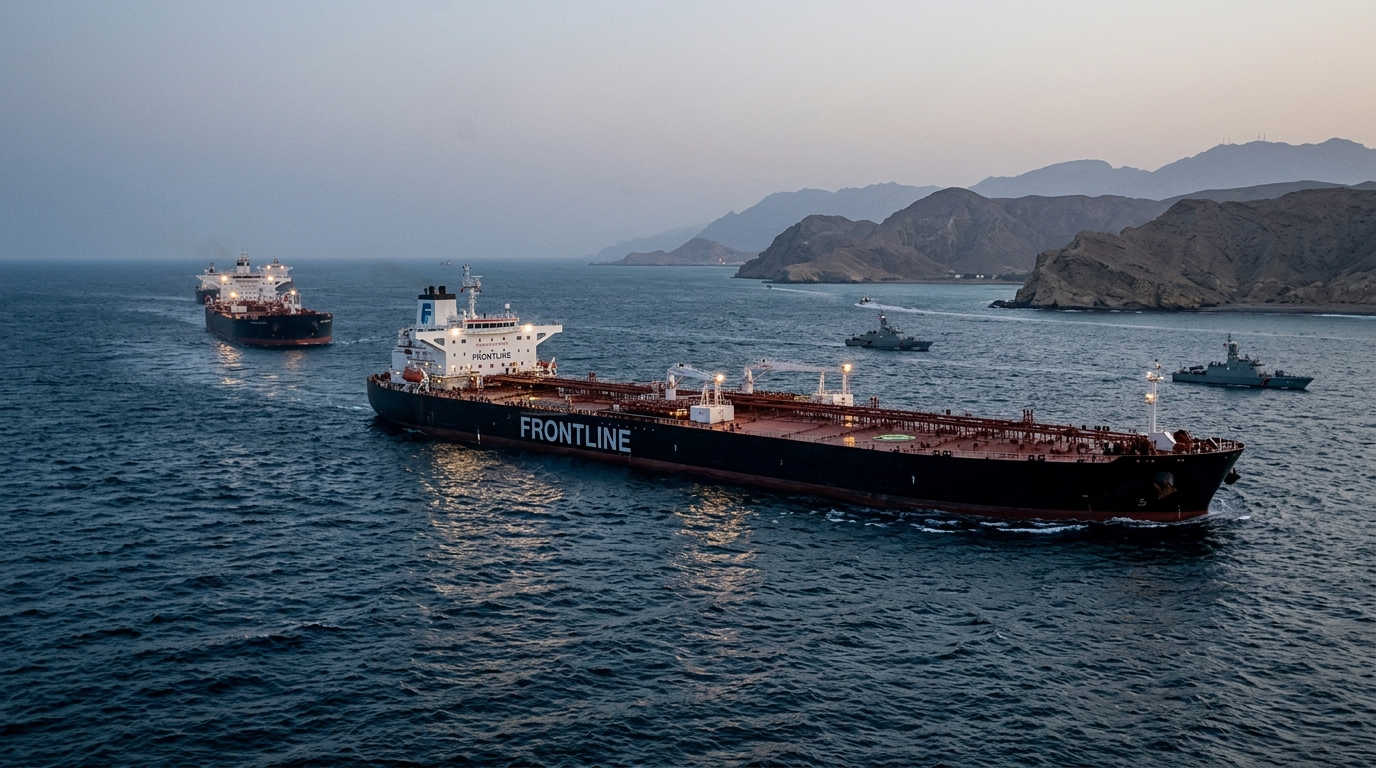
The tanker trade has always been a war-by-proxy play. But the Strait of Hormuz closure that began in earnest in late February and was officially confirmed by the IRGC on March 2, 2026 has made that abstraction literal. Roughly 20.9 million barrels per day of petroleum liquids moved through the strait on average in 2023, roughly 20% of global petroleum liquids consumption. The IRGC officially confirmed the strait was closed on March 2, 2026, threatening passage for “unfriendly” shipping. A brief ceasefire reopened partial passage in April, then broke down. By mid-2026, reporting from multiple shipping and insurance sources still described traffic as far below normal, with insurance costs acting as the binding constraint on routine commercial movement.
Lloyd’s List has repeatedly highlighted how extreme Middle East Gulf VLCC economics became during the Hormuz crisis, with the Baltic Exchange’s TD3C index printing well above $300,000 per day at points and remaining highly volatile. War-risk insurance premiums have surged, with additional war-risk premiums for Hormuz transits reported as moving from roughly 0.25% of hull value pre-conflict to ranges that have been quoted from 3% up to 7.5% to 10% for higher-risk profiles, meaning a $100 million tanker can face roughly $3 million to $10 million in war-risk premium for a single passage versus about $250,000 prior to hostilities. That cost is mostly passed through to charterers, which is precisely why the economics compress for everyone except the ship owners actually booking the voyages.
The Numbers Frontline Walks Into Friday With
Frontline will release its preliminary Q2 2026 results on August 28, 2026. Street estimates vary by data source, but recent published forecasts cluster around roughly $2.66 to $2.74 in EPS and about $746 million to $759 million in revenue. The Q1 comparable is formidable: Frontline achieved a Q1 2026 profit of $559.1 million, or $2.51 per share, with reported revenues reaching $714.2 million, and it described its adjusted profit as the strongest since Q4 2004. The booked rate for Q2 tells the story of the summer escalation. As of the Q1 2026 call and related disclosures, Q2 2026 bookings were 82% of VLCC days at $181,700, 79% of Suezmax days at $131,300, and 68% of LR2/Aframax days at $125,000 per day. Those were locked in before conditions tightened again into mid-summer.
The Overlooked SpaceX Play
The opportunity right now is NOT to buy SpaceX – it’s to own the small, overlooked stocks that could rip triple digits as Elon expands his empire. That’s according to Tim Bohen, self-made millionaire who called Tesla at $37.
Frontline reported a 67% year-over-year revenue increase for Q1 2026. The stock has been trading near its 52-week high heading into Friday’s print, and BTIG reiterated a Buy rating and raised its price target to $55 in late June 2026.
What the Market Priced, What Changed
The original Q2 guide assumed softer summer spot TCEs, and management said as much on the Q1 call. The second phase of disruption changed the denominator. The $181,700 bookings figure reflects a market that had partially reopened; the rates being quoted in the most stressed windows have been multiples of prior-cycle norms on the active corridors. The risk walking into August 28 is not a bad quarter. It is a good quarter followed by a reopening headline that detonates the forward rate assumption.
That asymmetry defines the options structure. Frontline CEO Lars Barstad has said tanker traffic through the Strait of Hormuz should quickly increase if the U.S. and Iran reach a credible deal. A deal, or a credible rumor of one, is the single largest tail risk to a long FRO position, independent of what Friday’s results show.
This Building in West Texas Is Generating “AI Royalties”
This is an AI data center. Thousands of them are popping up across America.
But this one in West Texas could pay everyday investors for decades.
Every ChatGPT query… every Alexa answer… every Netflix recommendation…generates a royalty you can collect.
It’s already paid out over $810 million since 2022. And the real buildout hasn’t even started.
Options Market Analysis
FRO options carry elevated implied volatility given the binary geopolitical backdrop. The expected move into the Aug. 28 print is approximately 8-10% in either direction, consistent with prior earnings reactions in heightened-rate environments. IV percentile is elevated relative to pre-conflict norms. Put/call flow has tilted toward calls, consistent with six consecutive up sessions.
Structured Trade Framework
Bull case: For traders expecting rates to hold and guidance to impress, a defined-risk bull call spread expiring in mid-September captures the earnings pop while limiting exposure to a reopening reversal. Strike selection: buy the at-the-money call, sell the call 8-10% higher. Premium outlay is the maximum loss.
Bear case: For traders expecting a ceasefire headline before or shortly after the print, a defined-risk bear put spread targeting the $38-40 area monetizes a reversion toward the average analyst target without naked short exposure to the dividend yield. Cash generation potential has been framed by third-party analysis as roughly $1.5 billion annually (about $7 per share) under the extraordinary rate environment discussed in late May 2026, with sensitivity to spot-rate declines.
Small Colorado Company (Backed by Sam Altman) Could Save U.S. Power Grid
A small Colorado company now owns rights to a tech that could save the entire public power grid from collapse. And billionaire Sam Altman is now an investor.
Neutral case: A short strangle around Friday’s print, with wings defined by long options one standard deviation out on each side, sells the elevated IV while the long wings cap the loss if a headline moves the stock outside the expected range. This structure benefits from IV crush post-earnings regardless of direction.
Risk Factors and Forward Outlook
The dominant risk is not operational. It is diplomatic. War-risk premiums have been one of the key transmission mechanisms for freight spikes, and any credible de-escalation that brings those premiums down can rapidly compress forward earnings assumptions. Free cash flow yield claims vary widely depending on the rate deck, share price, and whether the analyst uses operating cash flow, free cash flow, or an earnings proxy, so treat point estimates as scenario outputs rather than constants. Peers including INSW, TNK, and DHT are exposed to the same reopening risk, so a sector-wide hedge is worth consideration alongside any single-name position.
Action Checklist
- Verify FRO’s booked Q2 TCE rates versus the roughly $746 million to $759 million revenue forecast range before sizing
- Check IV rank on Aug. 29-expiry options versus the 30-day IV for the crush estimate
- Define maximum loss before entry on any structure; no naked short positions given reopening binary
- Set a geopolitical stop: any confirmed U.S.-Iran ceasefire language warrants immediate reassessment
- Monitor Baltic TD3C forward freight agreements for Q4 2026 as the forward signal for rate normalization pace