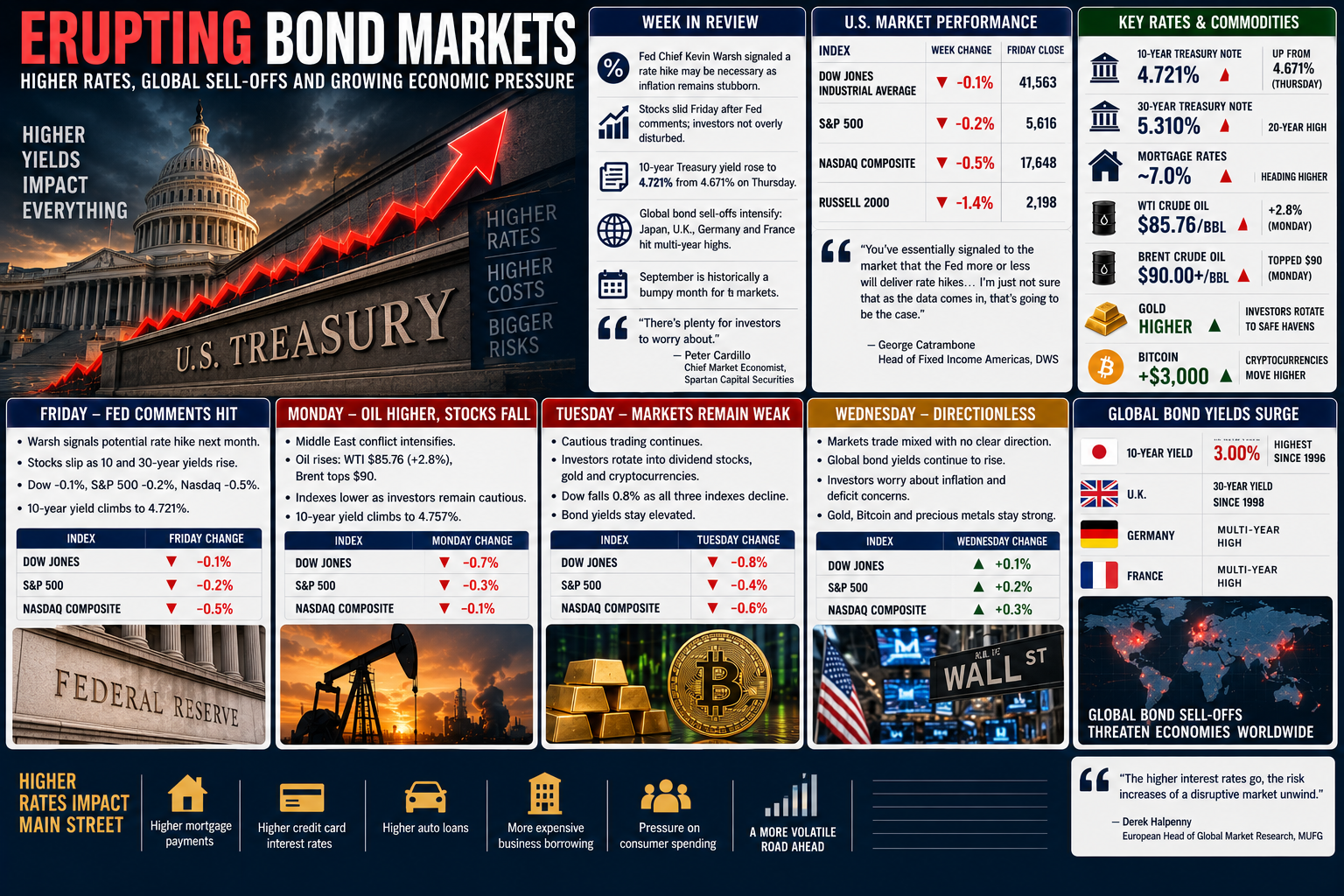
Higher interest rates are on the horizon as Kevin Warsh, Federal Reserve Chief gave indications stubborn inflation is dictating a hike may be necessary. In speaking at the “Fed’s annual symposium” in Jackson Hole, Wyoming, inflation was a ‘main topic’ with a possible hike next month. (Lurking just around the corner…the bond implosion is gaining momentum). Stocks reacted to Friday’s Fed comments, sliding lower as the 10 and 30–year Treasury yields rose higher. “You’ve essentially signaled to the market that the Fed more or less will deliver rate hikes,” said George Catrambone, head of fixed income Americas at DWS. He adds. “I’m just not sure that as the data comes in, that’s going to be the case” Interestingly investors and traders were not particularly disturbed by Warsh’s comments. The Dow Jones Industrial Average fell just below flatline, 0.1%. The S&P 500 and Nasdaq Composite declined 0.2% and 0.5% respectively. The 10–year Treasury note, the “force–full influencer” of future borrowing costs creepy up to 4.721% from 4.671% on Thursday. The smaller value–company Russell 2000 index lost 1.4%, as many of its companies making up the index were closely tied to the economy’s roots. The month of September is “historically a bumpy month for the stock market,” as investors attempt to align strategies for the final months of the year.
A familiar scenario….as the market opened Monday… oil prices marched higher, stocks fell. Fighting in the Middle East Conflict intensified, giving a ‘chill’ to investors and traders. Hopes for a conclusion have ‘dulled,’ with diplomacy’s “war–of–words” falling on deaf ears. West Texas crude traded up to $85.76 a barrel, up 2.8%, while Benchmark crude topped $90.00 a barrel All three indexes were lower as investors treated techs, semiconductor and artificial intelligence issues with caution as those markets were flat. The Dow Jones lost 374 points, off 0.7%, followed by the S&P 500 and Nasdaq dropping 0.3% and 0.1% respectively. All major indexes finished August “with gains” according to Wall Street Market Watch. AI and technology stocks whip–sawed much of the month, clouded by Software stocks leading the market higher for the month. The 10–year Treasury note continued to rise, climbing to 4.757% from 4.721% on Friday. “There’s plenty for investors to worry about,” said Peter Cardillo, chief market economist at Spartan Capital Securities.
Economies worldwide are threatened by the massive bond sell–offs. Japan’s 10–year bond yield is 3%, the highest since 1996. The 30–year yield in England also “crested the highest level since 1998.” Germany and France followed, with both countries reaching 10–year highs. Economic financial conditions have deepened in countries, large and small, pressuring borrowing costs. Higher interest rates, sure to follow, affecting governments, credit–cards, home–buyers and every type of debt will cost the consumer much more. Tuesday’s market was flat, as cautious investors and traders hedged their investment choices, and even rotated into dividend stocks and the ‘beloved’… gold and precious metals. Bitcoin, also now a desired hedge, was up over $3.000 on Thursday, as cryptocurrencies all moved higher. Tuesday’s Dow Jones fell 0.8%, while both the S&P 500 and Nasdaq dropped. “We’re in the danger zone already,” said Derek Halpenny, European head of global marketing research at MUFG. He added. “The higher interest rates go, the risk increases of a disruptive market unwind.” Wednesday’s market remained ‘directionless’ as investors worried about the bond sale fall–out and potentially higher interest rate increases, across–the–board. “The sharp rise in global bond yields reflects investors reassessing inflation,” said Mike Goosay, chief investment officer at Principal Asset Management.
RUMBLINGS ON THE STREET
Kristan Kerr, head of Macro strategy for LPL, WSJ – “There’s this element of still trying to figure [Warsh] out. That’s going to go on for a while.”
Michel O”Rourke, Chief market strategist, JonesTrading, WSJ – “When people overpay for assets in a bubble–type investment environment, there is usually an overshoot to the downside as well.”
Seema Shah, Chief global strategist at Principal Asset Management, Barron’s – “Higher bond yields reduce the present value of future earnings and place downward pressure on valuations, particularly in long–term duration growth sectors. They may also threaten one of the market’s key supports: the wave of AI–related capital expenditures.”