September 5, 2026
Four days until Sept
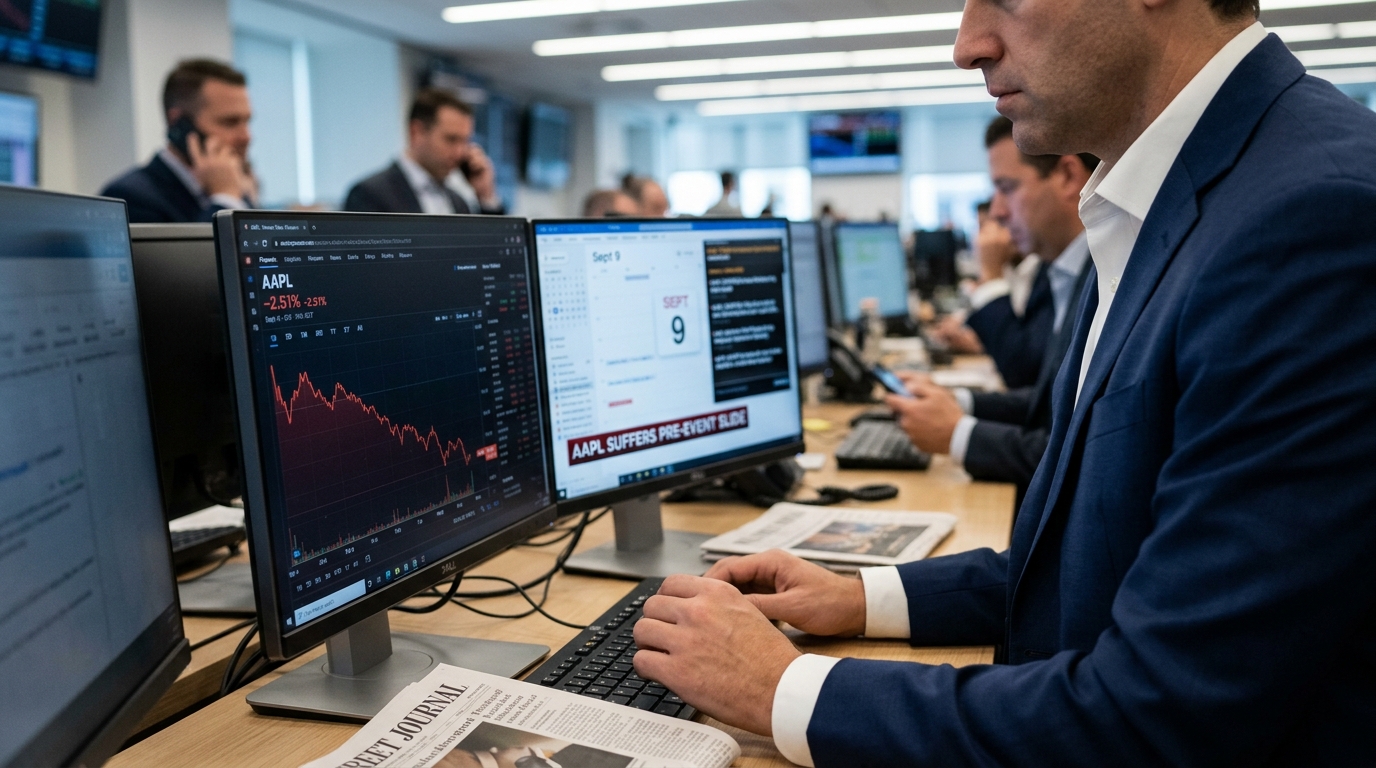
This is not an earnings week. There is no EPS number coming Wednesday morning, no revenue beat or miss to trade through by noon. What arrives instead is a product event, and product events carry their own volatility mechanics. The market is already testing them. Apple’s stock fell 2.51% on September 4, 2026, amid a report of production challenges for its rumored foldable iPhone. At the session low, AAPL was down as much as 3.2%.
Did Trump Draw a Red Line Around This Mystery Stock?
When a major U.S. trading partner targeted one American energy company’s profits, Trump publicly warned it was making a “big mistake.”
Why defend this company?
Nikkei Asia reported that the initial production run of the foldable iPhone was limited to only a “few hundred” units per day. The slow initial output was attributed primarily to Apple’s stringent quality-control requirements, while the company and its suppliers work to increase production. That report landed four days before Apple’s “Surprise and shine” event at Apple Park, and it landed on top of a downgrade that was already sitting in the market’s memory.
Jefferies downgraded Apple stock to Underperform from Hold on August 10, with analyst Edison Lee citing supply chain checks suggesting the company canceled its planned all-glass iPhone due to low production yield. Jefferies cut its FY28 and FY29 EPS estimates by 2.1% and 3.4%, respectively, and said its $263.66 price target implied roughly 16% downside from the prior close at the time of the note. The analyst also argued the foldable iPhone is the “only key driver of higher ASP and margin” in the near term. That framing matters: if the foldable stumbles, the bull story has nowhere to go.
What the Event Will Deliver
Apple will hold its “Surprise and shine” event at 10 a.m. PT, where it is widely expected to introduce the iPhone 18 Pro, iPhone 18 Pro Max, and its first foldable iPhone. TrendForce has said Apple is adjusting its launch schedule starting in 2026, splitting releases between fall and spring, with the fall focused on Pro models and the first foldable.
TrendForce has said the foldable could start between $2,099 and $2,299, while the standard iPhone 18 and other lower-cost models are expected in Q1 2027. Analyst Ming-Chi Kuo’s figures are tighter on supply: he has estimated second-half 2026 assembly shipments of roughly 7 to 8 million units, including under 1 million in Q3, and expects pricing around $2,300 to $2,500. Against that, Kuo expects roughly 20 to 22 million iPhone 18 Pro and Pro Max shipments in Q3, which anchors just how small the foldable contribution is expected to be this quarter, regardless of how Wednesday goes.
5 Nasdaq Stocks Under $5 That Aren’t What You Think
Most stocks under $5 come with a reputation. These don’t.
Each company on this list is tied to major trends like AI, cybersecurity, and next-gen infrastructure.
They may not have the spotlight yet, but they are building real businesses in real markets. That combination is not always easy to find at this price level.
The event also marks the first major product reveal under new CEO John Ternus, who became Apple’s chief executive on September 1, 2026, succeeding Tim Cook. Apple’s most recent quarter delivered revenue up 16.4% year over year to $109.4 billion and EPS of $2.02 (up 29%). iPhone revenue rose 21.7% to $54.3 billion, which Apple described as its strongest-ever June-quarter iPhone performance. Ternus inherits a strong operating position and a stock that has pulled back roughly 7% from its July 29 high of $344.57.
Options Market: What Volatility Pricing Signals
AAPL’s 30-day option implied volatility is at 25, compared to its 52-week range of 18 to 33. That places IV rank in the upper half of its annual range, elevated but not extreme, consistent with a known binary event rather than an unscheduled shock. The call-put ratio stands at 1.1 calls to 1 put heading into the Sept. 9 event, reflecting modest directional lean without the kind of put-heavy skew you’d see in genuine panic. Realized volatility is currently running above implied volatility, with a VRP of -7.3 percentage points, meaning the stock is moving more than options are pricing. That’s an unusual condition: premium sellers face elevated assignment risk even as IV sits near the top of its range.
A product event is not an earnings catalyst. There is no IV crush guaranteed after Wednesday. If the foldable reveal disappoints, the market can keep selling. If it exceeds expectations, the rally may be muted by pre-existing supply concerns. Both outcomes are live.
Structured Trade Framework
Bull case: For traders expecting a strong reveal and positive foldable demand signal from Apple on Sept. 9, a defined-risk call spread expiring Sept. 12 captures directional exposure while capping the premium cost in an elevated-IV environment. The asymmetry favors a spread over an outright call given the cost of optionality at current vol levels.
5 Nasdaq Stocks Under $5 That Aren’t What You Think
Most stocks under $5 come with a reputation. These don’t.
Each company on this list is tied to major trends like AI, cybersecurity, and next-gen infrastructure.
They may not have the spotlight yet, but they are building real businesses in real markets. That combination is not always easy to find at this price level.
Bear case: If you believe the production volume constraint is more severe than the market has discounted, a put spread targeting the $300 area on the Sept. 19 expiry gives defined downside exposure through any post-event drift. Jefferies’ price target of $263.66 implied roughly 16% downside from the stock’s prior close at the time of the downgrade, meaningful, but a timeframe question, not a week-one event.
Neutral case: A short iron condor on the Sept. 12 expiry captures premium if the stock stays range-bound through the event. The risk: realized vol running 7.3 points hotter than implied means assignment pressure is real, and an iron condor needs the stock to behave. Size accordingly.
Risk Factors and Forward Outlook
Three risks sit above the others. Supply: production of the foldable iPhone was reported as running at only a few hundred units per day in late August. If that figure surfaces in post-event analyst commentary, it constrains the revenue contribution regardless of demand. Price: at $2,099 to $2,299, demand is inherently concentrated. And leadership: Ternus commands enormous credibility as a product engineer, but the September 9 stage will be his first solo performance in front of the market as CEO.
Action Checklist
- Check Sept. 12 weekly straddle pricing at open Monday for implied move sizing
- Compare to realized moves at prior iPhone events, product launches historically move AAPL 2% to 4%, smaller than earnings catalysts
- Confirm IV rank against 30-day realized before entering any premium-selling structure
- Define maximum risk before the event; do not hold undefined short volatility through Wednesday’s 10 a.m. PT keynote
- Watch the foldable supply guidance closely, unit availability commentary, not the device itself, is the key post-event variable