Washington handed the AI sector two headline events this weekend, and they point in opposite directions. Traders who treat them as a single bullish catalyst are missing the more interesting rotation hiding underneath.
What Changed Saturday
President Trump announced he is creating an “AI Force” modeled on the Space Force and will soon name a new AI czar, doubling down on his push to accelerate artificial intelligence development with limited regulation. He provided few details about how the force would be structured or what legal authority it would have, but his broader objective was clear. Trump framed AI as “the next Industrial Revolution, or Internet, but will be even larger and more impactful, possibly as much as 25% of our Country’s GDP.”
That framing lands in a week where Trump’s principal outside voice on AI policy has come into sharp focus. With the debate about regulating artificial intelligence raging in Washington, Trump picked up the phone to call Nvidia CEO Jensen Huang at the All-In Summit in Los Angeles and said the robots are not going to be taking over the world. Treasury Secretary Scott Bessent, asked whether Trump understands AI risks, said on PBS’s Washington Week that the president is totally aligned with Jensen Huang.
Huang is also scheduled to attend Trump’s state dinner for Chinese President Xi Jinping in Washington on September 24.
The Fault Line That Matters for Traders
Here is the friction. A September New York Times/Siena poll found that 61 percent of likely voters opposed the construction of data centers to support AI, compared with 34 percent who supported it. Opposition reached 75 percent among Democrats and 47 percent among Republicans, while independents opposed construction by 60 percent to 36 percent. The concerns are often less about AI itself than about what the infrastructure requires locally: data centers can consume enormous quantities of electricity and, depending on design and location, substantial water resources.
That public opposition creates a political constraint that federal boosterism cannot simply override. Republican governors are already caught between Trump’s AI push and constituents who don’t want a data center next door. For Republican governors, they are left walking a narrow line between following Trump’s calls to support AI as an industry while arguing that companies should pay for the electricity, water, and infrastructure they consume.
The Rotation Trade
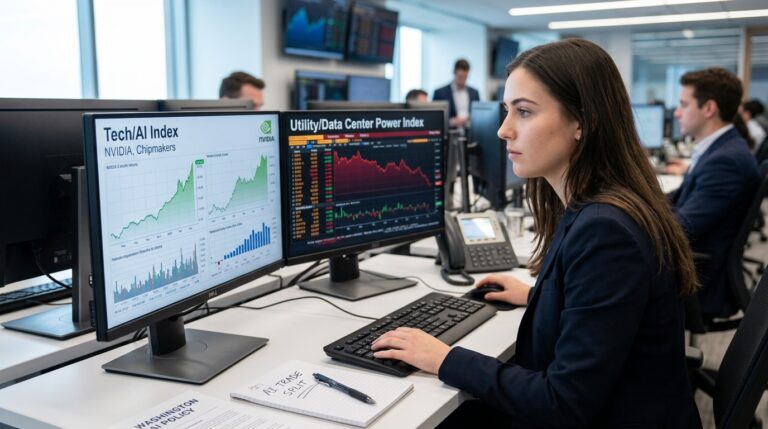
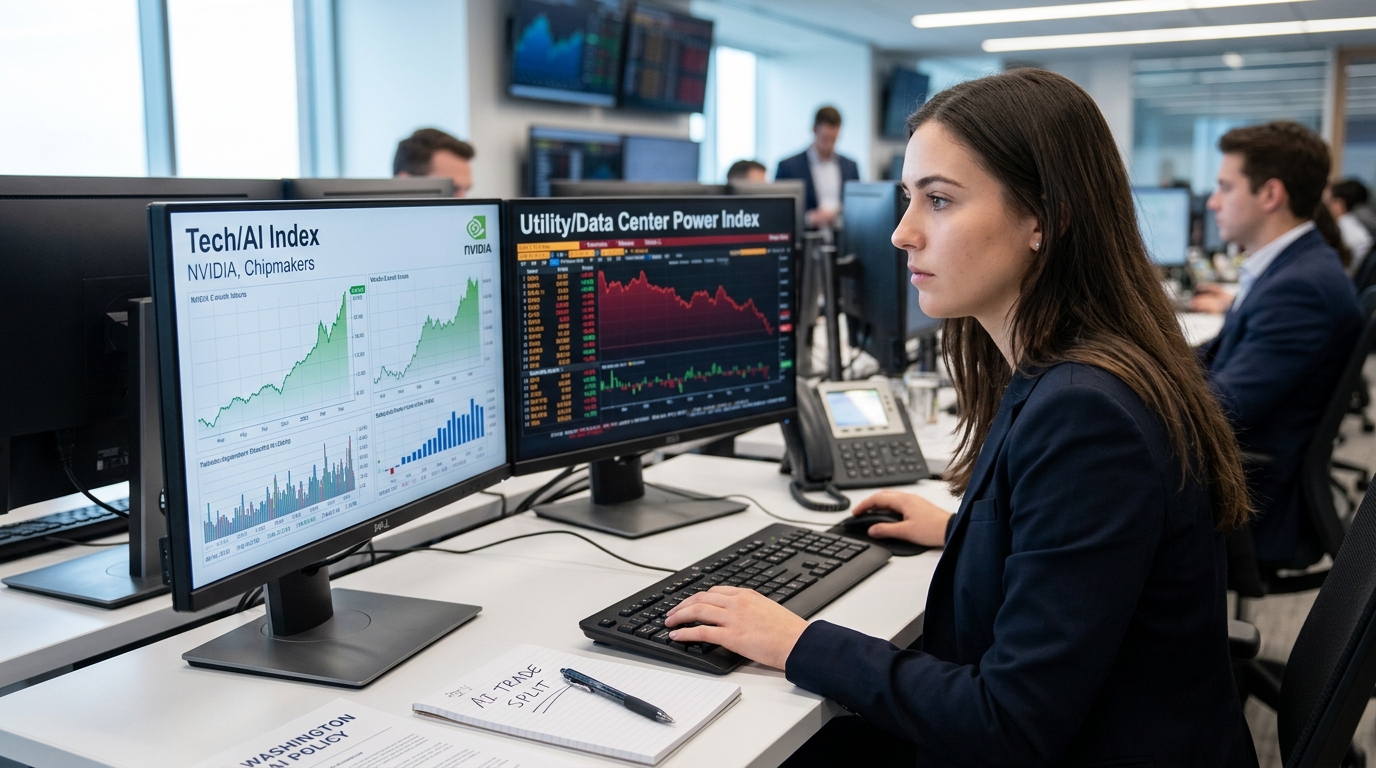
For NVDA, MSFT, GOOGL, META, and PLTR, the AI Force announcement is straightforwardly constructive. A dedicated federal body with a pro-growth mandate reduces the near-term regulatory risk premium embedded in these names. Nvidia in particular benefits from Huang’s direct line to the White House at a moment when chip export policy toward China is also on Xi’s agenda this week.
The more asymmetric opportunity sits one layer down, in the companies that actually deliver electricity to these data centers. CEG is down about 28% year-to-date and VST about 13%, yet both sit at the center of a structural demand shift in the power grid. Constellation Energy is the largest nuclear fleet operator in the U.S., and Vistra brings a diversified mix of nuclear, natural gas, and renewables. Constellation is already supplying Microsoft from the Three Mile Island Unit 1 restart and signed a 20-year, 1,121 MW deal with Meta.
GE Vernova rounds out the infrastructure side: its gas turbines and grid equipment have been pulled into the data center buildout as operators and utilities look for power solutions that can come online quickly.
Action Plan
Watch whether the AI Force announcement accelerates federal permitting for new generation capacity. That is the concrete mechanism connecting this week’s political news to VST, CEG, and GEV’s forward earnings. On the chip side, any clarity on the AI czar candidate will move NVDA first given Huang’s proximity to that appointment. The Xi dinner on the 24th adds a binary event: favorable AI chip export language is an immediate catalyst; a harder line is the primary downside risk for the week.