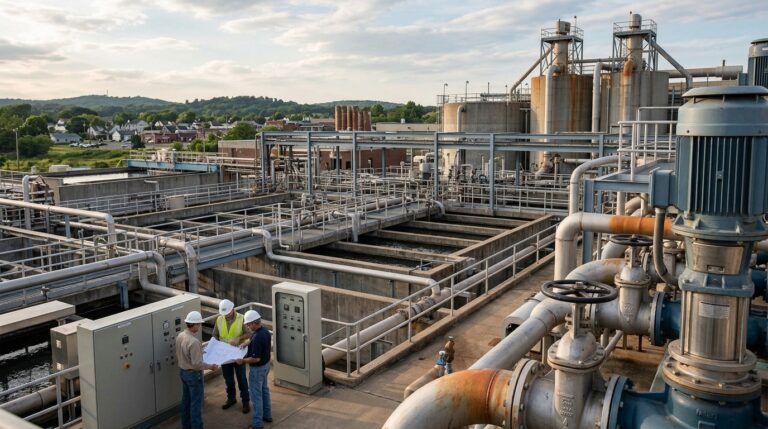
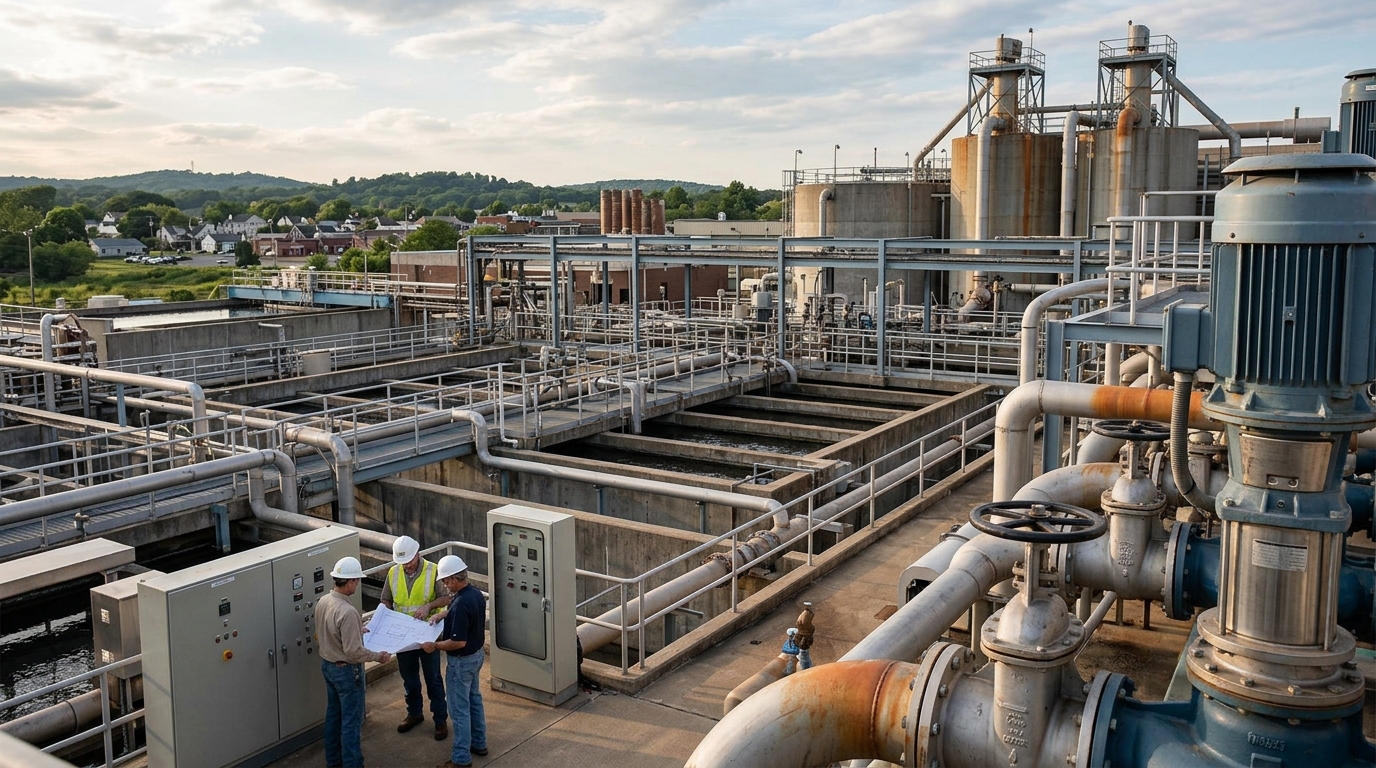
The old model for building a municipal water treatment plant looked like this: hire consultants, issue bonds, wait three to five years for permitting and construction, then hand the asset to an operator who may or may not have the crew to run it. The capex bill runs into the tens or hundreds of millions. The community carries the debt for decades.
That model is being quietly replaced. Not by a better engineering design, but by a different financial structure.
Water-as-a-Service (WaaS) flips the ownership equation. A private operator finances, builds, owns, and runs a modular reverse osmosis or desalination plant on the municipality’s behalf. The community pays only for delivered water, per unit, under a long-term contract. No bond issuance. No construction risk. No staffing headaches. The provider takes on all of it.
The decentralized water treatment market was estimated at roughly $21.9 billion in 2026 and projected to reach about $54.2 billion by 2034, according to Straits Research. That growth is not coming from bigger centralized plants. It is coming from smaller, faster, containerized units that can be dropped in, commissioned within days rather than months, and stacked as demand grows.
Seven Seas Water Group is the most instructive case study right now. The company says it owns more than 200 water and wastewater treatment plants across the U.S., Caribbean, and Latin America, and has implemented its WaaS model for more than two decades, providing communities with customized desalination, advanced water purification, and wastewater reuse solutions. EQT, through its Infrastructure VI fund, agreed to acquire Seven Seas from Morgan Stanley Infrastructure Partners in a deal Bloomberg Law reported valued the company at more than $1 billion including debt.
That transaction is the tell. EQT did not buy a utility. It bought a recurring-revenue platform whose contracts run 10 to 30 years. The company’s plants sign long-term, inflation-linked contracts with take-or-pay minimum volume commitments, creating stable, predictable cash flows. S&P Global Ratings has described a 30-year service agreement between Seven Seas and the South Texas Water Authority tied to a three million gallons per day reverse osmosis desalination plant. Seven Seas also says its Aruba project will produce a minimum of 16,500 cubic meters of drinking water daily under a 10-year Build-Own-Operate-Transfer agreement, with commissioning expected in 2026. Deal multiples vary, but 10x to 12x EBITDA is a commonly cited range for larger, contract-heavy water and wastewater platforms.
The shift also matters on the industrial side. In 2026, the industry has moved away from viewing modular units solely as emergency backups. Engineers now implement planned modularity, where mobile systems function as permanent, scalable components of a facility’s water infrastructure. In April 2026, DuPont launched an AI-enabled RO Operations Advisor that analyzes operating data and provides guidance on cleaning and membrane replacement to help reduce downtime and improve performance.
What has changed is not the technology. Reverse osmosis membranes are not new. What has changed is who holds the balance sheet risk. When that risk shifts from an under-resourced municipality to a capitalized operator with a portfolio of 200-plus plants, the cost of capital drops, the project timeline compresses, and the revenue stream becomes something a pension fund will price.
That is already happening in private markets. The U.S. EPA’s Clean Watersheds Needs Survey has put decentralized wastewater treatment systems needs at about $74.7 billion over a 20-year horizon. The public equity question is which equipment manufacturers, membrane suppliers, and engineering contractors ride the volume increase as modular deployments accelerate. The contract winners are already being identified. The supply chain behind them has not caught up yet.