

November 1, 2026
Bonus Content: Datadog Reports Wednesday. The Real Question Is Whether AI Pays the Bill.
For a while now, I’ve been showing regular traders like you how to take advantage of a specific 60-minute window…
One that lets us go after 50% returns every morning – whether the market opens higher… or lower.
Here’s what I mean…
If you had spotted this 60-minute opportunity yesterday morning… all you would’ve had to do was place a quick trade before 10 am…
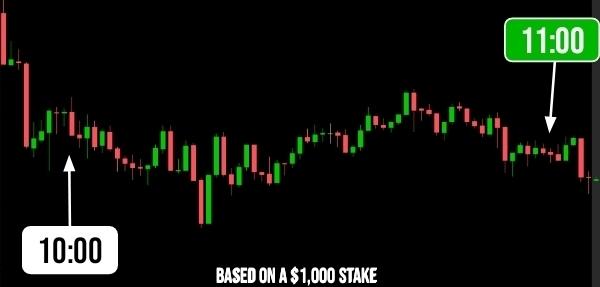
Went ahead with your morning plans and when you return a couple of minutes later, there’s a good chance you’d find $500 in extra income sitting in your account (on a 1k stake)
It wouldn’t have mattered what happened with the overall market… this 60-minute window would have been all you needed to target cash.
Today? Same story.
Place a quick trade, grab your coffee… and let the setup do the heavy lifting.
And just 60 minutes later… come back to what could be a nice $500 in extra income sitting in the brokerage account.
I designed the setup to be that straightforward.
Granted, there will be trades that won’t work out
But if you want in?
Datadog Reports Wednesday. The Real Question Is Whether AI Pays the Bill.

Datadog enters Wednesday’s Q3 report in an uncomfortable position: the stock just shed 11.5% on October 30 without a single company-specific headline, the options market has priced a roughly ±14% swing, and the last time management delivered a genuine upside surprise the shares still fell about 19% the following day. That sequence is what elevated implied volatility actually looks like in practice.
The selloff was sector-driven. ServiceNow’s results revived fears that AI could erode enterprise software demand rather than expand it, and Amazon’s cloud commentary rattled the hyperscaler thesis that underpins much of Datadog’s growth story. Snowflake dropped 7.3% in the same session. None of that is Datadog-specific. All of it is priced into Wednesday’s event.
The Numbers on the Table
Consensus for Q3 2026 sits at $1.14 billion in revenue and $0.64 in non-GAAP EPS, representing 28.9% year-over-year revenue growth. Datadog’s own guidance, issued August 6, called for $1.135 billion to $1.145 billion in revenue and $0.63 to $0.65 in non-GAAP EPS. The company posted $1.12 billion in revenue and non-GAAP EPS of $0.65 in Q2.
The Q2 beat came with an asterisk. Management disclosed a usage reduction from its largest customer, deliberately de-risked into Q3 and full-year guidance. That admission is why the Q2 numbers produced a sharp gap-down rather than a rally. The Q3 report answers whether that headwind materializes as guided or worsens.
Remaining Performance Obligations are the quieter metric worth watching. Analysts project $3.55 billion versus $2.79 billion a year ago. RPO acceleration would signal that multi-year contracts are being signed at a faster rate, a leading indicator the AI workload thesis is converting to committed revenue rather than speculative usage.
RPO is not unique to Datadog as a signal. Oracle’s contracted revenue backlog became the central bull argument when its stock sold off ahead of earnings, showing how committed-revenue metrics can diverge sharply from what the stock price implies.
What the Market Expected vs. What It Got Last Quarter
The Q2 dynamic is instructive. Datadog beat on every headline metric: revenue, EPS, operating cash flow of $316 million, and free cash flow of $279 million. The company also reported approximately 4,720 customers with ARR above $100,000, up from about 3,850 a year earlier. None of it mattered once the largest-customer disclosure landed. The market did not reward the beat. It sold the guide.
Wednesday reframes that dynamic. The Q3 guide was already conservative precisely because management flagged that headwind three months ago. A result at or above the high end of guidance ($1.145 billion) with no new customer concentration surprises would mean October’s decline overshot the fundamental deterioration. Analysts’ EPS estimates for the next 12 months, approximately $2.65, did not move during October’s selloff. The stock fell; the math did not.
Options Market Analysis
As of late October, DDOG’s 30-day at-the-money implied volatility was elevated versus recent realized volatility. That premium means options were pricing substantially more movement than the stock had recently delivered, giving sellers a theoretical edge on pure volatility. The IV rank has been elevated for weeks ahead of this event.
The options market is pricing a roughly ±14% move for the November 4 report, roughly $34 to $35 at current prices. Historically, DDOG’s actual earnings move has exceeded the implied move in approximately 59% of reports. The August 6 session produced about a 19% drop against an implied move of roughly 13.2%. The options market has underestimated DDOG’s post-earnings volatility in both directions.
Structured Trade Framework
Bull case: For traders expecting a clean Q3 result near or above guidance with no new customer concentration warnings, a defined-risk long structure using a November expiry call spread (buying the at-the-money call, selling a strike 10%-12% higher) limits premium exposure to the IV crush that follows the event while capturing the first leg of a rebound. The implied move gives a clear maximum target zone.
Bear case: If you believe a second consecutive guidance disappointment, or a worsening of the largest-customer situation, is the more likely outcome, a put spread struck at current prices with the short leg at the bottom of the implied move range (-14.7%) offers defined downside participation without uncapped risk from a volatility spike. The August gap shows the actual move can clear the implied range.
Neutral case: With implied volatility elevated versus realized, a short straddle or iron condor centered near current prices collects a meaningful premium if the stock stays within the implied range. The risk is explicit: about 59% of DDOG earnings have moved beyond the implied move historically. Position sizing to that base rate matters more than the structure itself.
Risk Factors
The largest-customer usage decline remains unresolved. A second disclosure would not be a repeat of Q2; it would be confirmation of a structural shift. Enterprise software multiples across the sector were cut this week on fears that AI disrupts incumbent platforms. Datadog’s observability layer is theoretically essential to AI infrastructure, but that case still requires proof in the revenue line. A miss on RPO would be the cleanest signal that the AI monetization thesis is behind schedule.
Forward Outlook
Full-year 2026 revenue guidance stands at $4.45 billion to $4.47 billion. Rosenblatt, which reiterated a Buy and $305 price target October 30, anticipates approximately 30% full-year growth. UBS raised its target to $320 on October 27. Neither analyst cut numbers during October’s selloff. Wednesday either validates that posture or forces a reckoning with it.
Action Checklist
- Confirm revenue vs. $1.135B-$1.145B guidance range and $1.14B consensus before sizing any position
- Monitor RPO: analyst estimate is $3.55B; acceleration signals AI contract conversion
- Watch $100K+ ARR customer count vs. the 4,720 reported last quarter
- Listen for any update on the largest-customer usage situation in the call at 8:00 AM ET
- Account for the roughly ±14% implied move in any defined-risk structure; the IV crush post-report resets option values regardless of direction
- Track ServiceNow and Snowflake reactions this week as context for enterprise software sentiment entering the open