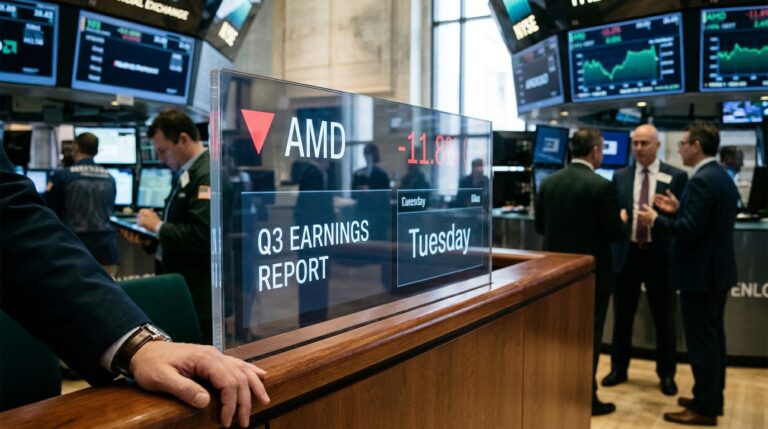

The Nasdaq 100 entered a technical correction on Friday, falling 2.9%. Apple reports fiscal Q4 after Monday’s close. Those two facts belong in the same sentence.
Every other mega-cap has already reported. Apple goes last, into a market that just broke. The Nasdaq Composite finished October down about 5.3%, its worst month since March 2025, driven by mounting skepticism over AI capital spending. Apple has, remarkably, acted as a hedge inside that selloff. That relative strength is real. It is also exactly why the guidance number on Monday night carries unusual weight. Defensive positioning unwinds fast when the defensive name disappoints.
What the Quarter Is Expected to Show
Analysts expect Apple to post earnings of $1.99 per share on revenue of $113.39 billion. That implies EPS growth of 7.6% and revenue growth of 10.7% year over year. Those are respectable numbers on paper. The context makes them complicated. Apple has beaten EPS estimates for a long run of quarters, but strong results have not guaranteed gains.
The September quarter may not move the stock much. That buffer is fading. The December-quarter outlook matters more than the headline September-quarter result.
The Real Event: Ternus and the December Guide
John Ternus became chief executive on September 1, a transition that occurred inside the reported quarter, making November 2 his first earnings call as CEO, with Tim Cook moving to executive chairman. That alone changes the character of this call. Every word in the guidance language will be parsed for continuity or departure from the prior framework.
December-quarter gross margin guidance ranks first among the watchpoints. Guidance above 47% would indicate pricing pass-through running ahead of memory costs, while 46% or lower would align with the more bearish view that cost pressure remains unoffset even after pricing is fully reflected.
Memory cost pressure is not unique to Apple’s supply chain. Nvidia’s own margin guide fell even after a record revenue beat, with management attributing the compression directly to memory costs running above prior expectations.
Apple trades at roughly 39 times forward earnings, versus roughly 22 times for the S&P 500. At that valuation, there is no margin for a soft guide.
Options Market: What the Implied Move Says
Options currently price a move of plus or minus about 4.3% for the November 2 report. The options market is, in other words, underpricing the historical range. The stock price moved more than the amount suggested by options in six of the past eight earnings announcements. The most recent miss: on July 30, options indicated a 3.5% move, but the stock fell 5.2%.
The put-to-call ratio on contracts expiring November 6 is elevated and typically characterized as bearish. Implied volatility has followed the standard pre-earnings ramp: into the last close before results, then collapsing once the numbers are out. Buying premium here means paying for that crush. Selling it means accepting binary risk on a guidance call nobody has modeled before.
That IV crush dynamic is not unique to this report. Apple’s options market has already shown how a record-beating quarter can still produce a 10% post-earnings drop when guidance disappoints.
Structured Trade Framework
Bull case. If Ternus guides December-quarter gross margin at or above 47% and revenue growth in the low teens, the implied 4.3% move is likely too small. For traders expecting that outcome, a defined-risk structure would be a call spread expiring November 7, buying the at-the-money call and selling the strike 5% higher, to cap cost while capturing the bulk of an upside gap.
Bear case. If gross margin guidance comes in at 46% or below, or if Ternus hedges language on iPhone Duo supply, the July post-earnings pattern repeats. Traders in this scenario should watch $339.50 as first support. A defined-risk put spread, buying the at-the-money put and selling 5% lower, captures a move without unlimited exposure to a short-squeeze reversal on any bullish surprise.
Neutral/IV-sell case. If you believe the stock resolves inside the implied range, a short iron condor, selling the 4% strangle and buying wings 3 points further out, collects premium while the IV crush does the work. This structure loses if the actual move exceeds roughly 7%, which history says is possible but uncommon.
Risk Factors
Three variables make this report structurally harder to model than any Apple report under Cook. First, Ternus’s guidance language is unquantifiable in advance: there is no prior sample of how he frames uncertainty. Second, the correction-mode index amplifies downside. A weak guide from the world’s largest company by market cap does not occur in a vacuum. Third, dozens of analysts cover Apple and their targets span a wide range, suggesting deep disagreement about whether Apple is a hardware maker facing rising costs or a services and AI platform that deserves a premium. That disagreement gets resolved Monday night.
Action Checklist
- Watch reported Q4 gross margin against the guided 47% to 48% range.
- The December-quarter gross margin guide is the primary signal. Above 47%: bullish. Below 46.5%: bearish.
- Monitor put-to-call ratio on November 6 expiry contracts for real-time sentiment shifts post-report.
- Note exact wording of Ternus’s supply and memory cost commentary, his first as CEO.
- Size all positions to survive a 7%+ move. The options market is pricing about 4.3%; history argues the realized move can exceed that.