For years, the question hanging over Intel’s foundry ambitions was blunt: who would actually pay to have their chips made there? On Wednesday, that question got its first answer for Intel 18A.
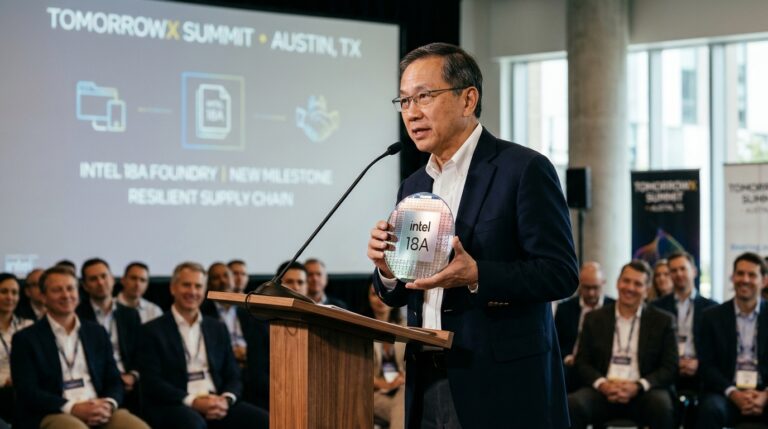
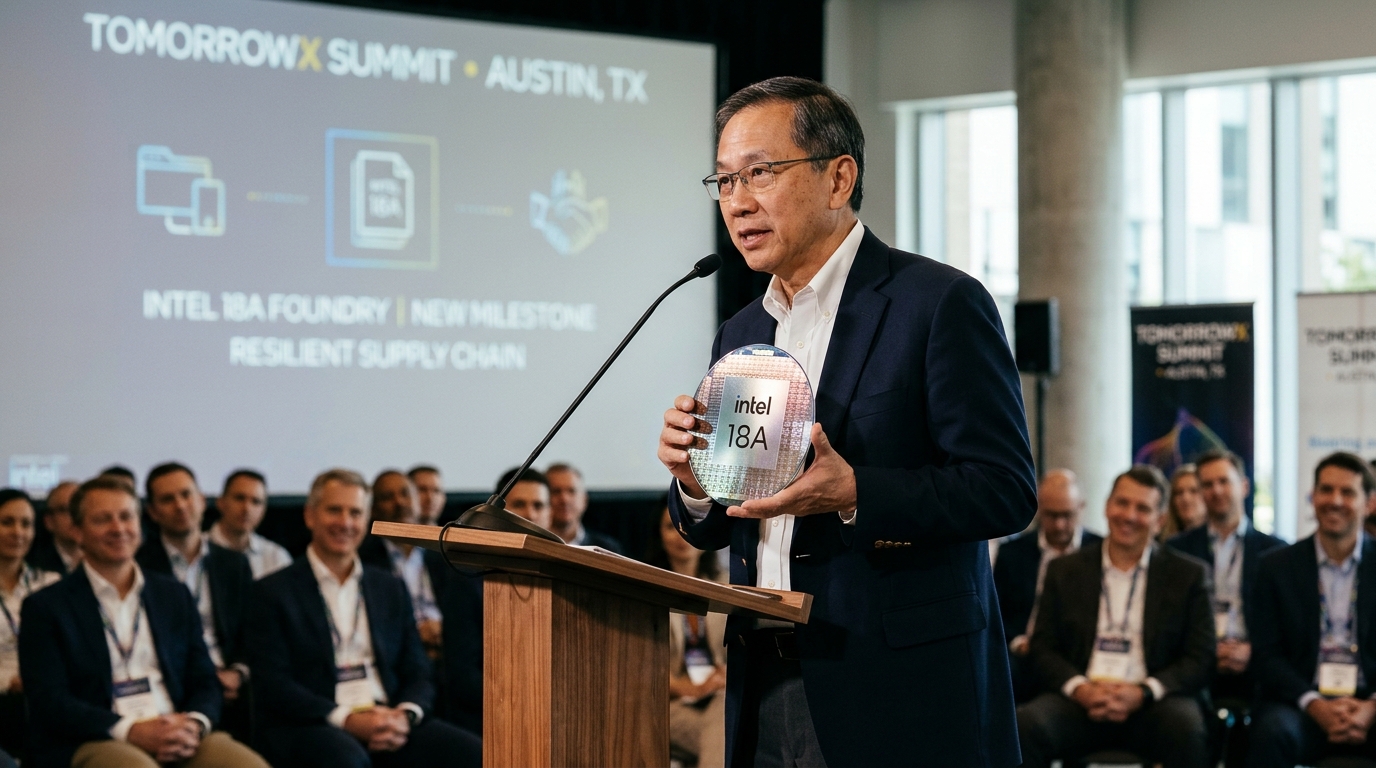
CEO Lip-Bu Tan, speaking at the TomorrowX Summit in Austin, Texas, said Intel has signed the first outside customer for its 18A-family chips. “Resilient supply on the foundry is very important,” Tan said, adding: “18A, I’m involved in production and we just signed the first customer.” He declined to name the client. Intel’s technology chief, Pushkar Ranade, later said on X that the customer signed up for the 18A-P process node.
Intel 18A-P entered the risk production phase in June 2026. That is a compressed timeline for a node that, when Tan took the helm in March 2025, was producing yields he characterized as “not good.” Tan said at the summit that 18A yields have now climbed to 70%. Getting to 70% is the sort of improvement that turns a science project into a product line.
The same day brought a second, named win. Intel said Microsoft is the first company to publicly announce use of Intel Foundry’s Embedded Multi-die Interconnect Bridge technology for Azure first-party silicon. Intel also said the agreement confirms multi-year Intel Xeon supply capacity alongside the packaging deal. EMIB connects multiple chip pieces inside a single package, a capability that has become critical as AI workloads demand ever-denser silicon integration.
The strategic backdrop is what gives both announcements real weight. AI-driven demand is stretching advanced foundry and packaging capacity, pushing hyperscalers to seek alternative suppliers. Creative Strategies analyst Ben Bajarin told CNBC that “Amazon, Microsoft and Google are struggling to get capacity for their CPU ambitions at TSMC.” Intel, which spent most of the past decade as an also-ran in the foundry conversation, is now positioned directly in the path of that bottleneck. Tan said in late October that he sees the global market for server processors increasing as much as five times over the next five years, to roughly $200 billion, and that Intel cannot currently meet customer demand.
A disciplined long-term investor looks at this moment not as a reason to buy Intel today, but as the first concrete evidence that the thesis is not dead. Without external customers on leading-edge nodes, Intel’s foundry effort risks looking like an expensive science project. The unnamed 18A-P customer changes that calculus at the margin. So does Microsoft’s willingness to put its Azure silicon on Intel packaging.
What could still go wrong is a long list. Volume commitments and contract values remain undisclosed. Intel’s foundry business has faced long-standing challenges with yield ramps, PDK toolchain maturity, and a lack of landmark external customers at the leading edge. One customer, however credible, does not make a business. Samsung Foundry has found that even respectable technology does not guarantee order flow when TSMC’s execution track record is the alternative. Intel needs not just a first customer but a second, third, and a confirmed ramp to meaningful revenue.
Intel is now running two foundry stories simultaneously: an 18A offering available today and a 14A pitch aimed at external customers on a 2028 time frame. The first story just moved from aspiration to fact. The second remains entirely unproven. Investors who have watched Intel disappoint for a decade are right to stay skeptical. But the count of external 18A customers went from zero to one on Wednesday, and that is not nothing.