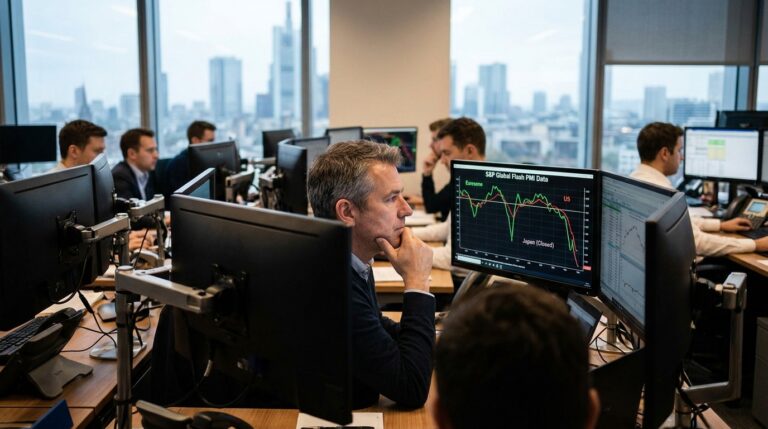
When three governments intervene in a single weekend, it is worth asking why they felt they had to. The answer, spread across Seoul, Taipei, and Shanghai, is an AI-driven selloff deep enough to force state hands everywhere at once.
What Actually Moved
China’s state-backed funds poured a record amount into the market on Friday, with inflows into the nine ETFs known to be actively traded by the so-called national team totaling 90 billion yuan ($13.5 billion) in a single session, according to Bloomberg data. That broke the prior single-day record of 87 billion yuan set during an earlier national-team buying surge in 2025. Individual funds also broke records: the Harvest CSI 300 ETF drew 23 billion yuan, while the ChinaAMC SSE 50 ETF attracted an all-time high of 21.7 billion yuan.
South Korea’s finance ministry said Sunday it would prepare its securities-market stabilization fund for immediate activation. The fund, established in 2020 by financial institutions, is valued at 10.76 trillion won, or about $8 billion. It has never been deployed. Activation was considered in 2022 during a credit-market shock but was not carried out. The last time a stabilization fund was actually used to buy stocks was in 2008.
Taiwan, exposed to the AI industry through TSMC and other tech firms, also moved. The Financial Supervisory Commission announced that short selling below the previous closing price would be prohibited for stocks that fell 3.5% or more in the prior session, with an exception for hedging and certain business purposes by securities and futures firms.
What the Market May Be Missing
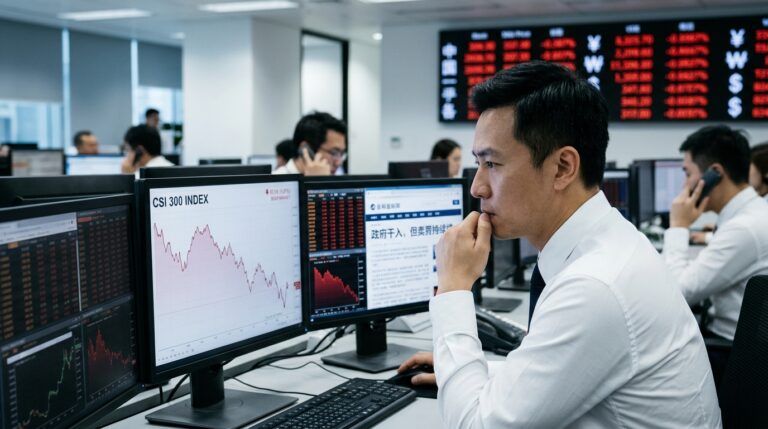
The scale of the interventions is not reassuring. It is diagnostic. The CSI 300 has continued to slide despite repeated state-backed purchases, leaving the index in a bear market.
Seoul tells a similar story. The KOSPI is deep in bear territory, down about 48% from its June peak. Daily turnover on the KOSPI is large enough that the stabilization fund’s size looks modest in comparison, and heavy foreign participation in short selling has added to the pressure.
Where It Shows Up
Korea’s KOSPI dropped 3.31% on Monday as a global AI stock rout pressured Samsung Electronics, SK Hynix, and other technology shares. Samsung Electronics fell 3.06% on the day, while SK Hynix declined 2.52%. Both are cornerstones of EWY, the iShares MSCI South Korea ETF. FXI and KWEB carry the heaviest exposure to Beijing’s intervention target, while EWT tracks the Taiex, which reversed earlier losses to gain over 2% on Monday after the short-selling curbs took effect.
The disconnect between Samsung and SK Hynix’s fundamentals and their share prices is worth noting. The selloff is being driven by AI sentiment and foreign outflows, not on-the-ground demand signals. Stocks are falling on fear, not on orders.
Risks and Counterpoints
Analysts have said the support is aimed at stabilizing the market and warding off systemic risks rather than igniting a sustained rally, with hopes for a genuine recovery still resting on rebounds in domestic demand and corporate earnings. That framing matters. Governments can cap volatility at the margin; they cannot replace the AI capital expenditure cycle if it slows.
Markets can rally sharply on announcements of official intervention, only to resume declining when investors discover that the economic and earnings assumptions supporting earlier valuations have not materially improved. Taiwan’s short-selling curbs produced a session of relief. Whether it holds into next week depends heavily on what Wall Street’s AI sentiment does next.
What to Watch Next
Three things will determine whether this weekend’s actions matter. First, whether South Korea’s stabilization fund moves from prepared to deployed, and in what size. Second, whether the CSI 300 can hold its current level given that Chinese equities remain under pressure from an AI-led technology selloff that the national team has been unable to reverse across months of buying. Third, any guidance from major U.S. cloud and hyperscaler companies on AI data-center spending commitments. That is the variable Seoul, Taipei, and Beijing cannot control.