

For a while now, I’ve been showing regular traders like you how to take advantage of a specific 60-minute window…
One that lets us go after 50% returns every morning – whether the market opens higher… or lower.
Here’s what I mean…
If you had spotted this 60-minute opportunity yesterday morning… all you would’ve had to do was place a quick trade before 10 am…
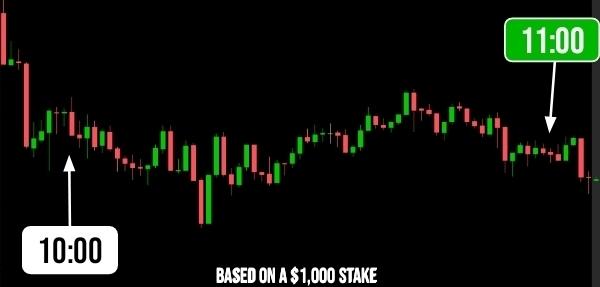
Went ahead with your morning plans and when you return a couple of minutes later, there’s a good chance you’d find $500 in extra income sitting in your account (on a 1k stake)
It wouldn’t have mattered what happened with the overall market… this 60-minute window would have been all you needed to target cash.
Today? Same story.
Place a quick trade, grab your coffee… and let the setup do the heavy lifting.
And just 60 minutes later… come back to what could be a nice $500 in extra income sitting in the brokerage account.
I designed the setup to be that straightforward.
Granted, there will be trades that won’t work out
But if you want in?
Disney’s FCC Win Is Real. The Risk Is Not Gone.

DIS closed at $125.60 on November 25, touching a four-year high, then pushed to $125.94 in after-hours trading. Part of that move belongs to strong fiscal Q4 earnings: revenue running at $102.3 billion trailing twelve months, operating margin widening to 16%, free cash flow nearly doubling. But a court ruling arrived the same afternoon that markets are treating as a clean win. It is not.
U.S. District Judge Loren AliKhan barred the FCC from putting the licenses of eight Walt Disney-owned ABC television stations up for early review on November 25. The judge found that the network faced a “campaign of retaliation” for its protected speech. “This is not a close case,” she wrote, citing “the extreme, indeed existential, nature of the possible penalty Plaintiffs face” as the basis for granting the injunction.
The injunction is limited and temporary: investigations are not barred, the FCC may use other tools, and ABC must post a one-dollar bond. The underlying lawsuit continues, and the FCC can appeal. An FCC spokesperson called the ruling “wrong on the facts and wrong on the law,” and the agency has pledged to prevail. Both sides must file a joint proposal outlining next steps by December 9, 2026.
What the Math Actually Says
The judge’s 45-page order counted eleven calls by President Trump over two years for FCC action against ABC’s licenses, the most recent in July 2026. That is not a one-off political moment. It is a sustained pressure campaign that the injunction interrupted, not terminated. FCC Chairman Brendan Carr ordered the early review on April 28, 2026, shortly after President Trump publicly called for ABC to fire late-night host Jimmy Kimmel. The FCC has also maintained a separate equal-time dispute involving ABC’s programming, and that equal-time fight can continue regardless of this ruling.
DIS closed at $125.60 on November 25, its highest since April 2022, but the stock remains 37.8% below its record close of $201.91 from March 2021 and has gained 35.9% from its $92.42 closing low in March 2026. Morgan Stanley carries an Overweight with a $138 target; JPMorgan raised its target to $140 following fiscal Q4. The consensus analyst target sits at $131.34. At $125.94, DIS is priced close to those estimates, leaving limited cushion against a legal reversal.
Sector Implications
This case is bigger than Disney. Broadcast stations need FCC licenses to use public airwaves, and while license revocations are extremely rare, the risk of losing a license could have a chilling effect on a broadcaster and raise concerns about government interference. Comcast’s NBC, Paramount’s CBS, and every other network with FCC-licensed stations watched this ruling closely. A precedent establishing the FCC’s retaliation as unconstitutional is valuable to the sector, but only if it survives appeal and is converted into a final judgment, neither of which is assured.
Options Market Analysis
The options market had flagged this uncertainty before the ruling. Pre-earnings data from mid-November showed implied volatility pricing a 5.6% move versus a trailing eight-quarter median actual move of 7.4%, an unusually compressed expectation given the regulatory overhang. On November 18, following Disney’s earnings, the stock rose 4% with total option volume reaching 64,253 contracts, of which calls accounted for 63%. That call skew faded before the injunction news broke, then reloaded.
With DIS now trading near its 52-week high of $126.28, implied volatility is likely compressing again. Historical realized volatility for the 20-day period ran at 17.3% as of early November, while at-the-money IV was running near 28%. That gap between realized and implied, roughly 11 points, makes outright long premium positions structurally expensive into a holding period where the legal outcome remains binary.
Structured Trade Framework
Bull case: If you believe the injunction holds, an FCC appeal fails at the D.C. Circuit, and Disney’s earnings momentum sustains, a defined-risk call spread targeting the $130 to $138 range captures the analyst consensus move without unlimited downside. The December expiry is too close given the December 9 joint filing deadline; January or February structures give the story room to develop.
Bear case: If the FCC appeals and wins a stay of the injunction before December 9, or if the separate ABC-related regulatory dispute accelerates into a formal enforcement action, DIS could retrace toward the $112 to $115 range where gamma support clustered pre-earnings. A defined-risk put spread in that zone offers asymmetric positioning against that scenario.
Neutral case: For traders expecting continued uncertainty without a sharp directional move, a short strangle at the $118/$133 strikes in January collects elevated IV premium while defining risk through wings. The position earns if DIS stays range-bound through the litigation calendar. A wider iron condor adds defined protection on both tails.
Risk Analysis
The core risk here is misreading a legal pause as a legal conclusion. The FCC’s vow to prevail is not bluster. The agency has institutional credibility, a chair with White House backing, and a Supreme Court precedent argument it has not yet fully litigated. The judge denied ABC’s broader request for an injunction barring the FCC from taking “any actions, formal or informal, to coerce or threaten” editorial decisions, ruling that courts cannot enjoin conduct that is “merely feared.” That partial denial matters. It leaves informal pressure channels intact, and those are historically the channels that change editorial behavior most effectively.
Forward Outlook
December 2 brings the bond deadline set by the court. December 9 brings a joint legal roadmap. Those two dates define the near-term risk window for DIS holders. An FCC appeal to the D.C. Circuit, the most likely administrative law venue, could come at any point and would immediately reintroduce the license overhang. This situation is not resolved. It is paused, priced at a four-year equity high, and scheduled to become complicated again within two weeks.
Action Checklist
- Monitor the court-ordered bond deadline by December 2 for procedural compliance and any signaling from either side
- Watch December 9 joint litigation proposal for case scheduling that could accelerate or extend the timeline
- Assess IV levels in January DIS options: compress further and credit structures become more attractive; spike on FCC appeal news and long-premium defined-risk positions become cheaper in volatility terms
- Track the separate ABC-related equal-time dispute and other regulatory avenues, which the injunction does not cover
- Treat $126.28 (current 52-week high) as a near-term ceiling until legal clarity improves; Phillip Securities cut DIS to Accumulate from Buy on valuation at a $130 target, suggesting the easy re-rating trade may already be priced