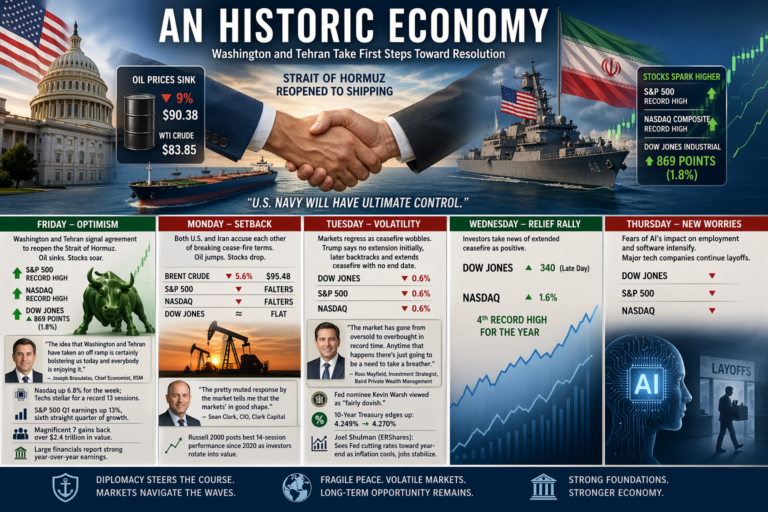
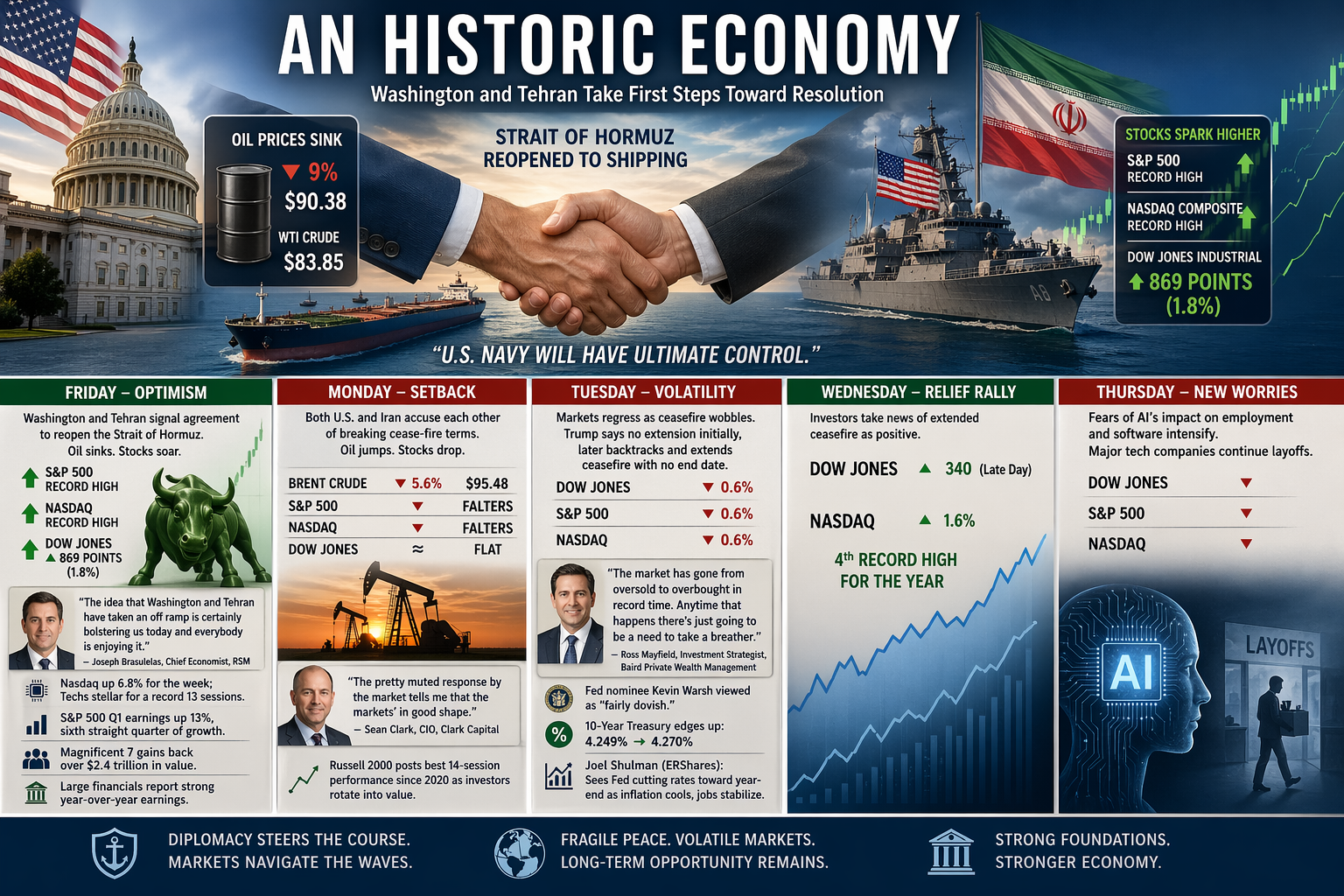
Finally… Washington and Tehran have come together, molding the first steps to seeking resolution to the lingering war. Iranian officials have signaled a ‘come-together’ agreement of reopening the Strait of Hormuz, allowing shipping to begin. The president emphasized that the “U.S. Navy will have ultimate control.” Oil sank, stocks sparked higher on Friday as oil was down 9% to $90.38 a barrel, with brokers predicting more downside on Monday’s open. West Texas crude followed downward, sinking to $83.85 a barrel. The indexes responded positive, with the S&P 500 and Nasdaq Composite again reaching new record highs. The blue-chip Dow Jones Industrial continued to soar, up 869 points, or 1.8%. “The idea that Washington and Tehran have taken an off ramp is certainly bolstering us today and everybody is enjoying it,” said Joseph Brasulelas, chief economist at RSM. The heavy technology Nasdaq had a very good week, up 6.8%, as techs have been stellar movers for a record “13 sessions.” Also according to recent statistics, the S&P 500 first quarter earnings so far released are up 13%, for the “sixth straight quarter of session growth.” Another ‘sliver sector,’ the Magnificent 7 has gained back over $2.4 trillion in value in recent sessions, according to Dow Jones Market Data. Large financials continue to report better year-over-year earnings results, strengthening the back-bone of the economy.
Stocks dropped, oil jumped as both the U.S. and Iran accused the other of breaking the ‘cease-fire terms.’ Dialogue between the countries continues to erode as each side tries to gain ‘higher ground.’ The market opened Monday with unnerving investors and traders again discerning market moves. Brent Crude slid 5.6% to $95.48 a barrel as ceasefire violations gave worries to investors. Tech again was weak as shown by both the S&P 500 and Nasdaq faltering. The blue chip Dow Jones struggled, finishing just above flatline. “The pretty muted response by the market tells me that the markets’ in good shape,” said Sean Clark, chief investment officer at Clark Capital. The Russell 2000, made up of smaller value-laden companies, continued to add to its “best record 14-session performance since 2020.” Good evidence that some investors are taking profits in their technology, software and AI holdings, into value-growth issues in the Russell.
Stocks again regressed on Tuesday as the fragile U.S./Iranian cease fire wobbles. All three indexes lost 0.6% as the market reacted to President Trump’s assertion that there would be no extension initially. After markets closed he back-tracked, extending the ceasefire with no end date. “The market has gone from oversold to overbought in record time. Anytime that happens there’s just going to be a need to take a breather,” said Ross Mayfield, an investment strategist at Baird Private Wealth Management. He added that Federal Reserve nominee, Kevin Warsh, was a ”fairly dovish” pick as reinforced by market view. The 10-year Treasury benchmark note edged up a bit from 4.249% to 4.270%. Joel Shulman, chief investment officer at ERShares, said “he sees the Fed cutting interest rates toward the end of the year, as core inflation cools and employment figures settle out.” Wednesday’s open was mixed as investors took news of the extended ceasefire as a positive. The Dow Jones added 340, most of the gain was late day. The Nasdaq gained 1.6% adding to a “4th record high for the year.” Stocks fell again Thursday, as fears of Artificial Intelligence’s impact on employment and software intensifies. Many lead technology companies have and are continuing major layoffs directly related to the coming of AI.
RUMBLINGS ON THE STREET
Jessica Rabe, Datatrek Co-founder, WSJ – “Investors are struggling to understand what AI means to long term corporate probability. So stock valuations are drifting in almost equal proportions between near term winners and those companies with less certain long term prospects,” said Ms. Rabe.
Brian Vendig, chief Investment officer at MJP Wealth Advisors, WSJ – “Investors have come back to the fundamentals, now that the headlines are calming down a bit. Tech is catching a bid this month because it got beaten up so much in the first few months of the year.”
Kirt Borklund, executive chairman of private equity firm Permira, WSJ – “Any bet against the U.S. economy long term, in my experience, is always wrong.” (he stressed the long-term resilience of the U.S. economy
About the Author