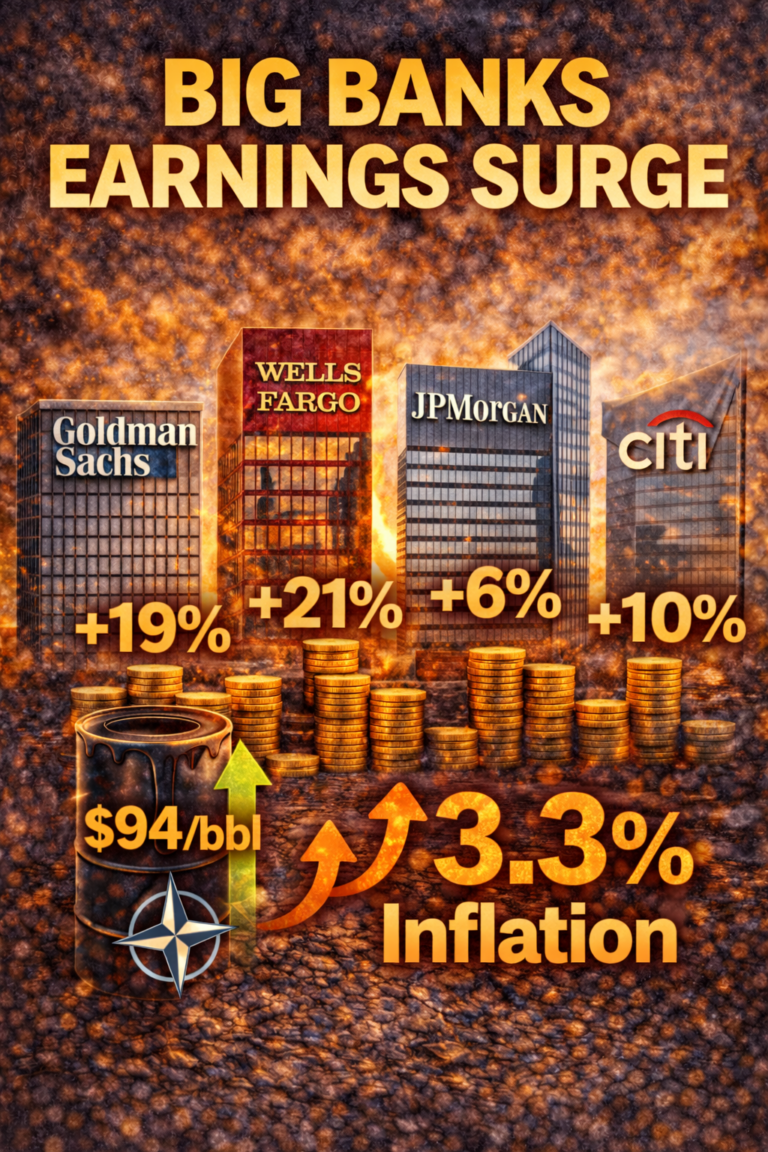
April 18, 2026
Ken Griffin’s Biggest Add
Citadel scaled NVDA into its largest individual equity holding and boosted AMZN by 336% – the more useful question is what the market is pricing now.
First a message from our friends at Weiss Ratings
Dear Reader,
America’s rapidly surging debt is no secret.
But for years, Wall Street and Washington have treated our $38 trillion national debt like a problem for tomorrow.
A crisis they can just keep kicking down the road.
However, the conflict in the Middle East over the last two weeks just violently accelerated the timeline.
With the Strait of Hormuz locked down, oil is surging. And analysts are predicting $150 a barrel if this drags on.
When oil spikes like that, inflation roars back into the economy.
In the past, the government would try to print, cut, or borrow its way out of an inflation shock.
But you cannot do that when you’re sitting on a $38 trillion mountain of debt and paying $1 trillion a year as interest on it.
In short, this match has just hit a powder keg.
And it’s going to trigger a radical, violent shift in the U.S. stock market.
Popular household stocks that looked untouchable a month ago could get gutted. And another set of overlooked stocks could go for massive, historic runs.
That’s why I rushed to get this special broadcast live this morning.
Inside, I pull back the curtain on a 100-year-old market signal.
It’s the exact same data-driven signal that called the bank collapses of the 1980s, the 2008 financial crisis, and the 2020 crash.
And right now, it is flashing its most urgent warning in decades.
I’m not going to ask you to read a 50-page economic report to understand this. I’ve laid it all out in a new video presentation that’s officially live as of a few minutes ago.
You’ll see exactly what this signal is telling us to do with our money today.
More importantly …
I’m giving away the names and ticker symbols of 3 stocks this system just upgraded to an urgent “BUY.”
No strings attached. You’ll get the names directly inside the video.
If you have a 401(k), an IRA or a standard brokerage account right now, you cannot afford to ignore this data.
Click here to watch the urgent $38T briefing and get your 3 free stock picks now
Chris Graebe
Weiss Ratings
Ken Griffin’s Biggest Add
Markets don’t need certainty. They only need a clearing price.
That’s why tracking what a high-speed, risk-managed institution did can be more informative than tracking what anyone said. When a portfolio manager with a mandate to survive every regime makes two positions meaningfully larger, the signal is rarely “these stocks will go up tomorrow.” The signal is usually about liquidity, durability, and what should work if the world stays roughly intact.
Recent disclosures highlight two aggressive adds tied to Ken Griffin’s Citadel: Nvidia (NVDA) – with the stake increased by nearly 120%, now Citadel’s largest individual equity holding – and Amazon (AMZN) – with the position boosted by a staggering 336%.
This is not about hero worship. It’s about positioning and probability. Specifically: what these adds imply at the macro and sector level, and how the options market can be used to translate “big ownership” into a defined-risk framework.
Why mega-cap concentration keeps winning (until it doesn’t)
Start with the regime reality: the market continues to reward scale, balance-sheet flexibility, and structural demand – especially when growth is uneven and capital is selective. That pushes flows toward the same handful of companies that can fund their own capex, command their own distribution, and price their own risk.
When capital is “picky,” size stops being a disadvantage and starts being a moat. Nvidia and Amazon sit at the center of two modern necessities: compute and logistics. Not “nice-to-haves.” Inputs.
What’s changed is the market’s tolerance for narrative. In 2020–2021, investors paid for distant optionality. In 2023–2026, investors have increasingly demanded near-term proof: revenue conversion, margin durability, and capex that produces visible cash flow. Nvidia and Amazon each have a clean answer to that demand, just through different mechanisms.
Nvidia (NVDA) – the market’s “compute tollbooth”
Positioning headline: Citadel increased its Nvidia stake by nearly 120%, making NVDA its largest individual equity holding.
Nvidia is no longer a “chip cycle” story in the traditional sense. It’s closer to an infrastructure story where the constraint is not demand but supply, power, and deployment speed. The market’s core debate is not whether AI workloads grow – it’s whether Nvidia’s economics normalize faster than investors expect.
Here’s the reframing that matters: this is not about whether AI is real. It’s about how quickly “AI is real” becomes “AI is priced.” The stock can be fundamentally strong and still be tactically difficult if expectations get too clean.
For an institution, owning NVDA size can be less about chasing a single quarter and more about owning the highest-quality liquid exposure to the AI capex cycle – with the ability to dynamically hedge around event risk. That last clause is where options become the language.
Mag 7’s relentless assault on Nvidia’s future
Nvidia’s biggest customers are now buying and selling chips to each other. That means, the virtual monopoly that fueled NVDA’s $4 trillion market cap is OVER. If you currently own NVDA, here’s a better alternative. Their competition is scarce, which puts them in a hugely advantageous spot. This supplier’s stock has outperformed Nvidia’s by 50X since July.
Click to get the full details on this urgent “Nvidia alternative” right here.
Amazon (AMZN) – the “cash flow flywheel” with multiple gears
Positioning headline: Citadel boosted its Amazon position by 336%.
If Nvidia is the market’s compute tollbooth, Amazon is the market’s operating leverage machine. The bull case is well-known: AWS as the profit engine, advertising as the margin enhancer, and retail logistics as a scale moat that gets better as density improves.
The more useful way to think about Amazon in 2026 is through the lens of “margin stability vs. reinvestment intensity.” Amazon can choose its margin profile. That flexibility is a strategic asset in a way few companies can match.
Again, this isn’t about a one-quarter beat. It’s about whether the market continues to underwrite a durable cash-flow compounding story while also accepting periodic reinvestment waves (AI infrastructure, fulfillment optimization, content, and new delivery initiatives). Options markets tend to reveal whether traders are paying up for those waves or quietly fading them.
What “+120%” and “+336%” do (and do not) tell you
Percent increases in holdings are emotionally powerful, but they can mislead if you treat them like a forward return forecast.
- They do tell you these positions earned priority in a risk budget – meaning the manager is comfortable with liquidity, borrow dynamics, and the ability to hedge.
- They do not tell you the exact entry timing, whether the exposure is delta-hedged with options, or whether the add is paired with offsetting positions in correlated names.
- They do imply that if you want to express a view in the same “institutional grammar,” you should think in terms of structures, not slogans.
That’s why the options angle matters: it forces you to be explicit about time, volatility, and risk containment. Stocks let you be vague. Options make you quantify your thesis.
AI capex, cloud optimization, and the “second-order” beneficiaries
Put Nvidia and Amazon together and you get a clean macro-sector message: the compute cycle is still in motion, and the distribution layer (cloud + commerce + ads) remains a primary monetization path.
In sector terms, this triangulates three active trade lanes:
- Semis and compute infrastructure: Nvidia as the flagship, but the broader complex is sensitive to “capex duration” and supply-chain confidence.
- Cloud and AI services: AWS demand elasticity, optimization cycles, and whether AI workloads meaningfully expand net spend.
- Digital advertising: Amazon’s ad business is increasingly treated as a margin stabilizer with secular tailwinds.
The key is not simply “AI is big.” It’s whether spending is incremental (new budgets) or substitutive (reallocating existing budgets). Nvidia tends to benefit either way if compute intensity rises. Amazon benefits more if AI expands consumption and transaction volumes across the ecosystem.
The Real Edge Hiding at Every Single Market Open
Forget mythical strategies and screen time that eats your whole day. One morning setup has been quietly delivering triple-digit wins to traders who know where to look. The Opening Bell Trade Guide shows you exactly how it works and right now you can grab it at zero cost.
Translating the thesis into pricing
Options are where the market posts its true receipt. Not an opinion – a price. The two most practical questions for both NVDA and AMZN are:
- Is implied volatility (IV) cheap or expensive versus its own history? (IV rank/percentile)
- Is skew signaling fear (puts bid) or appetite (calls bid)? (put/call behavior and wing pricing)
Because I don’t have your platform’s live options chain inside this editor, treat the numbers below as a repeatable template using common benchmarks. The point is the method: how to read IV, expected move, and skew – then pick a defined-risk structure that matches the view.
NVDA: what typically matters in the chain
Event gravity: Nvidia options often price like a macro instrument around earnings, major AI product announcements, and index rebalancing windows. The stock can move on positioning alone.
Expected move framework (template): into earnings, large-cap tech frequently prices an expected move on the order of mid-to-high single digits, and Nvidia can price higher when demand or margin narratives are most contested. Outside of earnings, weekly expected moves compress, but skew can remain elevated.
Skew: NVDA frequently carries meaningful downside skew (puts richer than calls) because of gap risk and the market’s fear of “expectations resets.” That skew can create opportunities for defined-risk put spreads (to express bullishness with limited downside) or call spreads (to avoid overpaying for high IV).
AMZN: what typically matters in the chain
Event gravity: Amazon’s biggest option repricings tend to cluster around earnings and guidance, with additional sensitivity to macro consumption data and cloud commentary from peers.
Expected move framework (template): AMZN often prices a more moderate earnings move than NVDA, but the market can underprice second-order effects (margin commentary, capex plans, ad growth). For traders, that mismatch is the edge: you’re rarely trading “retail sales.” You’re trading operating leverage perception.
Skew: AMZN can show persistent put skew as well, but it often behaves more like a “quality megacap” volatility surface – meaning call premium can be less extreme than high-beta AI names. That can make AMZN a cleaner candidate for calendars/diagonals when IV term structure is favorable (front-month rich vs. back-month cheaper, or vice versa depending on the event calendar).
Structured trade framework (defined-risk templates)
This is where narrative becomes math. If you believe Griffin’s adds represent “high-conviction long exposure,” you still need to choose how to express that view given IV, skew, and your time horizon.
Bull case templates (expect higher prices, but respect IV)
- Call debit spread (NVDA or AMZN): If you believe the stock rises but you don’t want unlimited IV exposure, a call spread defines risk and reduces premium outlay. Best when IV is elevated or when you want a target zone rather than a moonshot.
- Put credit spread (defined-risk bullish): If you believe the stock holds above a key level and IV is rich, a put spread sale can align with “time works for you.” Defined risk is the entire point – size it to survive a gap.
- Stock + protective put (synthetic risk budget): For traders who want direct delta but can’t tolerate an earnings gap, a put can function as a “known worst-case.” The cost is explicit, which is the feature.
When bull structures tend to be favored: IV rank/percentile is mid-to-high, skew is steep (puts expensive), and you want exposure without paying for the entire volatility surface.
Bear case templates (expect downside or an expectations reset)
- Put debit spread: If you expect an “expectations reset” but want to avoid paying top dollar for deep skew, spreads can reduce cost while keeping convexity.
- Call credit spread (defined-risk bearish): If upside is capped by positioning and IV is bid, selling call spreads can align with the view that the stock chops or drifts lower.
- Collar (stock + put, financed with call): For holders who want to stay long but reduce drawdown risk, collars convert uncertainty into a known range.
When bear structures tend to be favored: upside chasing is crowded, call skew is unusually firm (or calls are persistently bid), and the stock is approaching known event risk with asymmetry to the downside.
China Thought They Had This Locked Up
China controls 98% of the world’s gallium supply – critical for modern technology.
But a small American firm may have just changed the game with a breakthrough called GaN.
Watch this presentation to learn how it could reshape tech – and why investors are watching
Neutral/volatility templates (expect a range or IV mean reversion)
- Iron condor (defined-risk short vol): For traders expecting post-event volatility crush or range behavior. Works best when IV is high relative to realized volatility and you have clear levels.
- Calendar spread: If front-month IV is pumped into an event and back-month is calmer, calendars can express “IV comes in” while keeping directional flexibility.
- Diagonal call (longer-dated call, shorter-dated call sale): A structured way to express longer-term bullish bias while harvesting near-term premium if the stock doesn’t sprint upward.
When neutral structures tend to be favored: the stock has already made a large move, realized volatility is decelerating, and you believe the next phase is digestion rather than expansion.
Risk analysis: the three risks traders underweight
- Expectation risk (the invisible gravity): The better the story, the harsher the penalty for “only good” results. For NVDA, that’s often gross margin and forward supply commentary. For AMZN, it’s AWS growth cadence, retail margin sustainability, and capex tone.
- Correlation risk (macro sells everything): In sharp risk-off windows, even the best operators get sold because they are liquid. Liquidity is a blessing on the way in – and a curse on the way out.
- Volatility regime shifts: Options structures that look safe in calm markets can behave differently when vol-of-vol spikes. Defined-risk matters precisely because you can be right about the company and wrong about the path.
What to watch next (signal vs. noise)
Markets don’t pay you for being early to a narrative. They pay you for being right about the next revision to consensus.
For Nvidia, the next revisions tend to come from three places: (1) lead times and supply expansion, (2) margin shape as product mix evolves, and (3) evidence that software and platform economics can persist even as hardware growth normalizes.
For Amazon, watch for: (1) AWS re-acceleration vs. continued optimization pressure, (2) advertising growth as a margin lever, and (3) whether retail efficiency gains stick even as the company reinvests.
If Citadel is scaling these exposures, one plausible interpretation is that they prefer to own the highest-liquidity, highest-quality expressions of two durable themes – then use options to manage the path risk around events.
Action checklist: a practical options-first workflow
- Step 1: Identify the next major event for each ticker (earnings date, major product event, macro data sensitivity).
- Step 2: Pull IV rank/IV percentile and compare to the last 1-year range. If IV is high, lean toward spreads; if IV is low, consider buying convexity.
- Step 3: Measure the at-the-money expected move for the event week and compare it to the stock’s typical earnings move. Ask: is the market overpaying for fear or underpricing a real risk?
- Step 4: Check skew: are puts unusually expensive? If yes, bullish put spreads can be attractive; if calls are unusually bid, consider call spreads rather than outright calls.
- Step 5: Choose one defined-risk template that matches your thesis: bull (call spread / put spread sale), bear (put spread / call spread sale), or neutral (iron condor / calendar).
- Step 6: Predefine exits: profit target, maximum loss, and what would invalidate the thesis (price level or volatility behavior).
- Step 7: After the event, review: was the move driven by fundamentals, guidance, or positioning? Adjust the next structure accordingly.
In the end, the takeaway isn’t “copy the whale.” It’s: when sophisticated capital concentrates in NVDA and AMZN, the highest-value response is to stop debating the story and start reading the pricing – then express the view with a structure that survives being wrong on timing.
– Editorial Desk
About the Author