May 19, 2026
Mode Mobile: Redefining Big Data
Featured: Ford (NYSE: F) — The Energy Pivot Just Got a Customer
Anyone who invested in Palantir at its IPO in 2020 could be sitting on nearly 1,363% gains right now.
But that great return is already in the past, and the stock is now one of the S&P 500’s most expensive.
But while Palantir was climbing on the back of your public information, another company was redefining big data.
Mode Mobile has already delivered 32,481% revenue growth before even going public.
Mode has:
- 490M+ users
- $1B+ paid to users
- $115M+ in real revenue
- Nasdaq ticker secured for potential IPO
- Pre-IPO shares available for a limited time
Mode’s model pays users for their screen time and turns Big Tech’s free data mining play into a cash-generating engine for everyone.
Palantir now trades at 113x forward earnings, which means Wall Street has already priced in massive expectations.
But Mode?
Still private.
That means the market hasn’t had its say yet.
Right now, investors can get Mode Mobile shares at early-stage pricing.
When the Nasdaq ticker potentially goes live, that window could close fast.
59,000+ shareholders have already invested in Mode, and pre-IPO shares are still available at $0.50/share.
Palantir’s moment has passed.
Mode’s may just be starting.
$71M+ already raised – claim your stake at $0.50/share and earn up to a 20% bonus!
Ford (NYSE: F) — The Energy Pivot Just Got a Customer
Ford Energy didn’t exist in any commercial sense eight days ago. Then came Monday.
The announcement landed before the open: Ford Energy, Ford Motor’s newly formed battery energy storage subsidiary, signed a five-year framework agreement with EDF Power Solutions North America under which EDF can procure up to 4 GWh of DC Block battery energy storage systems annually – representing a total potential volume of 20 GWh over the contract term. Deliveries are slated to begin in 2028. The stock moved sharply on the news. What matters more than the price action is the structural signal embedded in the deal itself.
This is not a pilot program. It is not a letter of intent. It is not a press release built around aspirational language. It is a production-scale commercial commitment from a counterparty that has been providing energy solutions across the U.S., Canada, and Mexico since 1987.
The Anatomy of the Deal
Ford Energy was first announced in December 2025 and unveiled commercially in early May 2026 – less than two weeks before this agreement was signed. The subsidiary is built around the repurposed BlueOval Battery Park in Glendale, Kentucky, the same facility originally designated for EV battery production under the now-dissolved BlueOval SK joint venture with SK On. Ford fully acquired the Kentucky plants following the dissolution of that joint venture.
Rather than sit on stranded capacity, Ford pivoted the Kentucky operation toward grid-scale battery energy storage. The company plans to invest roughly $2 billion over the next two years to scale the business, targeting at least 20 GWh of annual production capacity out of the Kentucky 1 site by late 2027. The EDF framework agreement – up to 4 GWh per year – essentially fills the full projected annual output from day one of commercial operation. That alignment is not accidental. That is a demand signal negotiated in parallel with the subsidiary’s launch.
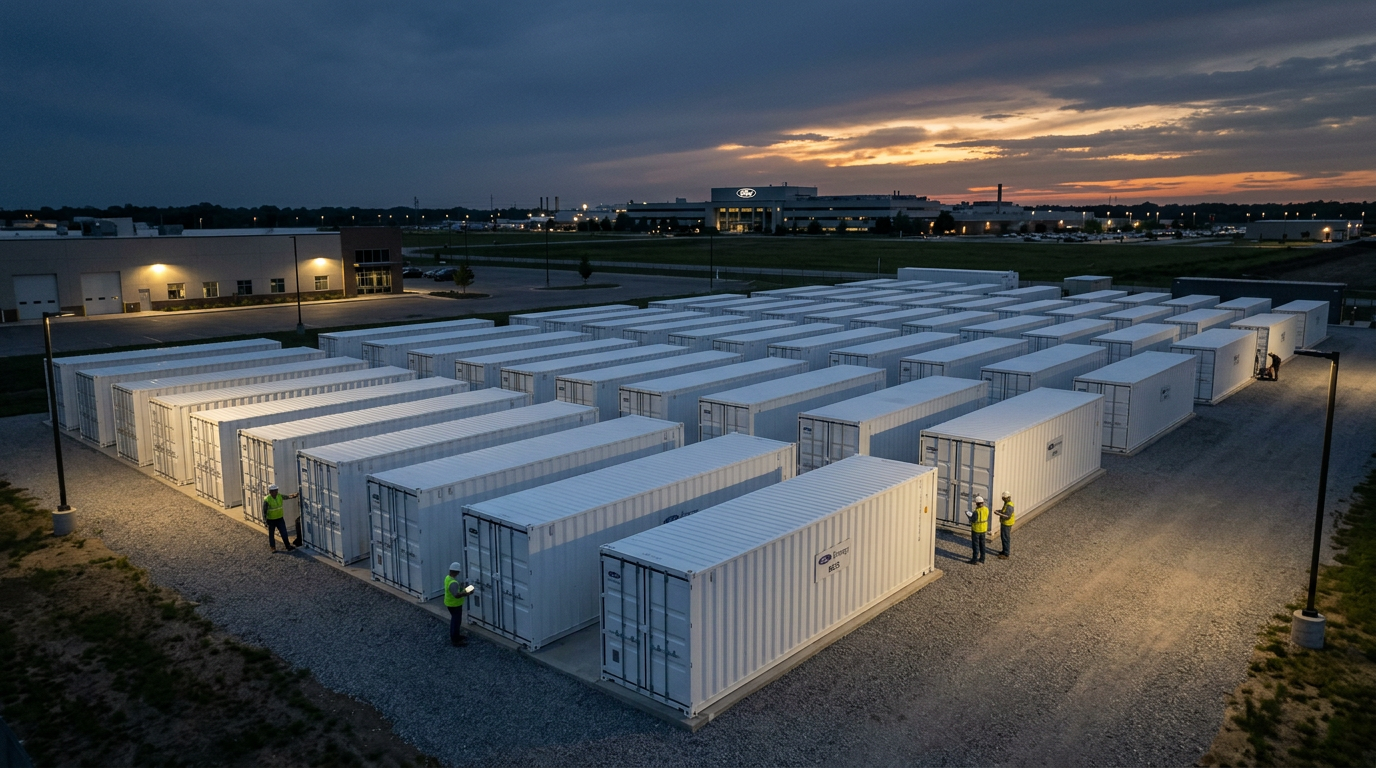
The flagship product is the Ford Energy DC Block: a standardized 20-foot containerized system built around 512 Ah LFP prismatic cells, purpose-built for utility-scale applications – utilities, data centers, large C&I customers. Units are U.S.-assembled, which matters in the current tariff environment and positions Ford Energy’s products to meet FEOC compliance requirements while qualifying for domestic content provisions under the IRA.
Slight tangent, but it’s worth dwelling on: EDF Power Solutions isn’t a marginal counterparty shopping for the cheapest hardware. Bringing together the businesses of EDF Renewables and EDF Group International Division, it is an entity of the broader EDF Group – an international energy player that develops, builds, and operates low-carbon energy facilities as well as flexible power and electricity transmission solutions across North America. When an operator of that scale locks in a supplier framework, it tends to structure subsequent procurement around it. This is not a one-off. It is a preferred-supplier dynamic being established from the start.
Lisa Drake, president of Ford Energy, framed it plainly: the EDF deal validates the market’s need for a BESS supplier that combines industrial-scale manufacturing discipline with full lifecycle accountability. That language, from an operator of that scale, carries weight beyond the press cycle.
In at 9:35 AM. Out by 10.
I call it the “Opening Bell Breakout.” It’s the same setup I used to catch moves like 113% on GOOGL and 240% on META. I trade one simple 15-minute window each morning – and I’m usually done by 10 AM.
The Financial Picture: What’s Underneath the Pivot
Full-year 2025 revenue came in at a record $187.3 billion, up 1% year-over-year from $185 billion in 2024. That top-line number looks clean. The structure underneath it is not.
On an unadjusted basis, Ford posted a net loss of $8.2 billion in 2025 – compared to net income of $5.9 billion in 2024 – driven primarily by approximately $17.4 billion in pre-tax special items tied to the company’s EV strategy reset, BlueOval SK disposition, and program cancellations. The full-year adjusted EBIT came in at $6.8 billion, down from $10.2 billion in 2024, weighed down by a $2 billion net tariff impact and a $1.5–$2 billion hit from the Novelis aluminum supplier fire, which disrupted production of high-margin trucks and SUVs. Q4 adjusted EPS came in at $0.13 versus the $0.19 consensus – a 32% miss and the company’s largest quarterly earnings miss in four years.
Breaking down the segment picture for full-year 2025:
- Ford Pro (fleet & commercial): the core earnings engine – generated more than $66 billion in revenue with EBIT of $6.8 billion and a double-digit margin; paid software subscriptions grew 30% year-over-year
- Ford Blue (traditional ICE): $3.0 billion in EBIT for the year; full-year revenue flat at $101 billion as higher pricing offset a 5% decline in wholesale volumes
- Ford Model e (EV segment): full-year EBIT loss of $4.8 billion, a $0.3 billion improvement versus 2024; management is guiding for the loss to remain in the $4.0–$4.5 billion range in 2026 as cost reductions continue
- Ford Credit: delivered full-year EBT of $2.6 billion, a 55% increase for the year
- Cash & liquidity: full-year adjusted free cash flow of $3.5 billion; operating cash flow of $21.3 billion; ended the year with approximately $29 billion in cash and $50 billion in total liquidity
- CapEx: $8.8 billion in 2025 actual; 2026 guidance calls for $9.5–$10.5 billion, including approximately $1.5 billion earmarked to begin ramping Ford Energy
For full-year 2026, management is guiding for adjusted EBIT of $8–$10 billion and adjusted free cash flow of $5–$6 billion – meaningful improvement on both lines versus 2025 if achieved. The 2026 segment blueprint calls for Ford Pro EBIT of $6.5–$7.5 billion, Ford Blue EBIT of $4.0–$4.5 billion, and a narrower Model e loss of $4.0–$4.5 billion. Ford Credit EBT is expected at approximately $2.5 billion.
The consensus analyst price target sits in the $13.29–$13.56 range across major aggregators, with the analyst range spanning $10 on the low end to $16 on the high end. The consensus rating is Hold across 13 analysts tracked by most platforms. That dispersion reflects genuine disagreement about execution, not about the market opportunity. The multiple is compressed for a reason – this is a show-me situation. Ford Energy’s first commercial commitment changes the framing, but it does not resolve the execution risk.
Sector Context: The BESS Market Isn’t Waiting
The macro tailwind here is structural, not cyclical. Data center power demand in the United States is growing rapidly, driven primarily by AI and machine learning workloads that draw power profiles fundamentally different from traditional infrastructure – rapid swings in load are increasingly common in hyperscale environments. Grid interconnection queues are running 3–5 years in most regions. BESS is not optional for this buildout. It is the buffer layer that makes the math work.
The broader C&I BESS market is projected to grow significantly through 2030 and beyond, with AI-fueled data center construction as the primary near-term demand driver – alongside 5G network densification and industrial electrification running in parallel. What Ford Energy is targeting is the domestic, utility-grade segment of this market – the slice that needs supply chain visibility, bankable warranty terms, and IRA-compliant domestic content.
That is not where every BESS competitor is positioned. Chinese-assembled hardware carries tariff risk and FEOC exposure. Ford’s Kentucky assembly footprint sidesteps both. The framework agreement with EDF reinforces Ford’s positioning specifically as a domestic supplier in this environment – the kind of differentiation that is hard to manufacture quickly and easy to lose if production timelines slip.
The competition is real. Fluence, Tesla Energy, and others are capitalized and established in this space. But the domestic manufacturing angle – and the manufacturing discipline that comes with over a century of production experience – is a differentiated entry point, not just a talking point.
Your Entire Portfolio is Dangerously Exposed…
If you own ZERO of the Next Magnificent Seven stocks.
Original Mag Seven turned $7,000 into $1.18 million.
But these seven AI stocks could do it in 6 years (not 20).
Now, the man who called Nvidia in 2005 is revealing details on all seven for FREE.
Options Market: What IV Is Telling You
F options have historically exhibited a 90-day implied volatility in the 30–35% range, consistent with a large-cap industrial transitioning through a strategic reset. The put/call IV skew has not been pricing extreme downside tail risk – this is a stock where directional uncertainty is elevated, but systemic hedging is not dominant. Post-announcement, call-side activity around near-term strikes is worth watching as a sentiment indicator.
The 52-week range and recent tape behavior suggest support clustering near $12.70, with near-term resistance at the post-announcement highs. Earnings are next expected in late July 2026 – that date is the next hard catalyst window for the Ford Energy narrative to either accelerate or stall.
For traders considering a defined-risk structure around this setup, the IV environment matters. Elevated near-term volatility increases premium cost on directional calls; premium sellers may find near-term covered structures attractive. The longer-dated options – looking out to Q3 earnings or beyond – tend to offer better risk-adjusted exposure to the Ford Energy execution narrative without paying for short-term noise.
Structured Trade Framework
This is analysis, not instruction. The following frames three distinct positioning logics based on how different traders might interpret the current setup. All three assume defined risk. None represent advice.
- Bull Case – If you believe the EDF deal catalyzes additional commercial commitments: Ford Energy’s 20 GWh annual production target is now backstopped by a single customer at full projected annual capacity. If a second framework agreement is announced before the Q3 earnings call, the narrative accelerates meaningfully. A defined-risk long structure – call spreads or long calls with a September or October expiry – targets the $14–$15 range, with a stop logic anchored near the $12.70 support level. Entry here is higher-risk because the tape has already moved on the announcement; a pullback to the low $12s would offer a cleaner setup.
- Bear Case – If you believe execution risk is underpriced: First deliveries don’t begin until 2028. Ford Energy has no revenue history, no production track record in this segment, and is operating inside a parent company still navigating $9.5–$10.5 billion in annual CapEx commitments, tariff headwinds, and ongoing Model e losses guided at $4.0–$4.5 billion for 2026. If Q3 earnings show no additional Ford Energy commercial progress or if the production timeline slips, the stock likely revisits the $10–$11 range. A put spread structure – buying the $12 put, selling the $10 put for a defined-risk hedge – captures this scenario without unlimited downside exposure.
- Neutral Case – If you believe the story is real but the timeline long: Ford’s dividend yield at current prices provides a floor for income-oriented positioning. A covered call overlay against a long equity position – selling calls in the $14–$15 range – generates premium while preserving upside to a partial re-rating. This is the patient-capital structure: long the transformation thesis, short the hype cycle.
Risk Register
- Execution Risk: Ford Energy has no production history in the BESS segment. The 20 GWh capacity target depends on a full $2 billion capital deployment by late 2027. Any delay in production ramp, supply chain disruption, or labor friction at the Kentucky facility compresses the timeline and delays the revenue inflection.
- Tariff & Policy Risk: The IRA domestic content advantages that underpin Ford Energy’s competitive positioning are subject to ongoing legislative and regulatory changes. A shift in incentive structure would alter the relative cost equation materially.
- Competitive Consolidation: The BESS market is moving fast. Fluence, Tesla Energy, and large-scale integrators with deeper balance sheets and established utility relationships are not standing still. Ford Energy has a window – but it is not an indefinite one.
- Parent Company Drag: Ford’s core business is absorbing $4.0–$4.5 billion in projected Model e losses for 2026, alongside commodity headwinds from aluminum and ongoing tariff pressure. If Ford Pro margins compress or other disruptions extend, capital allocation for Ford Energy could face scrutiny.
- Framework vs. Binding Contract: The EDF agreement is a framework. It gives EDF the ability to procure up to 4 GWh annually – not an unconditional obligation. Actual volume depends on EDF’s project pipeline execution and Ford Energy’s delivery performance. Volume shortfall below the cap is a realistic scenario.
Forward Outlook
The next inflection points are concrete. First deliveries under the EDF agreement are scheduled for 2028. Ford Energy’s Kentucky production line is targeted for initial commercial capacity by late 2027. Between now and then, what the market needs to see is additional commercial commitments, production progress updates, and Model e loss reduction playing out as guided.
The Q2 2026 earnings call and the Q3 earnings call in late July are the next real narrative checkpoints. If Ford Energy appears on those calls with additional customer announcements or early production milestones, the re-rating conversation starts in earnest. If the subsidiary goes quiet, the announcement fades into the broader Ford noise – and the stock drifts back toward the middle of its range.
Here’s where I keep landing when I think about this: the market opportunity is not in question. The BESS buildout is happening, the data center demand is real and accelerating, and the domestic manufacturing angle is genuinely differentiated. The question is purely operational – can Ford Energy execute at scale before better-capitalized, more established competitors consolidate the best utility relationships? That answer will not be in the tape today. But the first commercial commitment just told you the story is no longer theoretical.
Tactical Checklist
- ✦ Deal structure: 5-year framework, up to 4 GWh/year, 20 GWh total potential – first publicly disclosed commercial commitment for Ford Energy; deliveries begin 2028
- ✦ Product: Ford Energy DC Block – 20-ft containerized, 512 Ah LFP prismatic cells, utility-scale deployment, U.S.-assembled at BlueOval Battery Park, Glendale, KY
- ✦ Production target: At least 20 GWh annual capacity from Kentucky 1 by late 2027; ~$2B committed CapEx over two years; ~$1.5B earmarked in 2026
- ✦ Parent financials (FY2025): $187.3B revenue (record, +1% YoY); $6.8B adj. EBIT; –$8.2B GAAP net loss (~$17.4B in pre-tax special items); $3.5B adj. FCF; $8.8B CapEx
- ✦ Segment snapshot: Ford Pro EBIT $6.8B (>$66B revenue); Ford Blue EBIT $3.0B ($101B revenue); Model e EBIT loss $4.8B; Ford Credit EBT $2.6B (+55%)
- ✦ 2026 guidance: Adj. EBIT $8–$10B; adj. FCF $5–$6B; CapEx $9.5–$10.5B; Model e loss $4.0–$4.5B
- ✦ Analyst consensus: Hold; avg. price target $13.29–$13.56 (range: $10–$16); 2026 EPS consensus ~$1.55
- ✦ Key risk: Framework agreement, not binding offtake; no production track record; first deliveries 2028; competition from Fluence, Tesla Energy
- ✦ Options note: 90-day IV historically 30–35%; defined-risk structures preferred given binary execution timeline; next hard catalyst: Q3 earnings late July 2026
This editorial is for informational and analytical purposes only. Nothing contained herein constitutes financial, investment, or trading advice. All trade structures referenced are illustrative frameworks only. Past performance is not indicative of future results. Options trading involves substantial risk of loss. Always conduct your own due diligence and consult a qualified financial professional before making any investment decision.
– The Editorial Desk