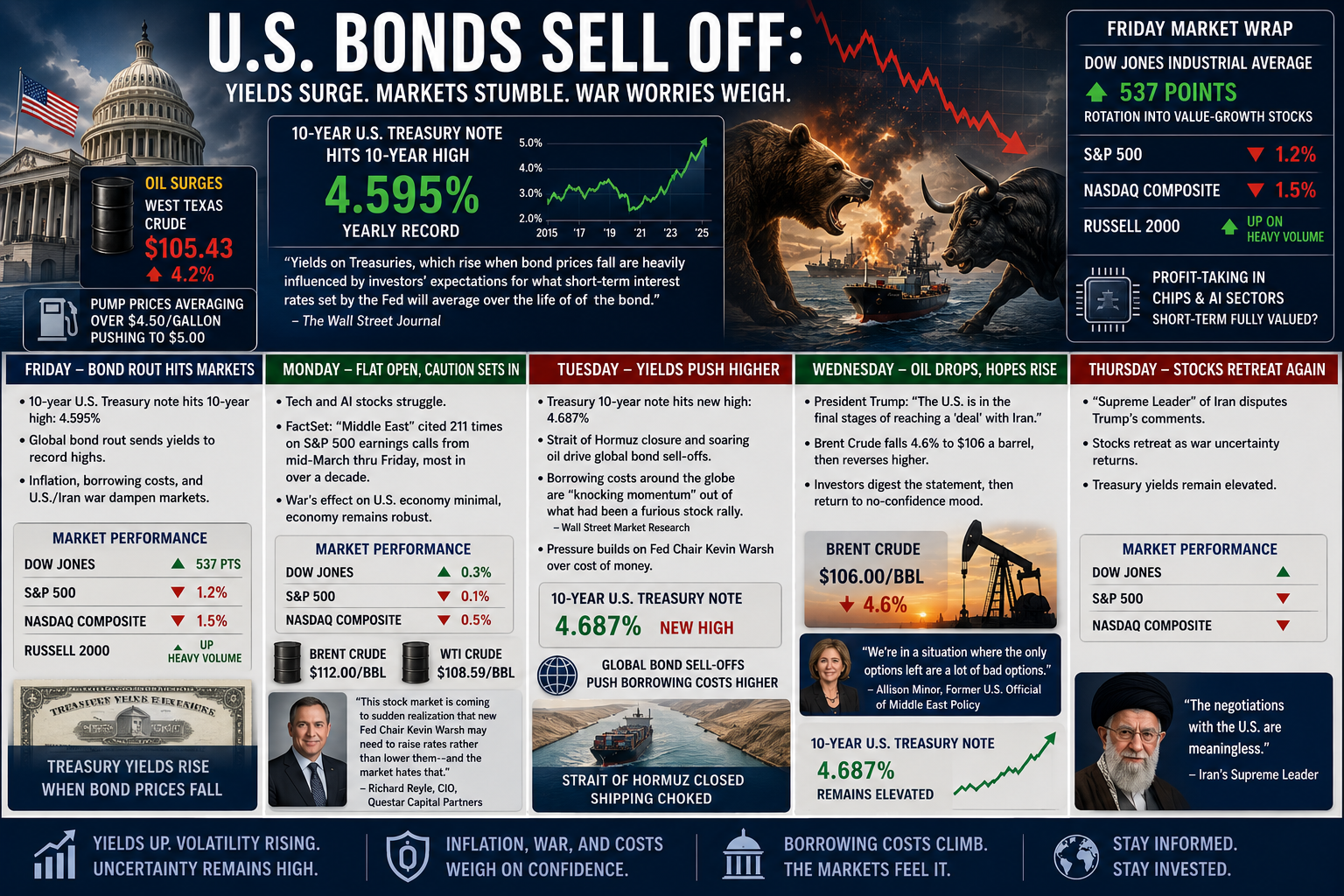
The 10-year U.S.Treasury note hit a 10-year high Friday, upending the stock market, and effectively ending the ‘hot streaks S&P 500, and Nasdaq Composite. A weeklong “rout in global government bonds finally upended U.S. bonds sending yields to record highs on Friday.” The U.S.10-year Treasury note closed at 4.595%, a yearly record. New worries of increasing inflation, the cost of borrowing, and the pessimistic concerns of the U.S./Iranian war has begun to dampen investors and traders market activities. Per The Wall Street Journal, “Yields on Treasuries, which rise when bond prices fall are heavily influenced by investors’ expectations for what short-term interest rates set by the Fed will average over the life of the bond.” Oil surged with West Texas Crude jumping to $105.43 a barrel, up 4.2%. Pump prices are averaging over $4.50 a gallon and pushing to the $5.00 level. The Dow Jones Industrial Average Friday added 537 points as investors rotated into value-growth stocks. The S&P 500 and Nasdaq lost 1.2% and 1.5% respectively. Some analysts and market ‘gurus’ have suggested the strong chip and artificial intelligence sectors are ‘short-term’ fully valued as profit-taking was evident. The smaller value company index, the Russell 2000 was up as heavier that average trading filled the day.
Monday’s market opened flat as technology and AI stocks struggled to stay even, Both the S&P 500 and Nasdaq dropped 0.1% and 0.5% respectively, breaking a streak of record-setting sessions. The Dow Jones finished the day just above flatline, up 0.3%. Brent Crude steadied at $112.00 a barrel, while West Texas Crude was $108.59 a barrel. According to FactSet, “the term ‘Middle East’ was cited 211 times on earnings calls from S&P 500 companies from mid-March thru Friday, the most in over a decade.” Some economists and analysts have quoted that the war’s effect on the U.S. economy has been minimal, and will not have a lasting impact. The proven robust economy has dispelled ‘nay-sayers’ predictions. The Bench-mark U.S. 10-year Treasury note rose again Monday, now at 4.622%, a high this year. According to Richard Reyle, chief investment officer at Questar Capital Partners, said: “This stock market is coming to sudden realization that new Fed Chair Kevin Warsh may need to raise rates rather than lower them-and the market hates that.” The retail sector will lead the earnings parade this week as many large volume retail giants are due to release quarterly results starting Tuesday.
The U.S. Treasury 10-year note edged to yet another high of 4.687%. Driven by the U.S./Iranian war, resulting in the closing of the Strait of Hormuz, and the soaring price of oil, bond markets around the world have experienced major sell-offs, pushing borrowing costs to appreciate significantly. According to Wall Street Market Research, “borrowing costs around the globe are ‘knocking momentum’ out of what had been a furious stock rally.” Pressure is building on new Federal Reserve Chair Kevin Warsh to carefully view the coming change in interest rates and the ‘cost of money.’ Extremely large build-outs for energy sources for the AI and technology sectors brings-to-bear large financial debt. Oil dropped dramatically Wednesday after President Trump announced: “The U.S. is in the final stages of reaching a ‘deal’ with Iran. ”Brent Crude fell 4.6% to $106 a barrel, then reversed, charging upward as the day finished. Investors and traders, after ‘digesting the statement’ drifted to the ‘no-confidence’ mood, and back to reality. Stocks retreated Thursday as the ‘supreme leader’ of Iran disputed Trump’s comments.
RUMBLINGS ON THE STREET
Sean Sun, a portfolio manager for Thornberg Investment Management, WSJ – “There are quite a few sleepy Japanese companies who do one or more things really well… and all of a sudden they’re really in demand.” [Referring to Japanese companies making components for the AI sector]
Brad Conger, chief investment officer at Hirtle & Company, WSJ – “People are just taking chips off the table, derisking a little bit after a very strong run. In other words, I wouldn’t take it as a signal that anybody’s given up on their positions.”
John Briggs, head of U.S. rates strategy at Natixis Corporation, WSJ – “It doesn’t seem like we’re getting a lot of solutions for any of the stuff that’s taking us here. I would not be surprised if yields rise another tenth of a percentage point given obvious catalysts on the horizon that could spur a reversal.